

By James Heinz
Imagine yourself 205 feet below the surface of Lake Michigan deep in the absolute darkness of the hold of a sunken freighter. It is utterly silent as you drift through a dark cavern full of silt, rust flaking off the sides, and the ghosts of rusted automobiles destined never to be driven again. Your hand brushes the headlight of one of the rusted hulks, disturbing the silt. And there it is, gleaming in the beam of your light in the darkness:
Gold.
Photo at top of page: LAKELAND entering Milwaukee’s Harbor
WMHS files show that the SS LAKELAND was launched in 1887 in Cleveland, Ohio, as the CAMBRIA. She was a classic steel Great Lakes bulk carrier of 2,425 tons, 280 feet long and 40 feet wide. She was one of the first Lakers to have a triple expansion steam engine.
She had a few accidents in her life. In 1887 she holed her bottom by striking an unidentified obstruction believed to be an abandoned anchor at the entrance to the Detroit River. In 1910 her name was changed to the LAKELAND and she collided with the barge JOHN SMEATON and then ran aground.
In 1920 she was converted to a part time auto carrier. She would carry bulk cargo during the shipping season and then carried cars from Detroit around the Lakes for the rest of the year. In the fall of 1924, while undergoing repairs, she was examined by government inspectors.
On December 3, 1924, the LAKELAND left Sturgeon Bay, Wis., eastward through the Sturgeon Bay Ship Canal and headed out into Lake Michigan. Winds were moderate and the Lake was calm.
And then strange things began to happen.
Commercial fishermen noticed the LAKELAND steaming in circles. At 10 am the Sturgeon Bay Coast Guard station noticed that the ship seemed to be sinking by the stern. However, the LAKELAND never sent a radio distress signal.
Instead of heading his sinking ship back towards shore, the captain continued out further into Lake Michigan, a full 9 or 10 miles out. He sailed over a submerged escarpment where the depth of the Lake dropped from less than 100 feet deep to over 200 feet deep, which was beyond the depth that commercial divers could reach. The captain refused two different offers to tow his ship. The LAKELAND then sank by the stern at 1130 am. All crew evacuated safely.
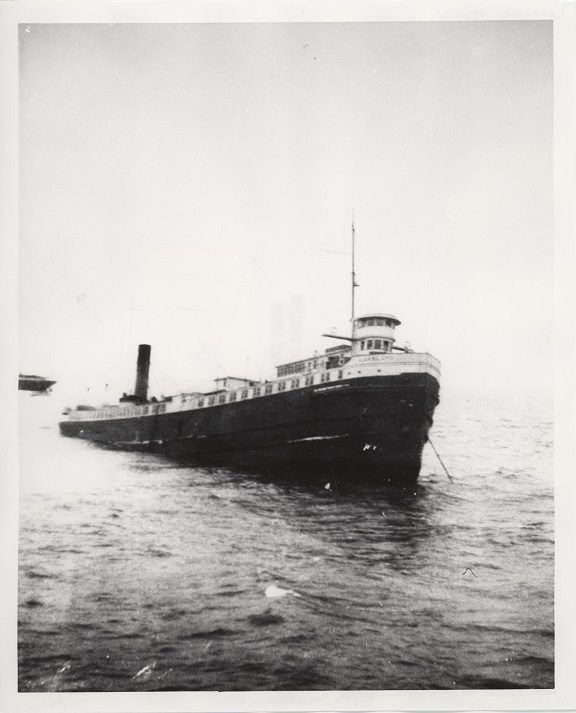
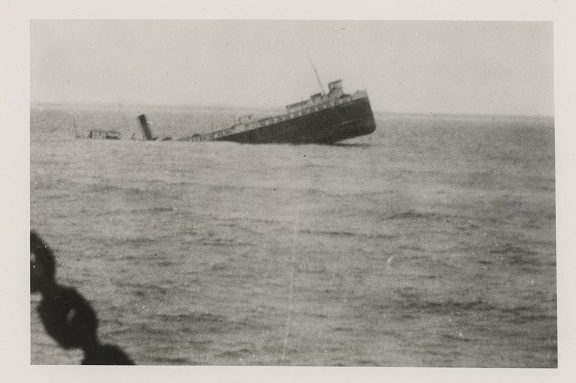
LAKELAND taking on water December 3, 1924
Further investigation revealed that the owners were in financial trouble, but did have a $350,000 insurance policy on the ship. The ship’s captain and engineer both claimed that the ship had struck rocks on the bottom of the Sturgeon Bay canal, which they said caused leaks that sank the ship. A government survey of the canal found no such rocks. The engineer said that as the ship began to list to port due to the leaks caused by the rocks that did not exist, he had opened the stern seacock in an effort to counteract the list. When this did not work, he claimed he closed the seacock.
In a rare example of corporate compassion, when the captain and chief engineer had their licenses suspended for two months because of this incident, the LAKELAND’s owners kept them on the payroll.
To the companies that insured the wreck, this all seemed as if the owners had sunk the ship in an effort to collect the insurance money. The question was, how to investigate a sunken ship that lay too deep for existing diving technology?
The U.S. Navy had been experimenting with new helium diving technology. The insurers obtained the services of Navy diver Clarence Tibbals, an expert on the new technology. Tibbals supervised three civilian commercial and two Navy divers who dove on the LAKELAND from the salvage barge JOHN W. CHITTENDON for three weeks in the summer of 1925.
It should be noted that all experiments involving the use of helium in diving up to this point involved animals in pressure chambers on dry land. This was the first time helium diving technology would be used by humans in an actual dive. The divers were not just divers, they were human guinea pigs.
The divers were using the classic hard hat helmet and hose diving gear. I described the difficulties in using this kind of equipment in a previous story: https://wmhs.org/how-i-relived-my-youth-on-the-bottom-of-lake-michigan/
(The Lake Michigan Classic Diving Organization will be conducting demonstration dives using the same classic diving gear to commemorate the sinking of the LAKELAND on Saturday August 16 at 9 am at the Door County Maritime Museum in Sturgeon Bay WI. See the LMCDO Facebook page https://www.facebook.com/lakemichiganclassicdiving/ )
The divers found that the LAKELAND had broken in two at the elevator that moved cars up from the hold onto the deck. The broken hull was full of floating debris, and the water was dark, murky, and 38 degrees Fahrenheit.
The diving was hazardous. One of the divers became ensnared in a tangle of ropes in the engine room. He had lost his dive knife, so he called for a new knife to be sent down to him and he then cut his way out of the entanglement.
Another diver found his air supply suddenly cut off. When the surface team was able to unkink his air hose, he went back to work only for his light to go out in the dark cavern of the engine room. He had to follow his lifeline back to the deck, crawling over and under pipes and up a ladder to the deck, all in total darkness. In a huge understatement, he said of this experience “Patience was called for.” I had a similar experience I described previously: https://wmhs.org/the-bends-ended-his-diving-adventures-but-not-the-tales-he-tells/
And what did the divers find in the engine room, at great peril to their lives?
The stern seacock was wide open.
The open stern seacock, which the engineer stated he had closed, had admitted a stream of water ten inches wide into the ship, beyond the capacity of the ship’s pumps. To the 16 insurance companies who had insured the ship, this was definite proof that the LAKELAND had been intentionally sunk to collect the insurance money. Unfortunately, they could not convince two juries and the case was probably settled out of court.
As for the gold plated automobiles, since the wreck was found in 1960, divers have confirmed the presence of 22 Nash and Kissel and one 1924 Rollin automobiles.
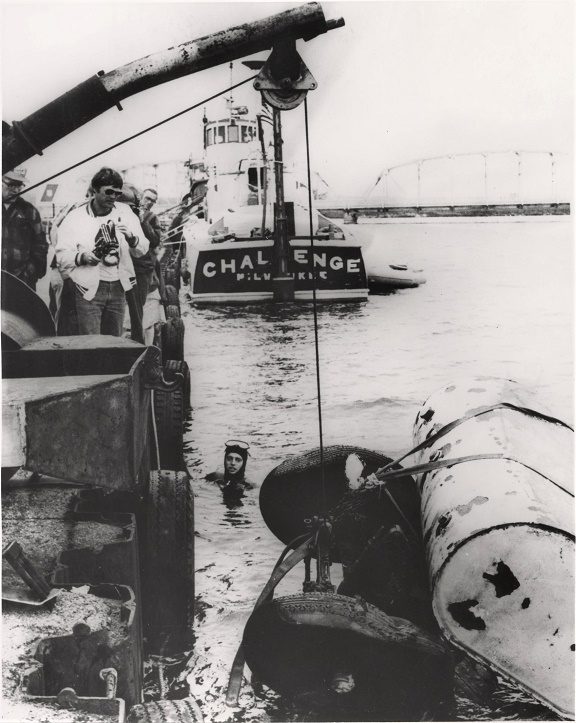
Recovery of car from the LAKELAND by Kent Bellrichard (in white jacket) and his boat the CHALLENGE
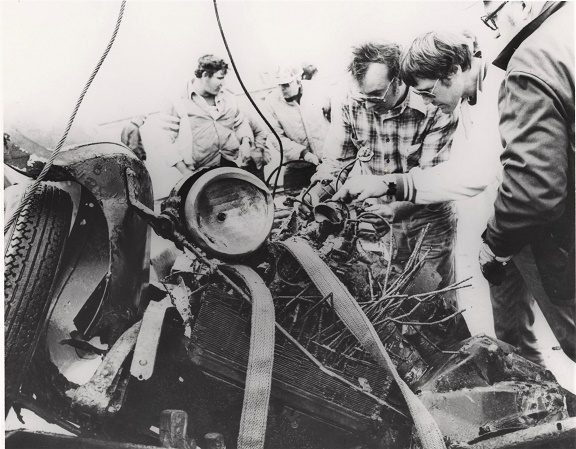
A 1924 Rollin from the LAKELAND
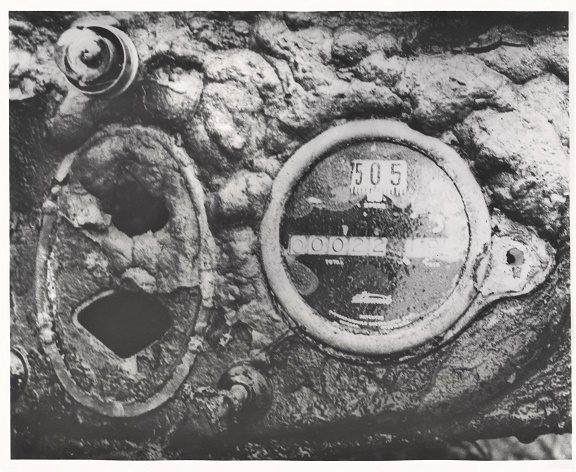
The odometer of the 1924 Rollin
In two previous stories about legendary Port Washington diver and artifact collector Butch Klop https://wmhs.org/the-greatest-shipwreck-diver-i-never-heard-of-conserving-the-klopp-collection-part-1/ and https://wmhs.org/the-conclusion-of-the-butch-klopp-story/ I reported how Butch found the gold plated cars in the manner described in the opening of this story.
Butch claimed that three Kissel two seater sports cars called Gold Bugs were actually gold plated and had been ordered by the then Shah of Iran, who had a documented history of owning gold plated automobiles. See my two Klopp stories for further details.
As for the future of helium diving, at some point during the three weeks of diving all five of the divers suffered at least one mild episode of decompression sickness, or “the bends”. The decompression tables needed to be adjusted but the experiment was a success.
Milwaukee’s own Max Nohl would work with Dr. Edgar End to perfect both the equipment and the decompression tables used in helium diving, and to establish a world record deep dive to 430 feet off Port Washington WI https://wmhs.org/max-nohl-makes-a-test-dive/
Much of the material in this story comes from the Autumn 2017 Wisconsin Magazine of History article about the LAKELAND by Paul Reckner, state underwater archeologist Tamara Thomsen, and WMHS’s own Dr. Richard Boyd. My thanks to them.
Photo credit: Great lakes Marine Collection of the Milwaukee Public Library and Wisconsin Marine Historical Society.
Facebook note from: Tamara Thomsen
Since I conducted the archaeological work on this particular wreck please allow me to comment on an error that continues to be repeated. A correction is needed. There are 21 cars on the bottom today – 10 are Nash, 5 are Kissel and 6 are Rollin. The additional Rollin car was removed as the photos here show. Total cargo at the time of the ship’s scuttling was 22. If you would like to reference our full field report. It is online at the link below. Lakeland begins on pg 44. https://wisconsinshipwrecks.org/Files/2013%20Field%20Season%20Field%20Report%20Draft.pdf
——————————–
James Heinz is the Wisconsin Marine Historical Society’s acquisitions director. He became interested in maritime history as a kid watching Jacques Cousteau’s adventures on TV. He was a Great Lakes wreck diver until three episodes of the bends forced him to retire from diving. He was a University of Wisconsin – Milwaukee police officer for thirty years. He regularly flies either a Cessna 152 or 172.
