
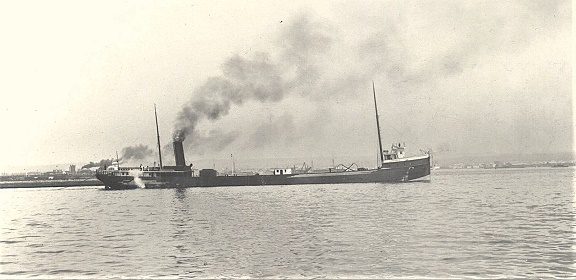
On this day September 21, 1907, while heavily laden with coal and about 13 miles west of Whitefish Point, the ALEX NIMICK’s steering gear became disabled during a rough storm with heavy seas. She was unmanageable and forced by the storm toward land striking near Pictured Rocks. Steward Thomas Parent was washed overboard and lost. The crew took to the two boats as the NIMICK was being pounded to pieces.
The boat containing Captain John Randall, First Mate James Hayes and four others was swamped by the heavy seas and sank leaving them clinging to the hulk. Chief engineer Charles Cray swam for shore. He made it. The others did not. The second boat, crowded with 10 of the crew, made it to shore.
Captain Randall took charge of the NIMICK only ten days earlier. He formally commanded the steamer MERRIMAC but had been on leave due to poor health. When he returned, he was given the NIMICK which had previously been commanded for two years by Capt. Frank Bertrand. Some early reports erroneously listed Capt. Bertrand as being lost with the NIMICK.

The Buffalo Evening News of September 28th printed the following account from the survivor Charles Cray:
“CRAY SWAM ASHORE THROUGH RAGING SEA
“SURVIVOR OF THE WRECK OF THE NIMICK IN LAKE SUPERIOR, IS HOME.
“Chief Engineer Charles Cray of the lost steamer ALEXANDER NIMICK is at his home, 49 Seventh street. When the NIMICK went down off Vermillion Point in Lake Superior last Saturday night, 10 men escaped in a lifeboat, three were carried down with her, and of the three remaining who attempted to swim a mile and a half to the mainland through a boiling sea, only Cray survived.
“The chief engineer says the statement that the NIMICK was unseaworthy is false. Her engines were running perfectly, he said, but the waves were of greater force than any engine could counteract. The big lifeboat was swept away and only 10 men could crowd in the small boat remaining, leaving Capt. Randall and four men, including Cray, clinging to the hulk. Cray was in the water from 9 until 10 o’clock, but does not show any bad effects of the struggle.
“Other survivors of the wreck who arrived yesterday are: John Smith, second mate, Detroit; Fred Brenner, second engineer, Detroit; R. R. Ewing, fireman, Doylestown, O.; Harry Hutton, second cook, Detroit; William Kock, deckhand, Detroit; James Henry, oiler, Buffalo; Frank Shaw, deckhand, Olean; James Wolvin, Detroit, and Austin McDougall, Goderich, Ont.”
The NIMICK was destroyed by the storm. Her wreck was submerged and considered a menace to vessels hugging the shore. A buoy was placed just outside of the wreck. By November she was abandoned by the Gilchrist Transportation Company. By June the next year, steps were taken to remove her.
The NIMICK was launched in January 1890 at Davidson’s Shipyard in West Bay City, Michigan. At the time she was the largest vessel on the lakes measuring 320 feet in overall length, 41 ½ feet in beam and 24 feet depth of hold. Built for the American Transportation Company of Painesville, Ohio, her first commander was Captain A. H. Reid of Bay City.
Suzette Lopez
Photo Credit: Great Lakes Marine Collection of the Milwaukee Public Library and Wisconsin Marine Historical Society.
