
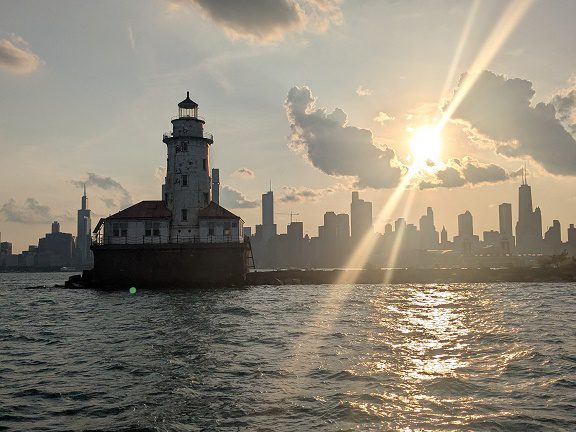
By James Heinz
August 7th is National Lighthouse Day because on August 7, 1789, Congress passed an act providing for federal support for lighthouses, buoys, and other aids to navigation. On Lighthouse Day 2025, I took a boat tour around the Chicago Harbor lighthouse. But first, a brief history of the Windy City lighthouses.
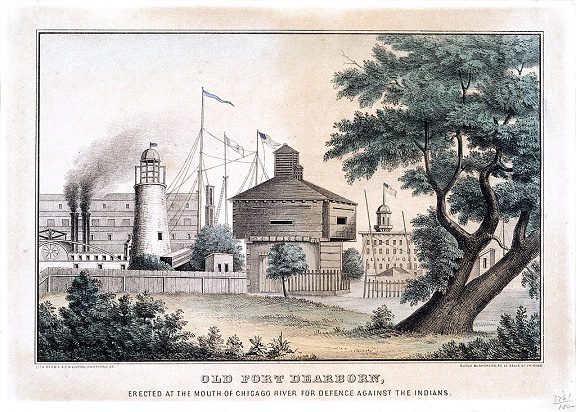
First Chicago Lighthouse courtesy of Wikipedia
The first Chicago lighthouse was built in 1831 on the south side of the river just west of where the second Fort Dearborn stood, at about what is now Wacker Drive and Michigan Avenue. It was not only the first lighthouse in Chicago, it was the first lighthouse on the Great Lakes.
Building a lighthouse at that location was a rare example of foresight on the part of the US government, who allocated $5,000 for the project, since at the time Chicago consisted of a small collection of log huts clustered around the fort, and no ship had ever docked there. The first ship arrived in Chicago in 1831 and only two more arrived that year.
When the lighthouse reached a height of 50 feet, residents noted that it seemed to resemble the Leaning Tower of Pisa more than a lighthouse. On October 30, 1831, perhaps to reassure the public, the builder took a tour group to the top, noting its three foot thick walls.
At 9 pm that same night, the lighthouse collapsed.
The builder blamed quicksand, but others blamed the builder. In 1832 he built a replacement. The second lighthouse was a cage style lighthouse forty feet high with a 14 inch reflector that could be seen 7 miles away and a bell used as a fog signal.
As time went on, the city grew up around the lighthouse, and most importantly, between it and the Lake. The buildings between the lighthouse and the Lake became so tall that its light could not been seen out in the Lake, but the keepers continued to faithfully light a light that no one could see.
In 1848 the Illinois and Michigan Canal was opened, connecting Lake Michigan and the Illinois River. Ship traffic swelled to the point where Chicago became the nation’s busiest port. Realizing that such a busy port needed a lighthouse that people could actually see, a lighthouse was built on the north side of the mouth of the Chicago River in 1859.
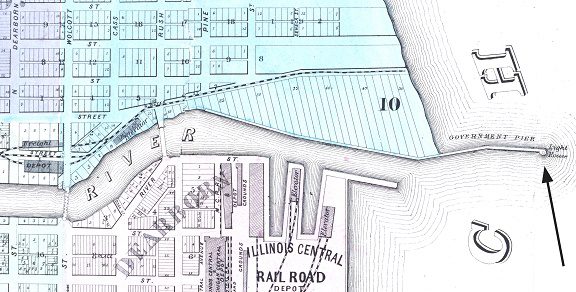
1863 map showing the lighthouse courtesy of Chicagology.org
It was a skeletal framed lighthouse with eight iron support girders supporting a central iron tube with the light in an octagonal lantern room on top. It was 83 feet high and could be seen 16 miles out into the Lake.
In 1869 a second lighthouse, referred to as a range light, was built at the end of the north government pier 1,200 feet east of the 1859 lighthouse.
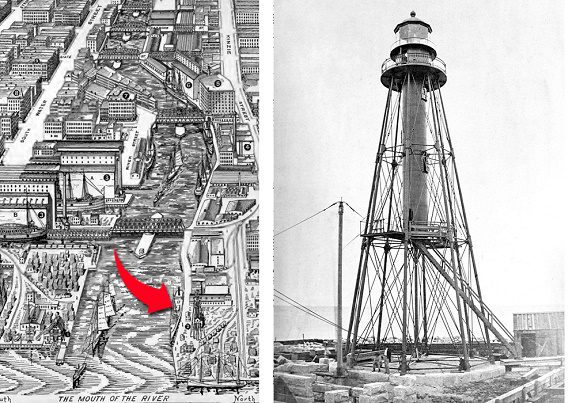
1893 map showing the lighthouse courtesy of Chicagology.org
The current lighthouse was built in 1893 for the Chicago’s World Fair. At that time, it was located at the south end of the Chicago breakwater. In an early example of recycling, in 1894 the federal government moved the skeletal frame lighthouse from the mouth of the Chicago River to Rawley Point, where it stands today.
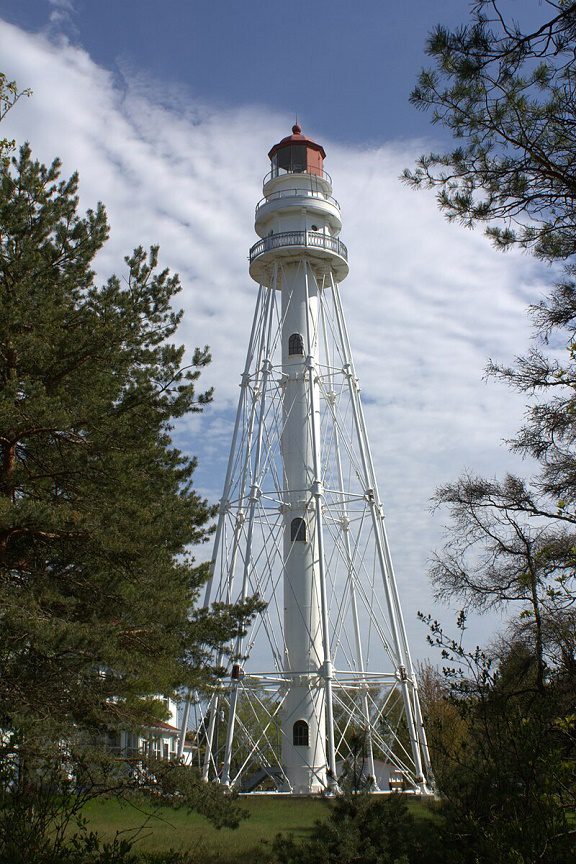
Rawley Point Lighthouse courtesy of Wikipedia
By 1919 the breakwater had been extended further south so the lighthouse was moved to its current location at the south end of the northern section of the Chicago breakwater, directly east of the mouth of the Chicago River.
It was built with a concrete base on top of a rubble foundation. The tapering cylindrical metal light tower is 66 feet tall and its third order Fresnel lens has a focal height of 82 feet and can be seen 24 miles away. It has a red roofed fog horn and boathouse buildings attached to it. It is still an active lighthouse, projecting a beam of light out over the Lake even today.
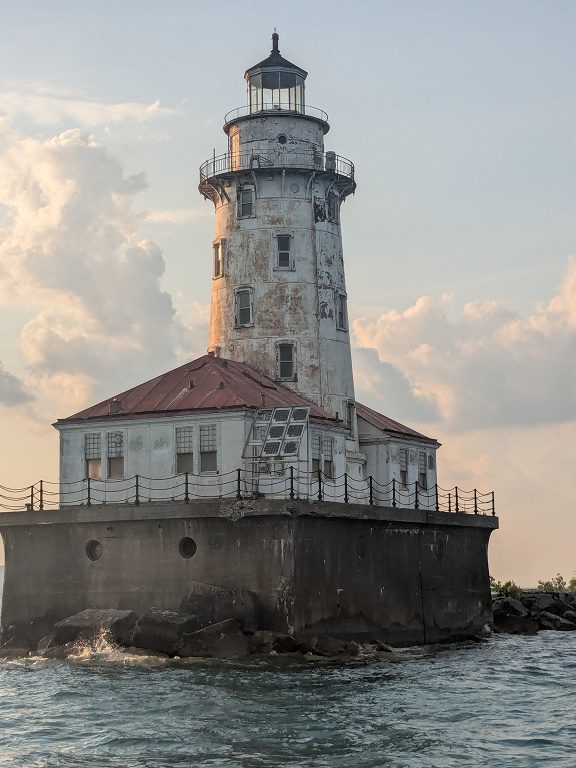
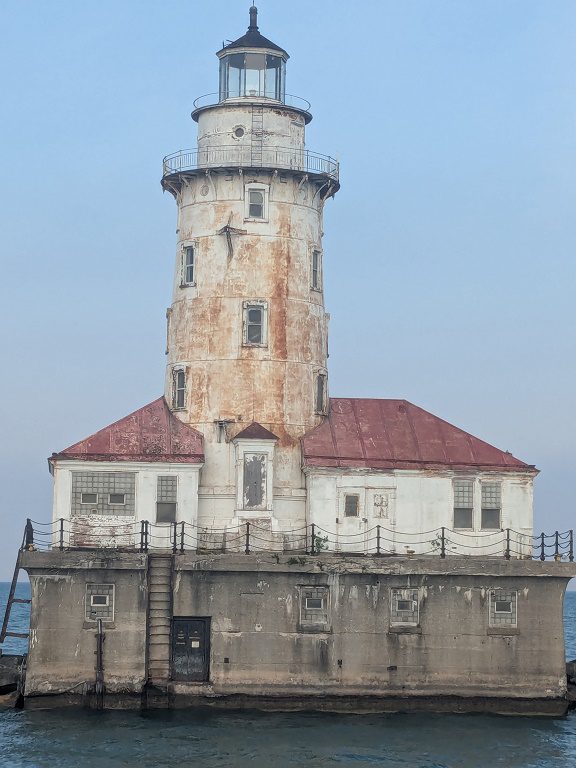
Current Chicago Lighthouse photos by James Heinz
While the fog horn was popular with mariners, it was deeply unpopular with downtown residents of the nation’s second largest city, located only a couple of miles away. They referred to it as “an unmitigated nuisance” and one resident suggested that those who had built it should be hanged. Often the foghorn was activated not because of fog but because of industrial smoke that drifted north from the steel mills at the south end of Lake Michigan.
In 1979 the light was fully automated. In 2005 the Coast Guard declared the lighthouse to be surplus. In 2009 the City of Chicago accepted ownership of the lighthouse. In 2022 the Friends of the Chicago Harbor Lighthouse was formed and in 2023 they petitioned the federal government to transfer ownership to them. It was FOCHL that sponsored the boat tour I took on Lighthouse Day 2025.
——————————–
James Heinz is the Wisconsin Marine Historical Society’s acquisitions director. He became interested in maritime history as a kid watching Jacques Cousteau’s adventures on TV. He was a Great Lakes wreck diver until three episodes of the bends forced him to retire from diving. He was a University of Wisconsin – Milwaukee police officer for thirty years. He regularly flies either a Cessna 152 or 172.
