
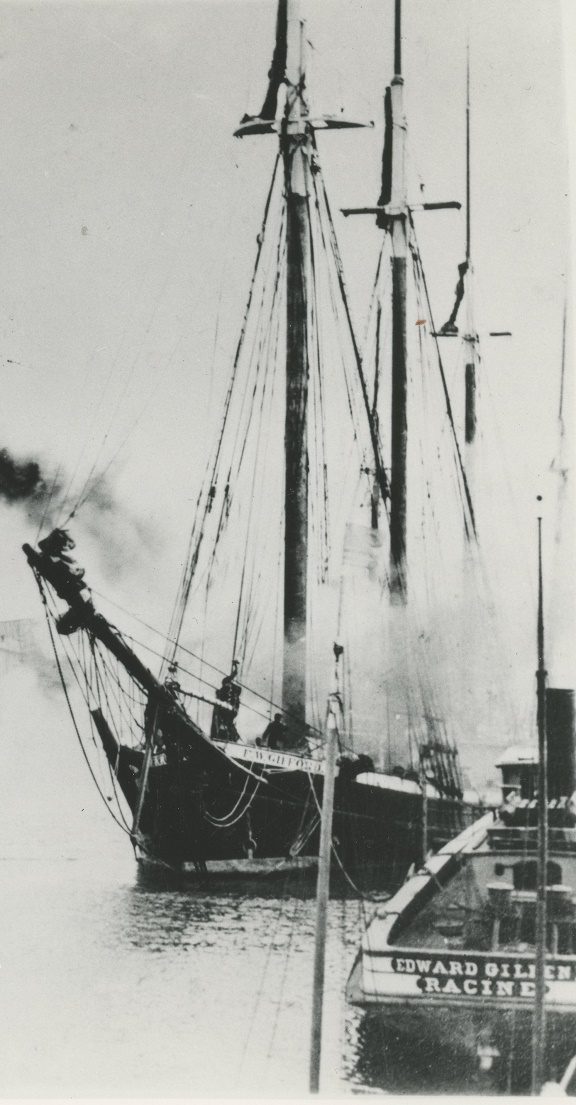
On this day October 21, 1897, a supernatural voice summoned the Captain from a deep sleep to come to the deck and it saved the crew. “The night was as dark as a stack of black cats.”
The FRANK W. GIFFORD was a three-masted schooner built in 1868 at Cleveland by Quayle & Martin for J. C. Van Scooter, Capt. George Berryman, and E. F. Christian of Erie, Penn. She was built as a top sail schooner and measured 160 feet in length, 31.2 feet in beam and 11.2 in depth. Her cost was about $27,000.
She had gone ashore a few times in her career and even thought to be a total wreck in 1877 but was lovingly put back together and continued to sail. Perhaps that is why the vessel summoned the Captain so he could save the crew when she was going down.
The following article dated October 25, 1897, is from an unnoted paper source in the Neff Scrapbook located in the Great Lakes Marine Collection. Other newspapers dared to note the occurrence as “supernatural”. You decide!
Sailors Saved from Death
Chief Officer Comes on Deck in Time to Warn his Crew
Chicago, Ill., Oct. 25 – Deeply laden with a cargo of iron ore and laboring in a heavy sea, the Chicago schooner, F. W. Gifford sprung a leak on Lake Michigan last Thursday night and went to the bottom within three hours. The eight men in the crew were driven to take refuge in the little yawl boat. In a night, pitch black, and with squalls constantly breaking from the Northward, they drifted about in the middle of the lake until they were picked up by the schooner City of Sheboygan, bound for Chicago. They were brought into port last evening.
The schooner was riding a heavy sea, and twenty-five miles off the east coast of the lake it bore toward Fruitport, Mich., having left Escanaba behind. It was 9 o’clock and Capt. Kronhert had been sleeping in his stateroom for an hour. The mate was in charge of the vessel. A strong wind was blowing – a wind that came in gusts, with now and then a sheet of rain. The night was as dark as a ’‘stack of black cats”. There was not a light discernible except that at the masthead of the Gifford. The mate and his crew of six men watched closely that neither wind nor wave got the better of the schooner. Everything seemed sate and they were talking of a prosperous trip. Unexpectedly, Capt. Kronhert walked among the men. No one could see him, it was too dark. But they knew he was there for above the howling of the wind and the beating of the waves, they heard him shout.
“What is it mate?”
“What is what, sir?” inquired the mate.
“Didn’t you call me” roared the Captain
“I did not sir”, replied the mate.
“That’s strange” said the captain. “I was asleep in my bunk, I heard your voice as plain as day, It said; ‘Captain we want you on deck, sir’
It woke me up and here I am. There is something wrong. Have you taken the soundings to see if the schooner is dry?”
“Not since you turned in, sir,” said the mate in reply.
The captain ordered the soundings taken. The line came up wet. The ship was sinking and the captain ordered the men into the boats. With a compass, a foghorn, a few provisions and a can of oil they deserted the schooner.
The spot where the Gifford sank is about twenty five miles from shore, east of Ahnapee, Wis. The schooner was owned by C. W. Elphicke, and considered one of the best of the sailing fleet. It was built in 1868, at Cleveland, Ohio and rated 429 tons net. In Inland Lloyd’s its valuation is set down as $12,000 and its insurance rating as A2. “
I know you are wondering so … the can of oil kept the heavy waves from breaking over the little boat. Spreading a thin layer on the surface helps to prevent the wind from gripping the water to form waves.
After drifting in the squall and fog for three hours, the crew was rescued by the CITY OF SHEBOYGAN. The crew, all Chicago men, made it home safely.
Suzette Lopez
Photo Credit: Great Lakes Marine Collection of the Milwaukee Public Library and Wisconsin Marine Historical Society
