
On this day October 25, 1898, the wooden steamer L. R. DOTY and her consort the four masted schooner OLIVE JEANETTE sailed into a fierce gale which parted their tow line and sent one to the bottom.
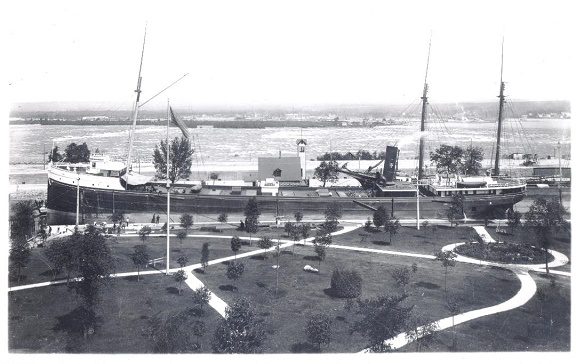
L. R. DOTY and schooner OLIVE JEANETTE in new Weitzel Lock, 1896
The DOTY left South Chicago on Monday the 24th with the JEANETTE in tow. The two were headed for Midland, Ontario, on Georgian Bay. The DOTY loaded with 107,000 bushels of corn. They were sighted off Milwaukee on the afternoon of the 25th before the gale force winds swept down from the north. Sixty mile per hour winds and tremendous seas rolled along Lake Michigan’s west shore during the night and next morning. Concern was expressed for both after the storm. Finally a sighting of a four masted schooner midlake off Kenosha was reported which brought relief to those on land. It had to be the JEANETTE and she had not been flying any signals of distress. Certainly the DOTY was just searching for her consort. Then, twenty-five miles off Kenosha, wreckage from a large steamer had been found. The DOTY was gone with her crew of 17.
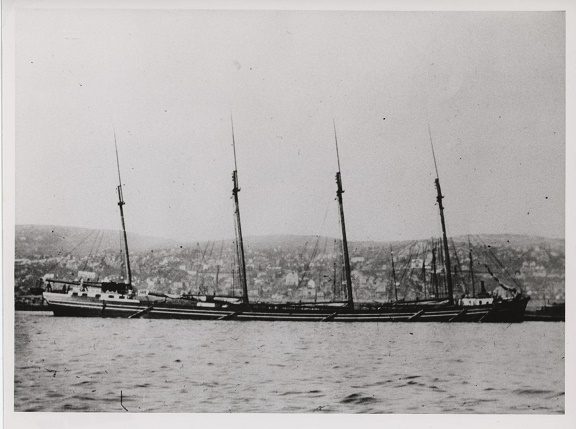
OLIVE JEANETTE with four masts
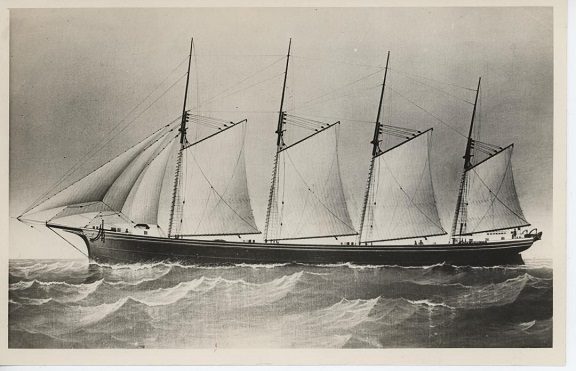
Painting of the OLIVE JEANETTE
The Milwaukee Sentinel of October 29th printed the following story from the crew of the JEANETTE:
“The OLIVE JEANETTE broke adrift from the DOTY at 5 o’clock Tuesday afternoon. The tow was then several miles north of Milwaukee. The wind was blowing a terrific gale, with rain and sleet. When the towline parted, the OLIVE JEANETTE fell off, but the DOTY continued northward, and when last sighted from the schooner, she was heading into the sea and was apparently in splendid shape. Capt. Cadotte, realizing that he had to look out for himself, spread a little canvas and started to run for Racine. He worked along slowly until about 11 o’clock Tuesday night, when his steering gear gave way. The JEANETTE at once fell off into the trough of the sea, and the waves swept her decks clear of everything. The steam pumps, deck houses and all went by the board. He succeeded in making temporary repairs and started to run for Chicago. It was not long before another huge sea destroyed his steering gear beyond all repair. Then Capt. Cadotte hove to the best he could and in this position the schooner drifted nearly 100 miles. The schooner was equipped with brand new sails, but every strip of canvas except the foresail was carried away. The hatches stood the ordeal, only one being torn by the debris when the decks were swept. The shipwrecked mariners passed through a bitter experience when the steering gear was carried away. They were then in sight of Racine light, and safety seemed but an hour distant. Then their hopes were dashed as their boat drifted off into the trough with solid water sweeping her from stem to stern.
“Mate Gives a Thrilling Account.
“”It was awful,” declared the mate, “although during my eleven years on the lake I have been in storms as furious. About 4:30 Tuesday afternoon the storm began to get down to business in earnest. The waves were coming so high that to see their crests we had to look up at the same angle we do to see the crosstrees. Pretty soon a big one that looked as if it had half the lake in it came straight at the boat’s nose, fell down on the deck like it was the end of the world. The fo’castle went in a thousand splinters, the staysail ripped, the donkey engine became a wreck and the mizzen-gaff came down, luckily catching in the standing rigging or it would have gone straight through the deck.
“We all got wet through, which was not of much account, as we all felt thankful it hadn’t carried us overboard with it. The men lost all their dry clothes, which were in the fo’castle, but the steering gear still held out. That kept the captain and me busy, while the crew of sailors–four men–kept at the pump with nobody to spell them.
“This was kept up all night and the fellows were dog tired. Waves washed over the sides and tangled up ropes and spars helterskelter and then ducked out the other side, generally carrying away a piece of plank. When the mizzensail went there was no steadying the craft at all. The cook kept hot coffee on the fire, but didn’t attempt to do any other cooking. When it seemed as if a man must give up and go to sleep we fed him a bracer from the pot and kept him working.
“Beauty of a Roller” Hits It.
“Wednesday morning we sighted Racine point and were feeling pretty good about it when a beauty of a roller swept over and broke the steering apparatus. The lake was still very rough and those waves did look ready to do for us. Well, we drifted all day and all night, pumping all the time and keeping a sharp lookout for vessels. The captain and I could take a spell at the pump now and then. There was no rudder to look after and the lone staysail was looking after itself, and it wasn’t any particular good at that. Yesterday morning we were well played out. Coffee’s all right, but it isn’t enough to keep a man up when he is wet and working hour after hour, with no sleep in between to amount to anything.
“Tug to the Rescue.
“We were sighted by the GRAND RAPIDS in the morning and she telegraphed to Chicago to get us a tug, which was sent, but even when being towed yesterday and last night, it kept us so busy that there was no time to eat.””
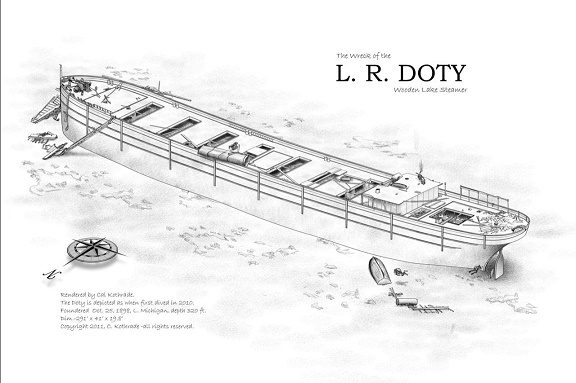
Photo at top of page: Sketch of L. R. DOTY as she rests on the bottom by Cal Kothrade
The DOTY was built in 1893 at West Bay City, Mich., by F. W. Wheeler for the Cuyahoga Transit Co. of Cleveland. She measured 291 feet in length and 41 feet in beam. Her wreck was discovered in 300 feet of water about 20 miles off Oak Creek,
Wis., in 2010.
The OLIVE JEANETTE was built in 1890, also at West Bay City, Mich., by F. W. Wheeler and was named after the owner Charles J. Smith’s daughters Olive and Jeanette. She measured 242 feet in length and 39 feet in beam. The JEANETTE foundered in a northeast gale off Huron Island, Lake Superior, with the IOSCO on September 2, 1905. Both were loaded with iron ore from Superior. The JEANETTE headed for Sandusky with a crew of 7 and the IOSCO for Toledo with a crew of 19.
Suzette Lopez
Photo Credit: Great Lakes Marine Collection of the Milwaukee Public Library and Wisconsin Marine Historical Society.
