
By James Heinz
In a previous blog post I showed photos of a shipwreck off Rawley Point that I took from an airplane that I was flying overhead: https://wmhs.org/rawley-point-from-the-air-wreck-one/ I asked our readers if they could identify the wreck, and one of them could.
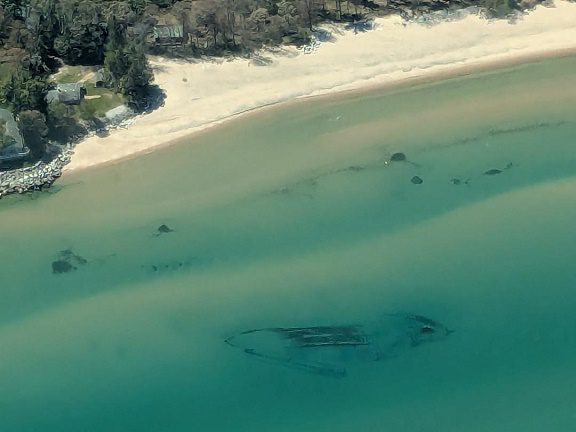
Rawley Point Wreck by James Heinz
It was Wisconsin state underwater archeologist and shipwreck sherlock, Tamara Thomsen. Tammy should know; she dove on and conducted an archeological survey of the wreck. According to her, the wreck is that of the steamer CONTINENTAL.
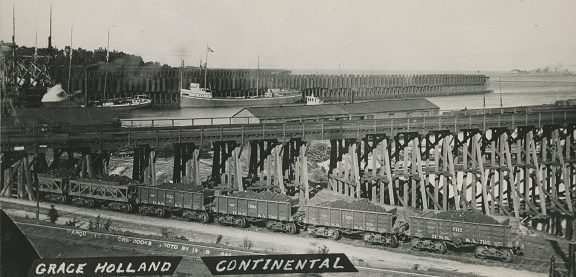
Photo at the top of the page: The sch GRACE HOLLAND and str CONTINENTAL at Marquette
WMHS files show that the CONTINENTAL was a wooden propeller bulk carrier launched in Cleveland in 1882. She was 1506 gross tons, 245 feet long, and 36 feet wide. In 1885 she was towing the schooner MAGNETIC through the St. Clair cut when she collided with the port quarter of the schooner BRADLEY, which in turn swung around and hit the MAGNETIC’s bow, badly damaging both schooners.
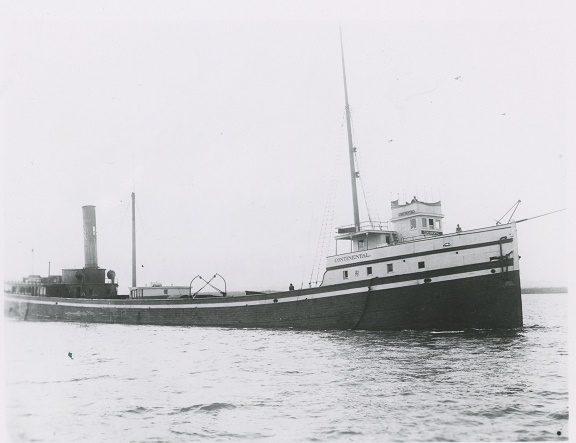
The CONTINENTAL
On the night of December 12, 1904, the CONTINENTAL was sailing from Kewaunee to Manitowoc. The CONTINENTAL got lost in the storm and because she was riding light she was able to pass over some of the Rawley Point sandbars until she ran aground on one about 200 feet from shore. Two of the crew walked all the way to Manitowoc through the night and the storm while the other 17 remained at the wreck.
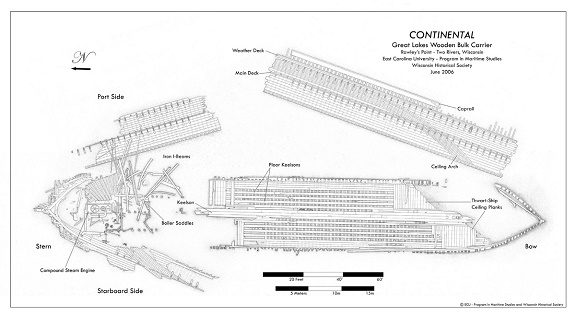
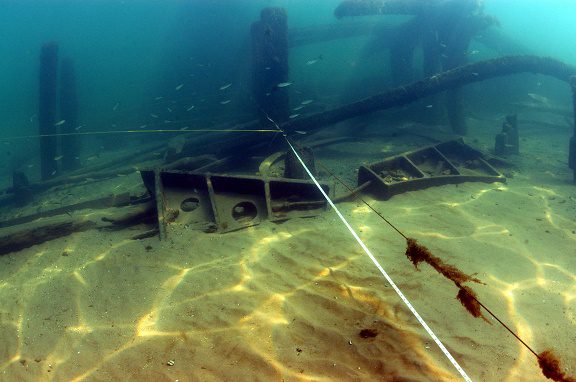
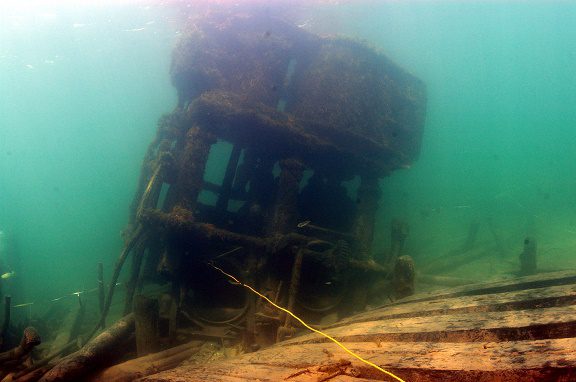
Attempts were made to salvage her but winter weather set in and broke up the wreck. Before that happened, “land pirates” stripped the wreck of anything of value. For many years her compound steam engine stuck above the surface above the surface. Tamara said the “The thing sticking out of the water on the right side of the wreck is the engine. “
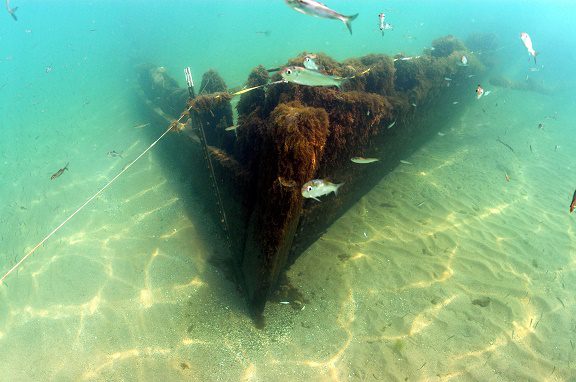
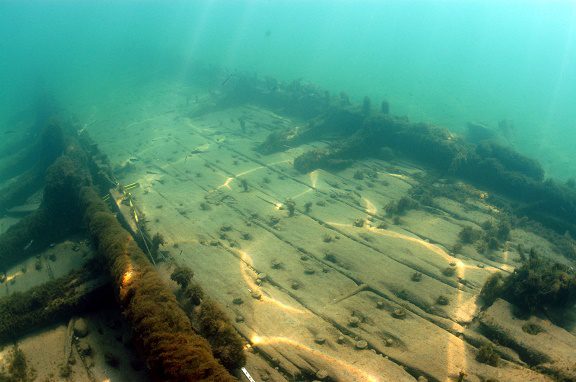
In the summer of 2006 Tamara Thomsen and a summer field student from the University of North Carolina surveyed the wreck, which, depending upon how the sand has shifted, lay in about 15 feet of water. Her ribs and decking stick up from the bottom when the sand does not cover her partially or completely. I should point out that about two weeks after I took the attached photo, the wreck was partially covered with sand, and two weeks after that it had disappeared completely beneath the sand.
Photographs of the wreck today are from www.wisconsinshipwrecks.com
——————————–
James Heinz is the Wisconsin Marine Historical Society’s acquisitions director. He became interested in maritime history as a kid watching Jacques Cousteau’s adventures on TV. He was a Great Lakes wreck diver until three episodes of the bends forced him to retire from diving. He was a University of Wisconsin – Milwaukee police officer for thirty years. He regularly flies either a Cessna 152 or 172.
Photo Credit: Above water photos: Great Lakes Marine Collection of the Milwaukee Public Library and Wisconsin Marine Historical Society; below water photos: Photographs of the wreck today are from www.wisconsinshipwrecks.com
