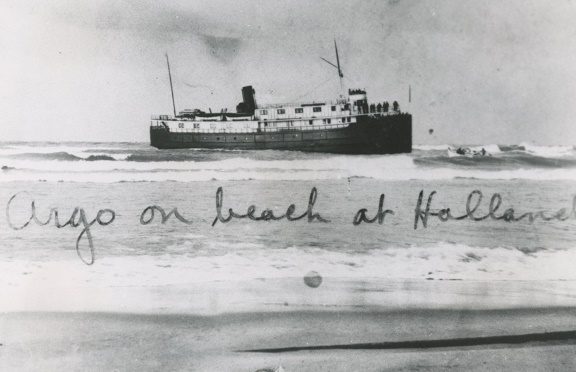
On this day November 24, 1905, passengers and some crew of the Graham & Morton passenger steamer ARGO were hauled to safety thanks to the life-saving crew and the breeches buoy.
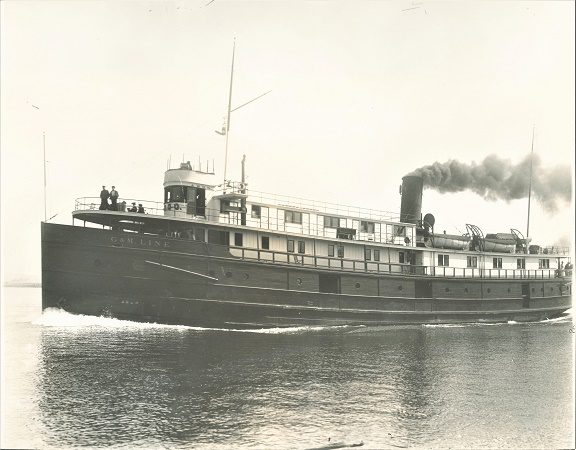
ARGO dated 1905
The adventure began at 8 p.m. on the 23rd when the ARGO sailed from Chicago, Illinois, with a crew of 22 men and 30 passengers aboard. They had a rough trip across Lake Michigan during the night, thanks to a terrible storm with tremendous seas and gale winds. The ARGO arrived off Holland, Michigan, at 4 o’clock. Gale winds were reaching 50 mph as they approached the harbor mouth. When alongside the piers a “great sea struck the ARGO and hurled her against the north pier, carrying a portion of it away. The steamer was carried along on the crest of the wave until she went aground on a sandbar fifteen hundred feet north of the pier. The vessel struck amidship with her head to shore.”
The boat was in danger of being pounded to pieces. The rolling heavy seas made it impossible for the lifesaving crew to reach the steamer by boat. The wind was shifting from the south to the southwest. It was then decided to use the breeches buoy.
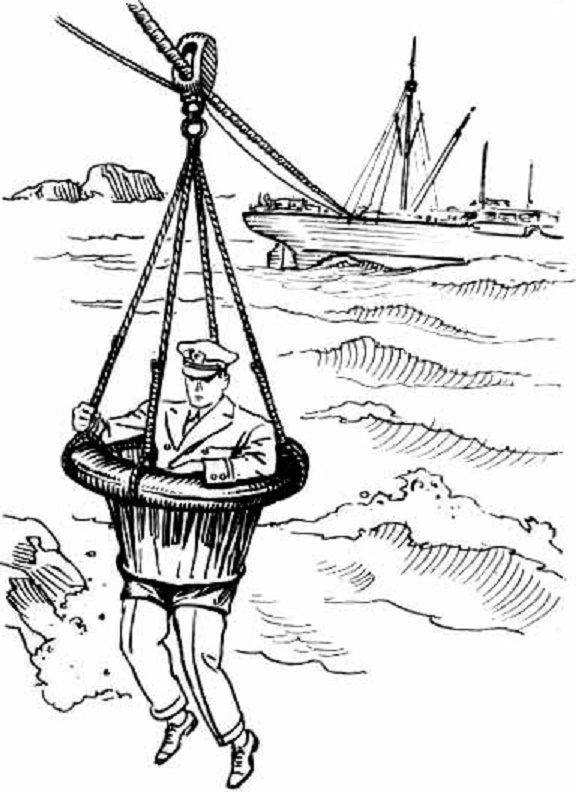
Breeches Buoy sketch from Wiktionary
As you can see by the sketch, a breeches buoy by definition is “a lifebuoy with canvas breeches attached that, when suspended from a rope, can be used to transfer a person to safety from a ship.” What is not mentioned is a shot line is fired from a cannon or lyle gun with the hopes that the line crossed over the ship so the crew can pull the hawser rope to the ship and secure it. The buoy running on the hawser is then used to haul the person from ship to shore and back again empty. Usually the rescued person is dragged through the freezing waves and wind before reaching shore.
Photo at top of page: ARGO stranded on sandbar at Holland, Michigan,
using breeches buoy to unload passengers with life boat
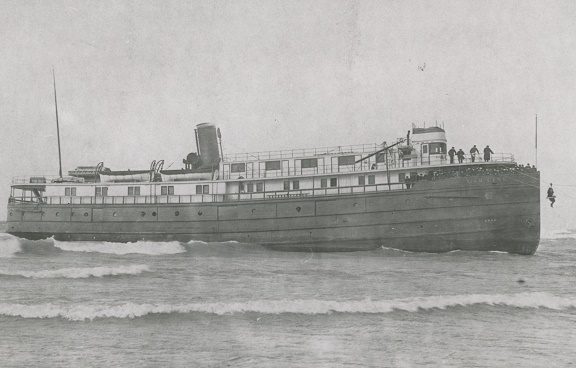
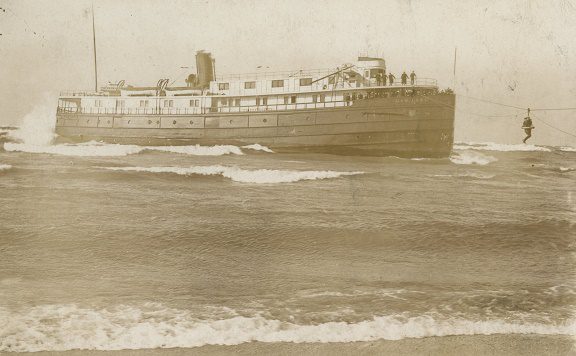
ARGO with passenger in breeches buoy
The following is from the Racine Journal Times of November 24th.
“It was finally decided to remove the endangered passengers of the ARGO with the breeches buoy. The lifesaving crew accordingly dragged their cannon to a favorable spot on the beach and fired a line cross the rough water to the ARGO. It was made fast on the steamer and then the breeches buoy was sent out and the rescue work began. The first persons brought ashore were Mrs. P. J. Miskern, Mrs. C. J. Johnson and Mrs. W. T. Conan and little daughter of Big Rapids, Mich., and Mrs. C. W. Earl of Chicago, all of them were thoroughly soaked during their trip across the swaying line on which the breeches buoy was drawn back and forth. Spray was dashed over them in clouds by the fifty miles an hour wind, but the four women and the child reached the beach without suffering any injury.
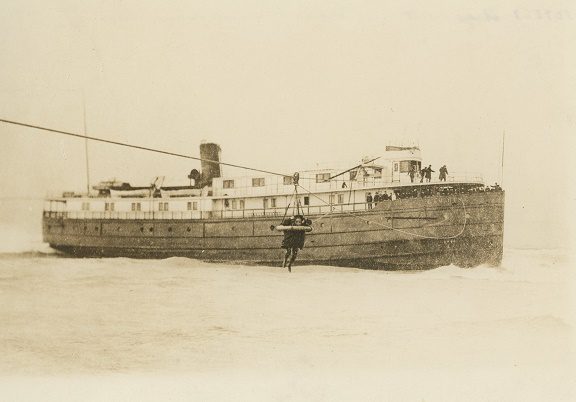
ARGO with child in breeches buoy heading to shore
“NO PANIC OCCURRED – After their safe arrival the work of taking off the male passengers was begun and one by one they were drawn to the beach. The passengers retained their self-possession throughout the trying experience and there was nothing like a panic at any time after the steamer struck.
“At one o’clock the cable used to haul the breeches buoy parted, fortunately while the buoy was being hauled back to the steamer for another passenger. At the time this accident occurred there were seven passengers and crew of twenty-two men remaining on the ARGO, The lifesaving crew when their buoy line broke, realized the peril of the situation, again took to their surf boats in a desperate effort to reach the steamer. The sea is running mountain high and it is not thought the life savers will succeed.”
A cliff hanger of an article. What is known is the captain and some of the crew remained safely on the ARGO overnight. Attempts were made to pull her off but were unsuccessful. By late December, she was stranded scarcely 100 feet from shore. Sand was piled against the hull on the lake side to a depth of seven feet. It was impossible to dredge a channel to her. Graham & Morton had turned her over to the Marine Insurance Company. She spent the winter on the sand bar.
She was released in the spring, taken to Manitowoc and later sold at auction to the Northern Michigan Transportation Company for whom she sailed through 1913 after being renamed RACINE around 1910. The RACINE sailed for the Chicago, Racine & Milwaukee Steamship Company from 1914 through 1916 and was sold in July 1917 to J. W. Ellwell & Co., of the Atlantic Coast. Ellwell sold her to the French Government in August and they renamed her RENE.
The ARGO was built in 1901 at Toledo by the Craig Ship Building Co. for A. Booth & Co. of Duluth to run on a passenger, freight and mail line from Duluth to Port Arthur, Canada and other north shore points on Lake Superior. She measured 173.5 feet in length and 31.6 feet in beam.
Suzette Lopez
Photo Credit: Great Lakes Marine Collection of the Milwaukee Public Library and Wisconsin Marine Historical Society.
