
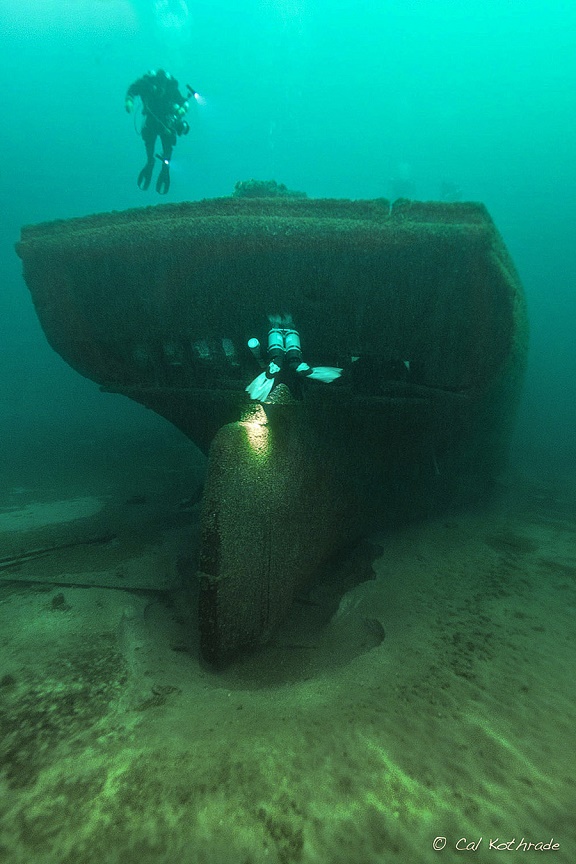
On this day December 15, 1932, the barge EMBA was taken out into Lake Michigan about five miles from Milwaukee and scuttled.
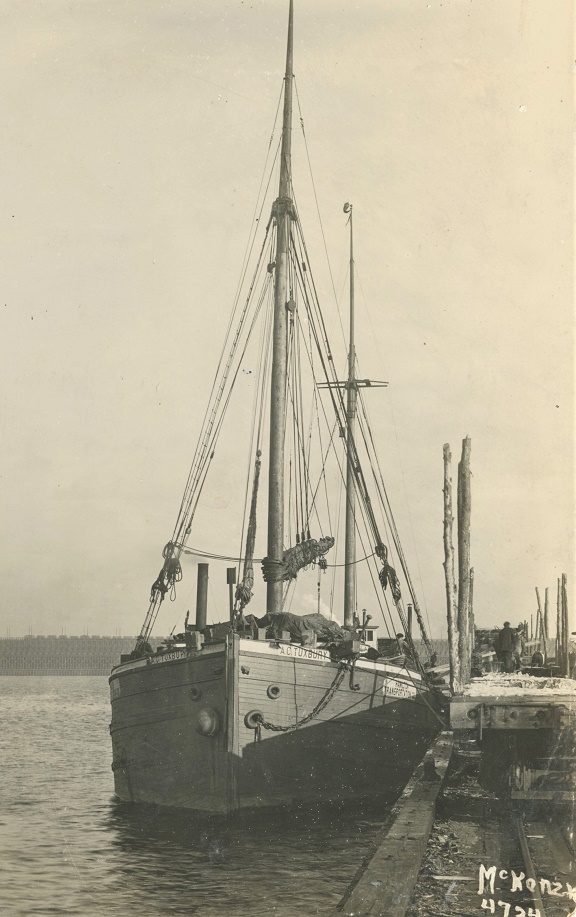
Schooner A. C. TUXBURY docked
The EMBA started her career as a three-masted schooner named A. C. TUXBURY. She was built in 1890 for the lumber and coal trade at West Bay City, Mich., by Frank W. Wheeler & Co. for W. H. Sawyer and A. C. Tuxbury of Tonawanda, New York. She measured 181 feet in length and 35 feet in beam. Her homeport from 1891 to 1905 was listed as Boston, Mass., but she never left the lakes. In 1905 she was sold to the Hines Lumber Co. of Chicago.
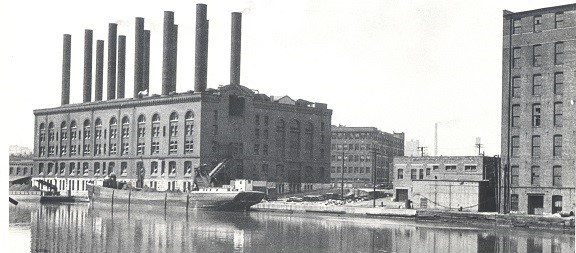
EMBA docked in the Milwaukee River
In 1923 she was sold to the Milwaukee Electric Railway & Light Co. She was renamed EMBA – Employee’s Mutual Benefit Association. Her masts were removed and she was fitted with an elevator and used as a barge to carry coal from the coal yards in the Milwaukee River to their power house on Commerce Street above the Juneau Avenue Bridge. By 1932 she was no longer needed and was intentionally scuttled. Her history continues underwater by giving a glimpse of the past to divers. Here is our Shipwreck Ambassador Cal Kothrade’s account of his 2013 dive on the EMBA.
If you live near the Great Lakes, upon scuba certification, it is only natural to do a few dives in the cold water of the Lakes to see if it is tolerable and to see what this whole shipwreck thing is about. Of course everyone draws their own line in the sand when it comes to the type of diving they deem ‘tolerable’. For me Lake Michigan fit comfortably within the ‘tolerable zone’.
Once you’ve decided that diving the shipwrecks of the Great Lakes is something you are going to pursue, a whole world of destinations opens up. Though, not all are available to the prudent new diver immediately. Obviously we all crawl before we walk, and so it is with scuba diving.
First comes Basic Open Water certification, and then Advanced Open Water…with each new level of training a new depth or skillset is revealed to us. The shipwreck of the EMBA is one of those that you work your way up to. Patience is a virtue, or so I’ve been told. One of the rewards for making it to ‘technical diver’ is shipwrecks like the EMBA, and other wrecks in the 130 foot to 175 foot depth range.
The EMBA lies at a depth of approximately 170 feet, making it a technical dive and one that I finally felt ready for in 2013. It is not one of those shipwrecks that went down in a vicious storm, carrying its crew and passengers to a horrifying death – thankfully. She was scuttled intentionally, but to a true lover of wreck diving, that really doesn’t matter. What matters is the condition of the wreck on the bottom…is it ready to sail off, or is it a board pile? This is really what is important to guys like me who live more for photographing them than diving them. The EMBA is much closer to the ‘ready to sail off’ end of the spectrum than the ‘board pile’ end. I didn’t know much about the vessel prior to diving it, so I wasn’t sure what to expect once I sank to the bottom of the lake. I was not disappointed.
I think one of the coolest parts about being a wreck diver is getting to experience that moment when the ship first appears out of the mist…when you get close enough for the vis to let your eyes lock in on a shape, and the next few seconds as you continue to fall closer and closer, as more and more of the vessel reveals itself to you, until you are ‘on the wreck’, at depth, and you level off your buoyancy, check your gear, check your buddy if you have one, and begin your tour. This introduction never gets old, no matter how many times I’ve dove the same wreck, but the old adage, “You only get one chance to make a fist impression” is so true in wreck diving. Meeting a new wreck for the first time is truly special for me.
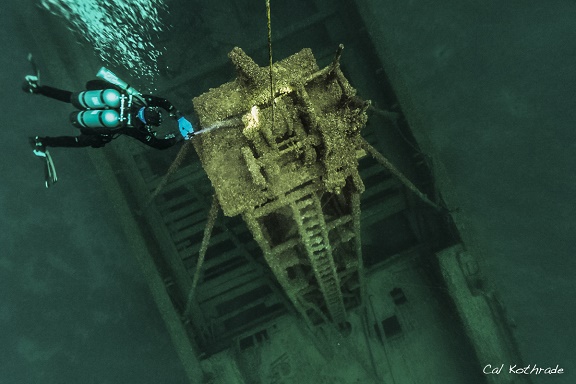
Self-Unloading Tower of the EMBA with down line
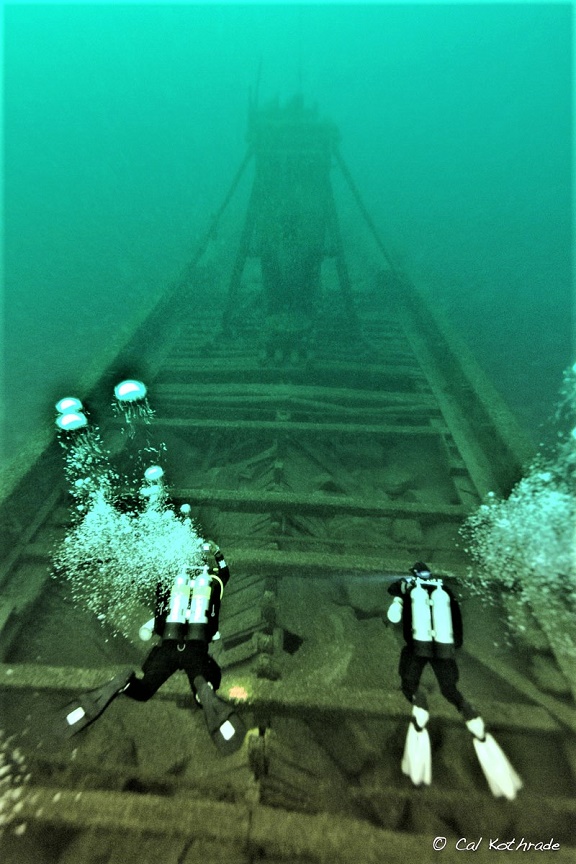
Divers heading to the tower
When I first met EMBA, it was her self-unloading tower that materialized out of Lake Michigan’s green-grey fog before anything else. It is by far, the part of the wreck nearest the surface, rising perhaps twenty feet or more above her deck. She started her life as a sailing schooner, but eventually lost her spars and canvas, and became a barge to be towed by other vessels. At some point, her owners saw fit to install a self-unloading system, this tower being a part of it. The tower was the first and last thing I saw of her on my dive, as the down line was tied off to the top of it.
Photo at top of page: Bottom view of the stern and rudder
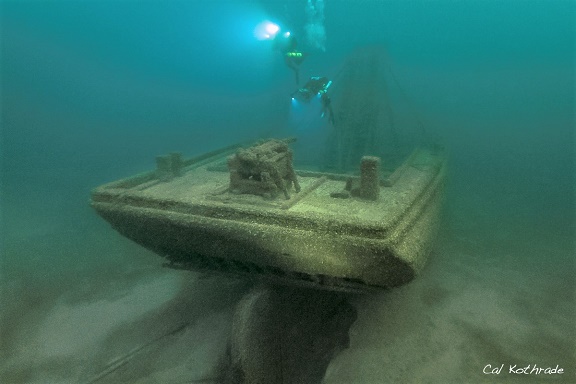
Top view of the stern
Another observation I made that surprised me was just how big her stern is. When you look at the image of the transom and rudder with the divers, it really puts it into perspective. This was a large boat!
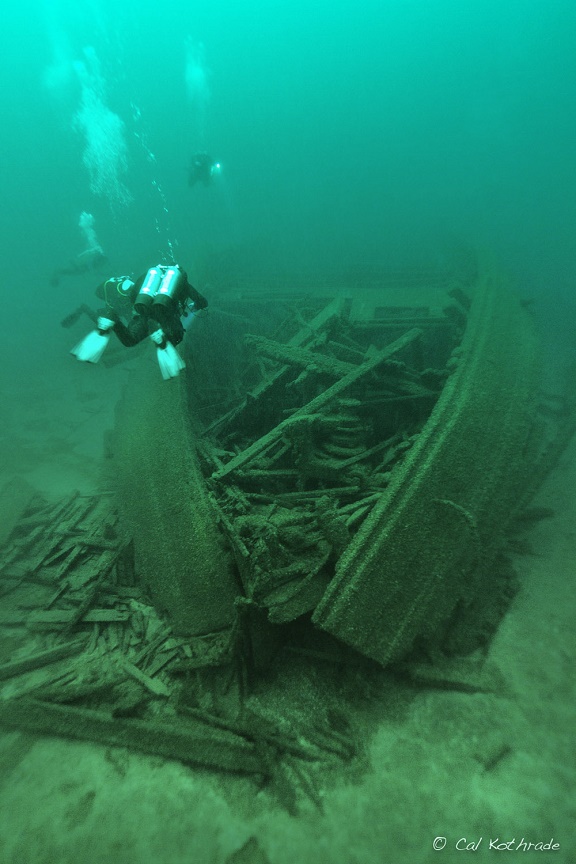
Bow of the EMBA in two halves
As a group, the six of us eventually made our way up to the pointy end, not knowing what I might find up there. Turns out the bow is not as water-tight as the stern…when she hit the bottom, the bow split open into two halves, right down the middle, making for a bit of a mess. If one looks closely enough, you will see the steam driven windlass standing on its end, coming to rest here, after it and the deck it was mounted to had collapsed upon meeting the bottom.
As is often the case with shipwrecks, the most interesting parts are the bow and stern. The middle portions tend to be monotonous, with little to entice the photographer. The middle of the EMBA is moderately interesting, a wooden hull with very large rocks which are easily viewed as the deck boards are conspicuously absent. I have been told the huge rocks in the hold were the guarantee she would go down in a hurry when they scuttled her. In 1932, when no longer of any use to her owners, she was stripped of most usable items like anchors, machinery and equipment, towed five miles east of Milwaukee’s harbor, and like so many other unwanted things in those days, sent to the bottom. Out of sight out of mind I guess.
I only dove this wreck the one time, back in 2013. I wouldn’t mind diving it again, hoping for even better visibility, I figure we had about 50 feet that day. Fifty feet isn’t amazing, but it isn’t bad either. If I doubled down, it could go either way, it might be better, or it might be worse. In the end, for me, it’s really about seeing as many of these Great Lakes time capsules as possible before I hang up my cold water fins. If I get good photos the first time I dive a wreck, I am much less likely to spend the time, energy and money to go back. I like the images I came home with in 2013.
Images were created with a Canon T1-I Rebel DSLR mated to a Canon 10-22mm super-wide rectilinear lens, in an Ikelite housing using natural light and Ikelite DS-161 Movie strobes X2. Post production was performed in Adobe Lightroom. Cal Kothrade
Suzette Lopez
PHOTO CREDITS: Above water – the Great Lakes Marine Collection of the Milwaukee Public Library and Wisconsin Marine Historical Society. Below water – Cal Kothrade.
———————————————–
Cal Kothrade is the Shipwreck Ambassador of the Wisconsin Marine Historical Society, a diver, a photographer and an artist. His work can be viewed at www.calsworld.net.
