
By James Heinz
This story is the type of story that everyone loves: Stupid criminal stories.
With a submarine.
On July 22, 1940, a note was left on the front porch of 2612 East Shorewood Boulevard in Shorewood, Wis. The note was intended for former resident Rowland Davie, who was the manager of all Sears Roebuck stores in the Milwaukee area. (For younger readers, Sears was the Walmart of the 1940s.)
The note said that a bomb would detonate that night at a Sears store and that more bombs would go off at other area Sears stores unless the note writer was paid $100,000.
Unfortunately, a circuit court judge was living at the residence instead. This would prove to be the first of many mistakes. The judge called the police.
The note instructed Davie to post a coded personal ad in the newspaper signaling his compliance, and to obtain an airplane from which to drop the money on July 26th at a place he would be notified of later. And, as threatened, that night a small pipe bomb did explode in an area of a Sears store that only Sears employees would be familiar with.
On July 26th, Davie received a phone call saying that the plot had been delayed. On August 3rd, the Milwaukee Police arrested three men, Daniel Carter and brothers Walter and Kurt Minx.
The key piece of evidence was that a piece of ornamental wire had been used as the trigger for the bomb. That type of wire had recently been used to build teller cages at several Sears stores. Walter Minx was the ringleader and he was the man who had built the cages. He told the police that he wanted the manager to drop the money from an airplane over Lake Michigan.
To a submarine.
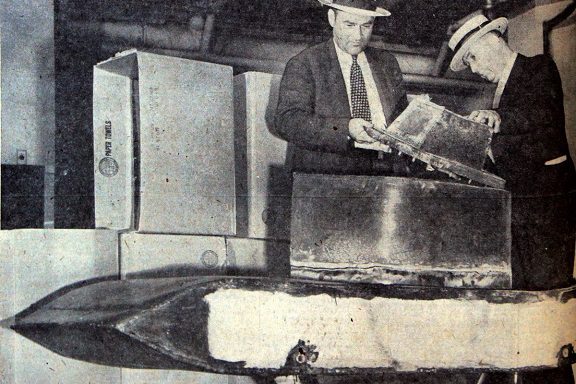
In the basement of Walter’s home, the police found a seven foot long home made submarine. It was three feet wide, weighed 400 pounds and was light enough to be lifted onto a trailer by two men. The makeshift sub had a conning tower with view ports, ballast tanks made of two gallon tin cans that were filled and emptied by plumbing fixtures, hand operating diving fins, and an oxygen mask and tank with enough oxygen for several days. It was propelled by an automobile starter motor powered by two batteries.
Photo at top of page: Get away submarine, courtesy of the Milwaukee Journal
It was the second sub built by Walter, he having abandoned his first effort in his parent’s back yard. Walter determined that it was watertight by sitting in it and having Kurt dump buckets of water over it. It took a week to build.
Walter’s plan was for the airplane with the money to fly 10 miles east over Lake Michigan, and then drop the money when they saw floating lights above the submerged submarine, which he would pilot. The sub would then surface, retrieve the money, and then submerge and proceed back to shore underwater until it came close to shore, where Walter would place the money in an inner tube to keep it dry, scuttle the sub, and then swim ashore at Bradford Beach with the inner tube. The plan had only one flaw:
The submarine would not submerge.
It did submerge the first several times they tried it in the calm waters of Whitefish Bay, but when they tried it in deeper and rougher waters on August 2nd, it stubbornly refused to submerge.
The criminals came up with another plan but were arrested before they could implement it.
Twenty days after their arrest (justice was quick in those days) Walter was sentenced to one to fourteen years, and Kurt was sentenced to one to twelve years. Both brothers testified that Daniel Carter did not participate in the plot and he was released.
Walter was released from prison in 1946, opened a hardware story in Saukville, and became a plumber. In his later years he obtained his pilot’s license, built a cabin cruiser in his back yard, and drove in the first NASCAR cup race in 1949. He died and was buried in 2009 in Florida.
Photo credit: Milwaukee Journal https://www.jsonline.com/
——————————
James Heinz is the Wisconsin Marine Historical Society’s acquisitions director. He became interested in maritime history as a kid watching Jacques Cousteau’s adventures on TV. He was a Great Lakes wreck diver until three episodes of the bends forced him to retire from diving. He was a University of Wisconsin – Milwaukee police officer for thirty years. He regularly flies either a Cessna 152 or 172.
