
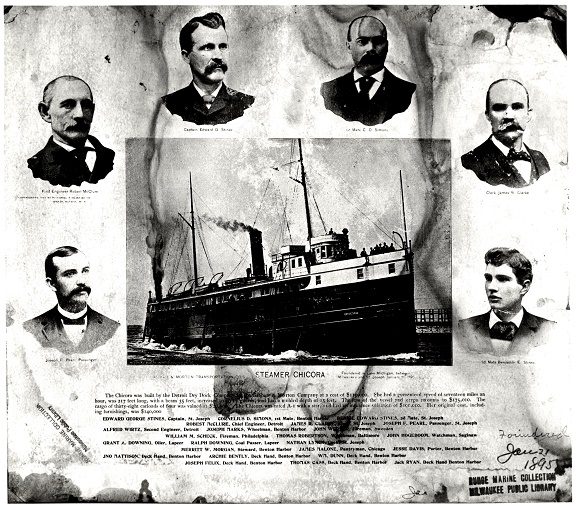
On this day, January 21, 1895, the CHICORA sailed out of Milwaukee at 5:45 am for St. Joseph, Michigan, and was never seen again. What started as just another day, docked at Shea’s Dock in Milwaukee, being loaded with merchandise, flour, paper, etc., changed drastically thanks to a 45 mph gale later that afternoon. She should have reached St. Joseph about six and a half hours later. A red light, thought to be from the CHICORA, was seen from the pier at Benton Harbor, but it disappeared. The northwest blizzard and gale had filled the harbors of St. Joseph and Benton Harbor with ice drifts to the point they were not accessible. The CHICORA may have reached Benton Harbor but found it blocked by ice. Her crew of 25 and one passenger disappeared with her.
Photo at top of the page: The CHICORA with some of her crew
Identifiable wreckage began appearing between St. Joseph and Saugatuck leaving no doubt she was gone. A chair known to belong to the engineer, pieces of the mahogany cabin, parts from around the engine room, a silver bracket from the clerk’s room and then, the fire extinguisher with the name CHICORA.
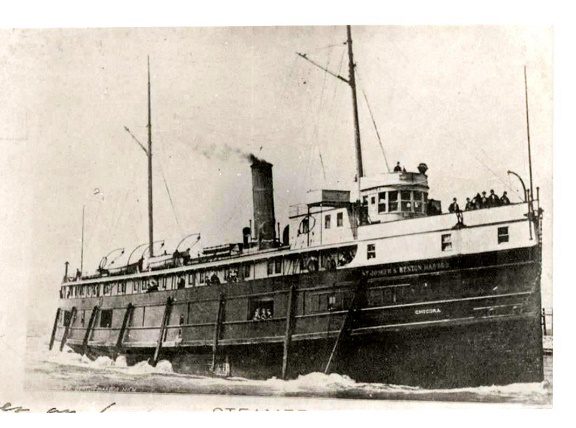
The only survivor of the CHICORA appeared at the door of Solomon Cutter at Pottowatomie Park, eight miles south of Benton Harbor. It was a snuff colored Skye terrier who was known to be aboard the CHICORA. The dog had evidently just come out of the water which lead people to believe the wreck was within a half mile of the east shore, as it was thought the dog could not swim more than a quarter mile.
The search for the CHICORA followed every lead, every piece of wreckage, but the wreck was elusive. Finally, the search then was abandoned on July 3, 1895.
The search continues today. A wreck of the same dimensions was found by Taras Lyssenko while searching for WWII planes but it has never been confirmed to be the CHICORA.
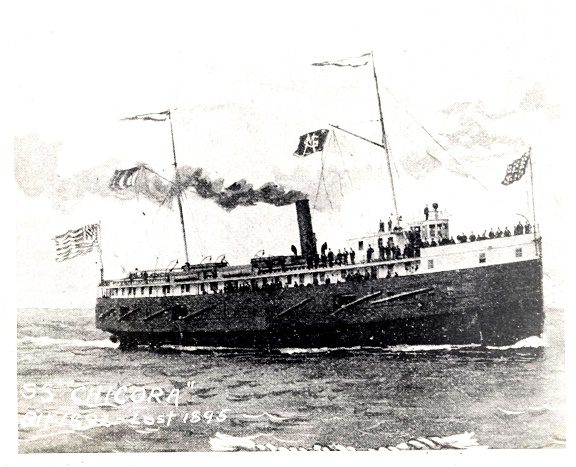
The CHICORA when new
The CHICORA was built in 1892 at Detroit by the Detroit Ship Building Co. for Graham & Morton Transportation Co. Measuring 210 feet in length and 35 feet in beam, she was built of wood to enable her to deal with Lake Michigan’s heavy ice. Her mahogany passenger cabin was the entire length of the ship. She had 56 staterooms, a spacious social hall, a large smoking room and sleeping room for 200 passengers.
In the summer, she ran between Chicago, Benton Harbor and St. Joseph. In the winter, she ran between Milwaukee and St. Joseph. She was used for both passengers and freight.
Suzette Lopez
Photo Credit: Great Lakes Marine Collection of the Wisconsin Marine Historical Society and Milwaukee Public Library.
