
By James Heinz
On August 25, 2025 a story was posted on the WMHS blog about an unidentified shipwreck on the bottom of Lake Michigan at Rawley Point, north of Manitowoc, Wis. https://wmhs.org/rawley-point-from-the-air-wreck-three/
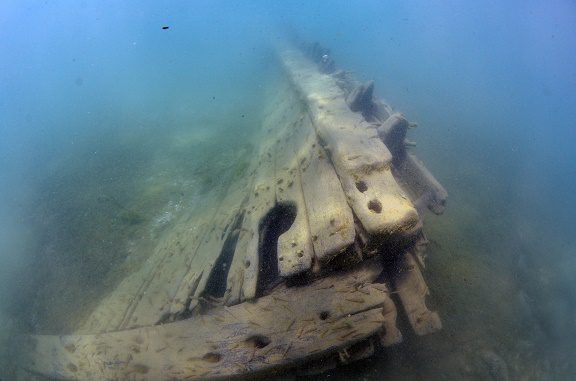
I asked our readers to help identify the wreck and once again, state underwater archeologist Tamara Thomsen rode to the rescue. She identified it as the wreck of the wooden barkentine MAJOR ANDERSON.
Wikipedia tells us: “ barquentine (alternatively “barkentine”) is a sailing vessel with three or more masts; with a square rigged foremast and fore-and-aft rigged main, mizzen and any other masts.”
WMHS files show that she was launched in 1861 at Cleveland, Ohio. She displaced 568 tons and was 153 feet long and 33 feet wide and carried 2,800 yards of canvas sails. She had three masts, a single deck, and a square stem. She was named for the hero of the hour, Major Robert Anderson, who was the commander at the recently fired upon Fort Sumter, which is why her stern was covered with a large painting of Fort Sumter.
Her early life was eventful. In September 1863 she sprang a leak and sank off Middle Island in Lake Huron. She was pumped out only to run aground on Point Pelee Island in Lake Erie. After being pounded on the rocks for three days she was towed off in a sinking condition. She stayed out of trouble until April 1871 when she ran aground on Graham Shoals in Lake Michigan.
According to www.wisconsinshipwrecks.org the end came at 2 am on October 7, 1871, the date of the Great Chicago Fire and the Great Peshtigo Fire. The captain of the MAJOR ANDERSON, blinded by darkness and smoke from the fires and fighting a heavy gale, got confused and ran the ship aground 4 miles north of Two Rivers, Wis. Both of her boats were destroyed so the crew had to swim ashore. Efforts to pull here off were unsuccessful, and in November she was sold for salvage.
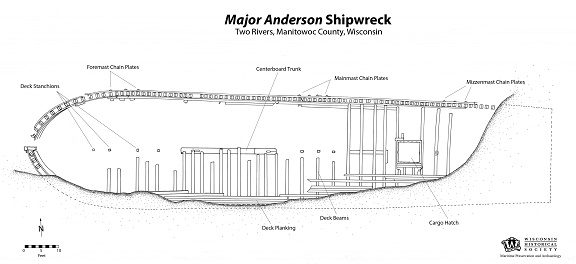
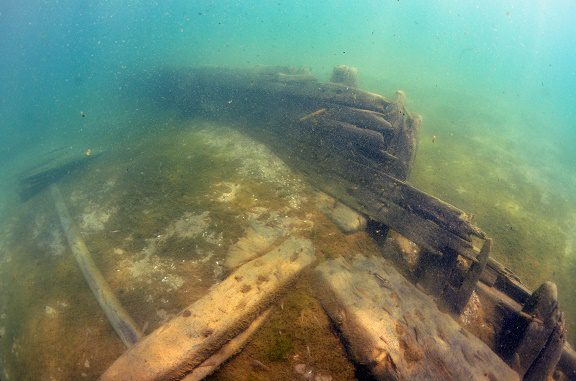
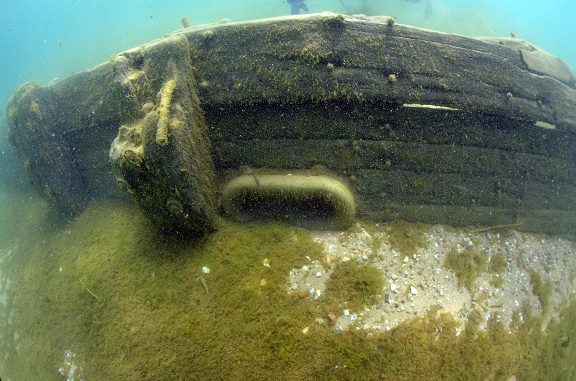
Tamara Thomsen surveyed the wreck and drew a diagram of the wreck. She describes it as: “After salvage, the Major Anderson’s wreck site remained forgotten until her discovery in May 2013 by ultralight pilots… Major Anderson lies on the lakebed in 3 to 10 feet of water. Although her rigging and deck machinery were salvaged, her lower hull remains intact and well preserved under an estimated ten feet of sand.”
Photo Credit: Tamara Thomsen
——————————–
James Heinz is the Wisconsin Marine Historical Society’s acquisitions director. He became interested in maritime history as a kid watching Jacques Cousteau’s adventures on TV. He was a Great Lakes wreck diver until three episodes of the bends forced him to retire from diving. He was a University of Wisconsin – Milwaukee police officer for thirty years. He regularly flies either a Cessna 152 or 172.
