
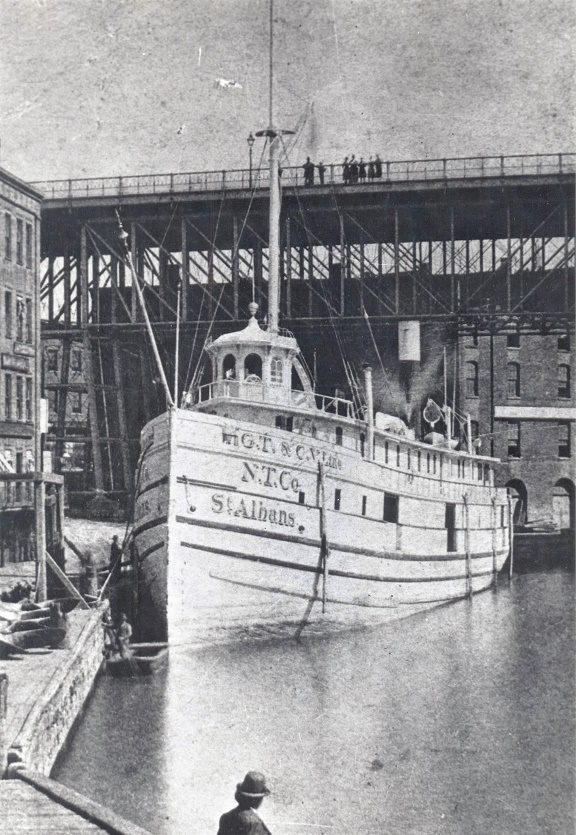
On this day January 30, 1881, Milwaukee had been experiencing a fierce snow storm but when the alarm was sounded for what was noticed off shore, hundreds came out to help. This was the day the package and passenger steamer ST. ALBANS was cut through by ice and went down off Milwaukee. Attempts were made to stop the leak but her fires went out and the order to abandon was given. Crew and passengers got into the small boats and safely made shore in Milwaukee. A few suffered frost bite.
Photo at top of page: ST. ALBANS above water at Cleveland in the Cuyahoga River
Although the Milwaukee papers covered the story and the rescue of the four life boats, this article from the Cleveland Herald of February 1st sums it up very nicely.
“Milwaukee, Jan. 31. — At 8 o’clock this morning George W. Amey, of this city, who resides near the lake shore, saw far out on the lake to the northeast four black specks that attracted his attention. He looked carefully, and through the snow that was driving from the northeast thought that he could discern boats with people in them. A few moment’s steady looking convinced him that the objects were boats and then he went and gave an alarm. Shortly the news spread that small boats with people in them were out upon the lake and needed assistance in making the shore. There were four in all and in one of them were seen women. Rescuing parties, composed mostly of police, were formed, and at 9 o’clock, one of the boats containing four men, reached the outer breakwater near the Northwestern depot, and the men in it were hauled safely ashore. Then it was learned that the small boats in sight were from the propeller ST. ALBANS, of the Northern Transit Company, which left here yesterday morning to cross the lake, and when about 12 miles out was discovered to be leaking, and in less than two hours from the discovery of the leak had to be abandoned by her crew of twenty persons and five passengers, four of whom were ladies. The story as told by the four men who first reached the shore was that yesterday morning, after the ST. ALBANS had been out about two hours, she was discovered to be leaking badly. Men were put at work on the leak, which was in the bow of the port side, and appeared to have been caused by almost constant contact with the ice. The cargo forward was thrown over to lighten her up, but the water gained continually, and in half an hour after the discovery the fires were out. Then the captain ordered the small boats out and concluded to abandon the fast sinking propeller. The twenty-five persons were divided into four boat loads, and left the propeller at 1:20 o’clock yesterday.
“She was then just ready to founder. The four boats kept well together, worked all night, and arrived off the piers here this morning as above described. Three of the boats have landed safely and one is yet out with hundreds of men attempting a rescue. All will doubtless be saved.”
The ST. ALBANS was built at Cleveland in 1868 for the Northern Transportation Company’s fleet. She had 17 staterooms and during the winter months ran between Milwaukee and Ludington and Manistee. She measured 138 feet in length and 25 feet in beam.
The wreck was found by Milwaukee diver Kent Bellrichard in 1975, on the same day he found the EMBA which was intentionally scuttled in 1932.
Photographer, diver and artist Cal Kothrade shares a few of his beautiful underwater photos and the story of his dives on the steamer ST. ALBANS.
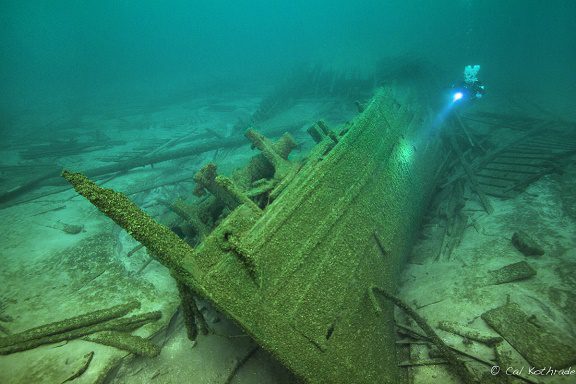
Bow of the ST. ALBANS wreck with diver
These photos are the fruits of two separate dives on the ST. ALBANS over the span of a couple years. The wreck sits about seven miles east of Milwaukee in approximately 165 feet of water. On both occasions, I was blessed with excellent visibility, somewhere in the neighborhood of 65 to 85 feet. This is not so rare at these depths, though diving the Great Lakes is akin to playing the lottery, sometimes you win more money than others, but you’ll never ‘win’ if you don’t dive.
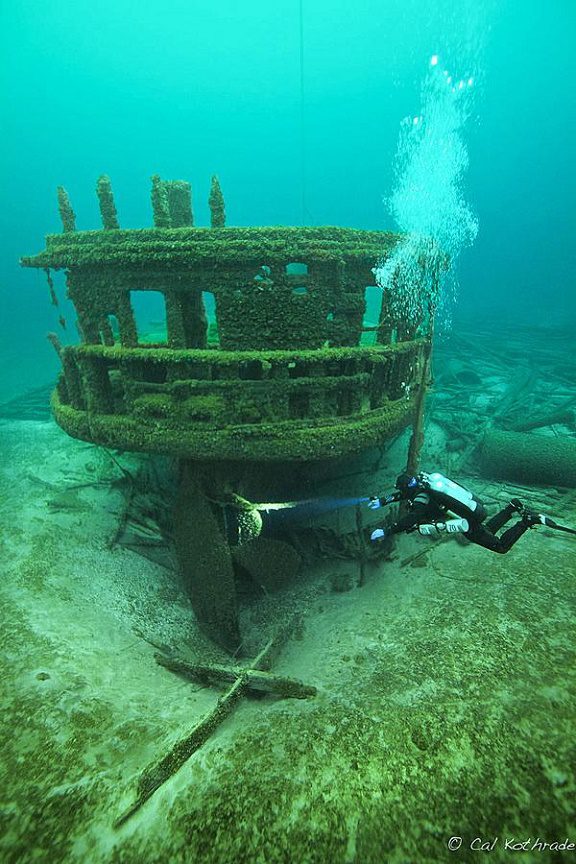
Stern of the ST. ALBANS wreck with diver
Different factors conspire to move visibility from bad to good in the Great Lakes. Things like wind, rain, currents, temperature, storms, and seasons all have some effect on water clarity, especially the closer you get to the surface.
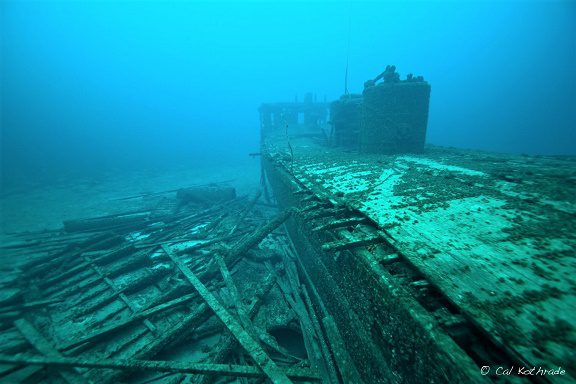
Deck view of the ST. ALBANS wreck
The ST. ALBANS is a wonderful dive site due to it still being in great condition, save for a section just aft of the bow that has collapsed since it’s sinking. The stern still sits upright and displays the rudder, prop, engine and assorted other hardware including a capstan on the aft deck. The lake bottom here is pretty darn flat and really showcases the vast expanse of the debris field, including the smoke stack lying on the bottom, just off the starboard side of the stern. There is little to no opportunity on this wreck for penetration. Both anchors were salvaged by Milwaukee area divers in the ’70’s, prior to the Abandoned Shipwreck Act of 1988, which made this type of activity illegal.
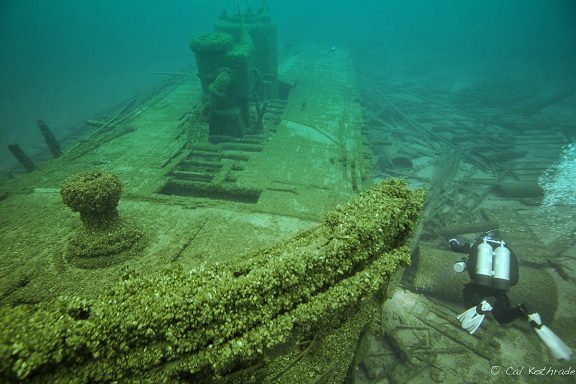
ST. ALBANS wreck showing capstan
I shot these images with a Canon T1-I cropped sensor digital camera body, Canon 10-22 mm super-wide rectilinear lens, inside an Ikelite housing using natural light. Cal Kothrade.
Suzette Lopez
Cal Kothrade is the Shipwreck Ambassador and a Board of Trustee member of the Wisconsin Marine Historical Society, a diver, a photographer and an artist. His work can be viewed at www.calsworld.net
Photo Credit:
Above water – Great Lakes Marine Collection of the Milwaukee Public Library and Wisconsin Marine Historical Society.
Underwater – Cal Kothrade
