By James Heinz
Chicago in the 1920s was a tough place. The Prohibition bootlegging wars were raging. So were the Chicago Circulation Wars, wherein the two leading newspapers each hired thugs to attack their competitors’ distribution networks, killing 27 people. At the same time the Chicago Taxi Wars were also happening, in which the city’s taxicab companies shot it out with each other.
It therefore shouldn’t come as much of a surprise that something as mundane as sand and gravel would also result in violence.
Construction was also booming, with a great demand for sand and gravel. The Material Service Corporation operated a gravel quarry at Lockport, Ill., and they decided to build a ship to move their material around Chicago’s waterways and to other Great Lakes ports.
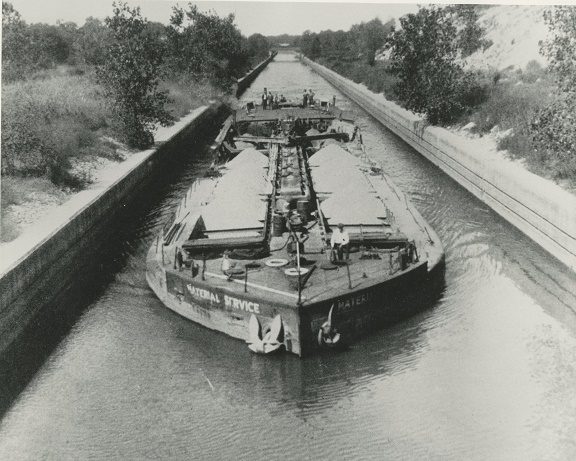
WMHS files show that in 1928 they launched the MATERIAL SERVICE at the Leathem D. Smith shipyard in Sturgeon Bay, Wis. She was 240 feet long, 40 feet wide, and displaced 1,077 tons. To avoid complaints from irate motorists, MATERIAL SERVICE was built to pass under all the bridges on the Chicago waterway system. She had only a small pilot house protruding from her deck at the stern, where the crew’s quarters were, and she was only 14.5 feet high.
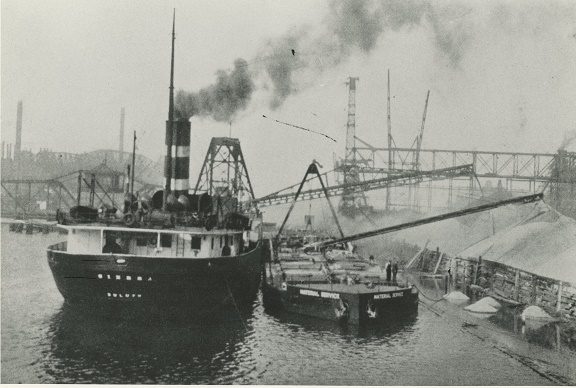
MATERIAL SERVICE at the Material Service Corp wharf, Ewing Ave, Calumet River with SIERRA 1929
She was powered by two 6 cylinder diesel engines, and had twin rudders as well as eight holds and four hatches secured by steel covers. She also had a self-unloading rig positioned by an A frame crane that could be lowered to the deck.
At 8 am on November 30, 1930, the MATERIAL SERVICE exploded.
The ship was on the Sanitary and Ship Canal when a bomb exploded in the stern, injuring 8 crewmen, including the captain, and killing one. The bomb caused $10,000 in damage to the galley, crew’s quarters, pilot house, engines, and steering gear.
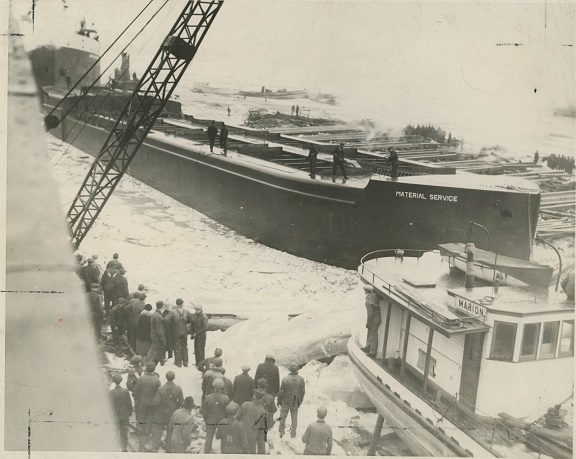
MATERIAL SERVICE with the MARION
Although the case was never solved, investigators concluded that the bomb had been planted by rivals of the Material Service Company who were concerned that Cook County politician Anton Cermak might steer contracts to Material Service.
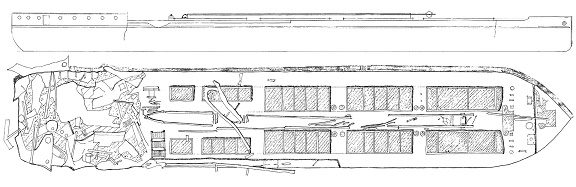
Drawing of the wreck of the MATERIAL SERVICE courtesy of Valerie Van Heest
The book LOST AND FOUND: LEGENDARY GREAT LAKES SHIPWRECKS by Valerie Van Heest tells us that “on July 29, 1936, the MATERIAL SERVICE sailed out of the mouth of the Chicago River and turned south towards the mouth of the Calumet River. The ship was not required to use hatch covers as long as it remained within the inland waterway system. Captain Charles Brown disregarded the requirement that she use her hatch covers when she sailed into Lake Michigan.
“Off the Hyde Park water crib the winds and waves picked up. The second engineer discovered two feet of water and rising in the bilges. He started two pumps and asked the second mate for permission to use the sand sucking pump, but the mate said that nothing was wrong, and also ordered the A frame to be raised to facilitate unloading.
“At 1:20 am the ship suddenly lurched 45 degrees to port and stayed there. Water started pouring into the holds and down the stern hatchway to the crew’s quarters, trapping at least 4 crewmen below.
“Even escaping the sinking ship did not guarantee survival. A young wheelsman recalled, “I saw my father go down with one hand in the air.” Another crewman tried to keep Captain Brown afloat as he thrashed in the water. The captain’s last words were, “It was those damn hatches.” Of the twenty two crewmen, 15 of them died in the sinking.
“The court of inquiry agreed with the late Captain Brown as to the cause of the sinking. The insurance company did not. Their investigation revealed that 48 twelve inch unauthorized holes had been cut into the hatch covers to facilitate loading, which the insurance company said was the cause of the sinking, and it refused to pay the claim.
“The ship settled on an even keel in 38 feet of water off the Calumet breakwater with the top of the A frame sticking above the waves. A salvage attempt failed to raise the ship, possibly due to the unrecorded holes in the hatch covers. The wreck was sold to another company which also unsuccessfully tried to raise the wreck.”
Tragedy would continue to stalk those connected to the MATERIAL SERVICE. In 1933 then Mayor of Chicago Anton Cermak died when an anarchist who was attempting to assassinate President-elect Franklin Delano Roosevelt shot and hit Cermak instead. His supposed last words to FDR were “I’m glad it was me, not you.”
MATERIAL SERVICE builder Leathem D. Smith died in 1946 when his sailboat sank in Green Bay. Three died in the sinking, one of who was a crewman who had survived the sinking of the MATERIAL SERVICE.
In the 1960s sport scuba divers discovered the wreck and badly damaged it until protected by the State of Indiana. It remains a popular dive site due its depth and convenient location.
——————————–
James Heinz is the Wisconsin Marine Historical Society’s acquisitions director. He became interested in maritime history as a kid watching Jacques Cousteau’s adventures on TV. He was a Great Lakes wreck diver until three episodes of the bends forced him to retire from diving. He was a University of Wisconsin – Milwaukee police officer for thirty years. He regularly flies either a Cessna 152 or 172.
Wreck drawing courtesy of Valerie Van Heest
Photo Credit: Great Lakes Marine Collection of the Milwaukee Public Library and Wisconsin Marine Historical Society.
