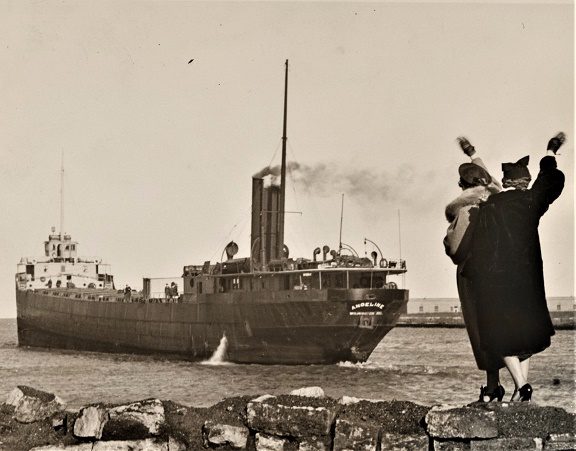
On this day April 8, 1937, the ANGELINE was the first of the winter fleet to leave Milwaukee after wintering at the Milwaukee Western Fuel Company’s Commerce Street Dock just north of the Holton Street Viaduct. She was headed to Escanaba to begin her season with a load of iron ore.
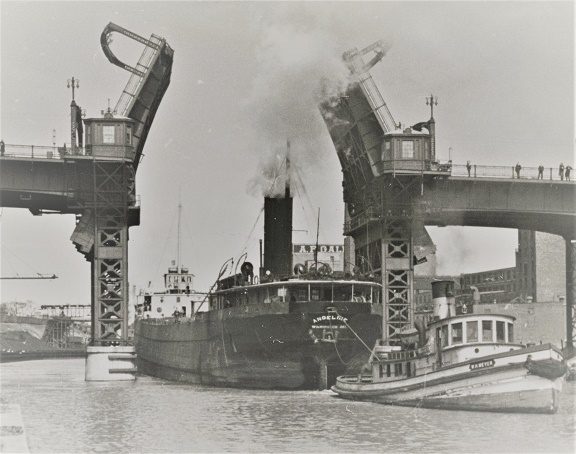
ANGELINE, April 8, 1937 at 300 pm, in Milwaukee River backing through the Holton St Viaduct with help of tug W. H. MEYER
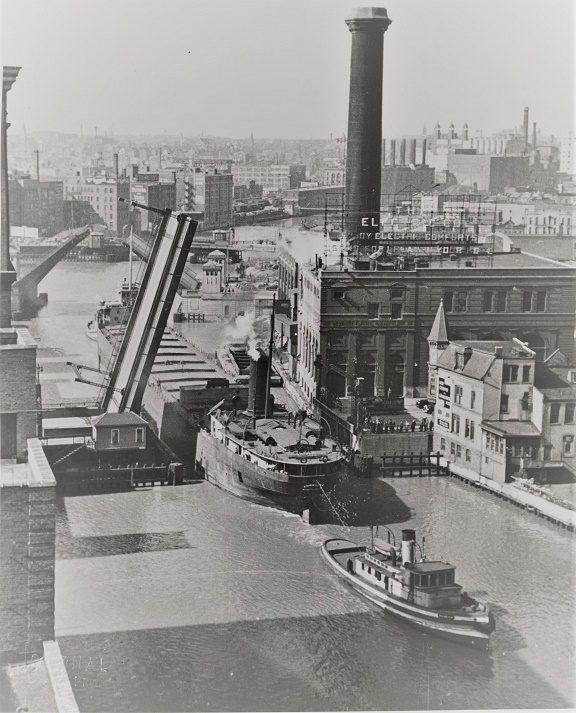
in the Milwaukee River backing through the Wells St Bridge
As you can see from her journey through downtown Milwaukee that day, she commanded attention as she squeezed through the Holton Street Viaduct and the Wells Street Bridge. It was a beautiful sight to see her backing down the Milwaukee River with the help of the tug W. H. MEYER. Of course, if you were in your car or on a bus waiting for the bridge to go back down, you probably had other thoughts.
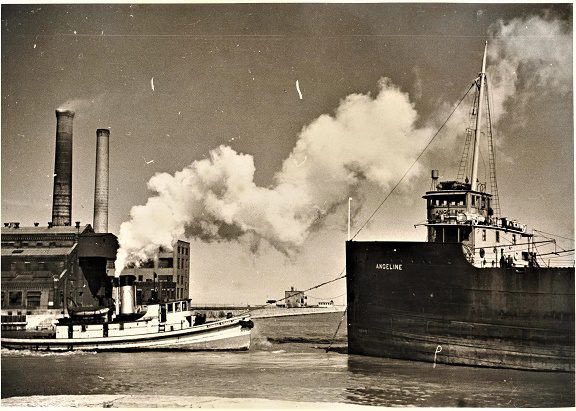
leaving Milwaukee on April 8, 1937 at 410 pm for Escanaba
The ANGELINE was launched on September 4, 1899, from the Detroit Shipbuilding Co.’s Wyandotte yard. Owned by the Presque Isle Steamship Co., she was billed as one of the largest and finest steel freighters on the lakes. She measured 423 feet in length, 51 feet in beam and 28 feet in depth and could travel at a speed of 12 miles per hour.
In 1950 she was transferred to the Cleveland Cliffs Steamship Co. who sold her in 1955 to Primo Lake Ship Co. of Buffalo, a subsidiary of Continental Grain Co. After 56 years, she was retired from active service and used as a floating grain storage facility in Buffalo’s harbor.
ANGELINE came out of retirement in 1956 and was used again as a steamer in the bulk trade for the Midland Steamship Line of Cleveland. But was once again returned to the inactive service of storage in Buffalo after the 2 year charter was over.
She was sold for scrap to Marine Salvage Ltd. of Port Colborne in 1962 and then to the Steel Company of Canada in Hamilton, Ontario, in 1964, where she was finally scrapped in 1965.
Suzette Lopez
PHOTO CREDIT: Great Lakes Marine Collection of the Milwaukee Public Library and Wisconsin Marine Historical Society.
