
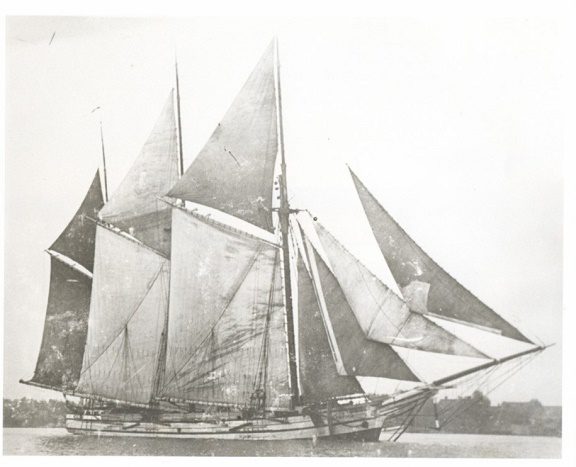
On this day April 17, 1869, the two masted schooner LAKE FOREST was launched by Thomas Spear at Little Sturgeon, Wis. Built for Bailey & Vincent she boasted spreading 3,400 yards of canvas. She was well built, a good worker and lasted over 35 years. A great history of her was written by Walter Hirthe in his book Schooner Days in Door County. A book that can be bought through the Wisconsin Marine Historical Society if you want to read more great Door County schooner history.
Hirthe was a great schooner researcher and historian. Here is his story on the LAKE FOREST.
“The amount of lumber cut at Little Sturgeon Bay during 1867 was 4,500,000 feet. A lath and shingle mill were added during the winter of 1867-68, and the gristmill was improved. Gardner sold the mill property, including the steamer OZAUKEE, to Erastus Bailey and Tristam Vincent in February 1868. Preparations for the building of another large vessel began at Little Sturgeon in the summer of 1868. The new schooner was being built for Messrs. Bailey and Vincent by Thomas Spear and Son to be finished in time for the opening of navigation the next spring. She was built sharp forward with a clean run aft to be a staunch, fast vessel. The schooner was launched on April 17, 1869, and named LAKE FOREST in honor of the city in which the owners lived. She looked well in the water, and it was felt that her 3,400 yards of canvas, together with her clean run, would make her one of the fastest schooners on the lakes. The LAKE FOREST left for Chicago early in May with a cargo of lumber under the command of Capt. R. J. Stubbs. Gardner officially acquired the schooner on March 19, 1870, but sold her two days later to Henry S. Halsted of Chicago.
“Predictions about her speed proved correct. On Wednesday evening September 22,1875, the LAKE FOREST left Chicago, loaded 353,000 feet of lumber at Whitehall, Michigan, and departed for Buffalo on Sunday morning. She arrived at her destination Wednesday night, making the whole trip in a little over seven days. In October 1876, the LAKE FOREST was reported to have made the run from Sheboygan to Chicago in nine hours, but as is the case for all modes of transportation, the price of speed is often disaster.
“A year later, the schooner with CAPTAIN NELSON, was bound from Buffalo to Chicago with coal in an easterly gale with fog and a heavy sea. She struck on Thunder Bay Island Reef one mile due south of North Point, Lake Huron, at 11:30 A.M. on October 10, 1877. The wreck was discovered by Keeper J.S. Matthews of Life-Saving Station No. 4 (Thunder Bay Island), who started to her assistance with the lifeboat and a crew of eight men. By the time they reached her, the schooner had jumped the reef and anchored, leaking badly. Her rudder had been carried away, sails split, and bulwarks stove in. One of the ten men on board, Peter B. Olson, had been killed by the falling of the foreboom when she struck, and the other nine were completely exhausted from pumping. Since the vessel was already sinking, the lifeboat crew relieved the men at the pumps to keep the Lake Forest from going down.
“Shortly afterward, Captain Nelson boarded the lifeboat and started for Alpena, about 5 miles distant, to procure the services of a tug and fresh men to save his schooner. On the way, the schooner J. B. KITCHEN was observed 4 miles away flying signals of distress. She was bound for Cleveland from Fayette, a furnace town on the Garden Peninsula of Upper Michigan, with pig iron and a crew of eight. The KITCHEN was leaking, her booms and gaffs were broken, her canvas was blown away, and her exhausted crew had water in the hold gaining on them. The lifeboat headed for the KITCHEN, took off Captain Herington, and bore away for Alpena, where the two captains engaged three tugs to assist their schooners.
“They steamed out under cover of land for North Point, with the lifeboat in tow and fresh men to relieve the crews at the pumps. The sea was running so high between the point and the stranded vessels that the tugs were unable to reach them, but the lifeboat succeeded in getting alongside each schooner and transferring the men. Both craft were safely brought into the harbor by the tugs the next morning, the sea having subsided somewhat. The estimated amount of the loss to the LAKE FOREST and her cargo was $3,000; for the KITCHEN the amount was $1,000. The LAKE FOREST had to receive nearly an entire new keel at Chicago before she could be returned to service.
“During September 1880, the LAKE FOREST, Capt. H. H. Kramer, accomplished one of the fastest, if not the fastest, trips on record during the previous 25 years. She left Ford River, Michigan, about 7 miles south of Escanaba, on a Tuesday evening with 500 tons of ice and reached Buffalo at 9:00 P.M. Friday, making the trip in exactly three days. To our knowledge, the only run to which it can be compared was made by the barque CANADA in 1854, when she sailed from Chicago to Buffalo in three days and eight hours.
“If the colloquialism “leaker” did not originate with sailing ships, it should have. After years of exposure to the forces of wind, water, and ice, which worked their wooden hulls and tore out the caulking, they leaked continuously and had to be pumped out constantly, usually by hand-operated bilge pumps. The U.S. Life-Saving Service came to the rescue of the leaker LAKE FOREST at least twice in her later years. On April 26, 1902, about three weeks after the schooner had been sold to James E. Erickson of Milwaukee by James T. Johnson of Chicago, she was sighted by the lookout of the Frankfort Station 4 miles to the north flying a distress signal. The station crew pulled to the schooner at once and followed her into port. The LAKE FOREST had sprung a leak en route to Milwaukee from East Tawas, Michigan, and the crew had become exhausted at the pumps trying to keep her afloat. She was loaded with cedar logs and had 4 feet of water in the hold. The lifesavers pumped the schooner out and returned to the station after making arrangements to provide further assistance if the master, Captain Ketteas, should signal. While lying at a wharf near the Old Chicago Station on October 21, 1904, leaking badly, with her crew exhausted from incessant pumping, Capt. James E. Erickson requested assistance. A crew of surfmen pumped her out and assisted her to the dock, where she was to discharge a cargo of lumber from Manistique, Michigan. At the time, the LAKE FOREST was valued at $4,000 and the cargo at $4,200.”
Suzette Lopez
Photo Credit: Great Lakes Marine Collection of the Milwaukee Public Library and Wisconsin Marine Historical Society.
