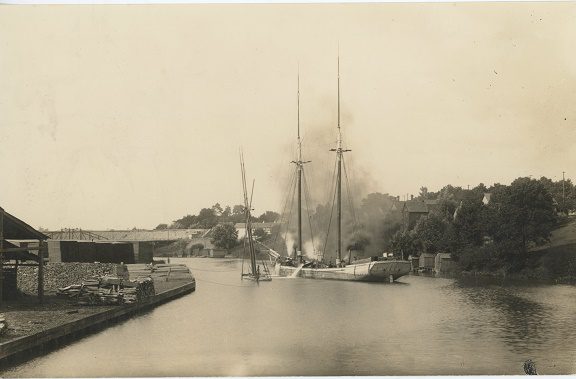
On this day, April 20, 1893, the two-masted schooner KEWAUNEE went ashore about a quarter mile north of the Racine harbor. The story of her crew’s rescue and the battle for the lumber which washed ashore is a great read and is below. The photo above is a scene from Racine’s Root River in May of 1893. That is the C & NW RR bridge in the distance. The KEWAUNEE is being pumped out after the gale of April 20th put her ashore. It took tugs about 12 days to finally release her. The schooner MOUNT VERNON is lying alongside her and was abandoned there.
The KEWAUNEE was built in 1866 at Port Huron, Mich., by J. P. Arnold for Murray & Slanson of Racine, Wis. She measured 125 feet in length, 27.3 feet in beam and 8.2 feet in depth
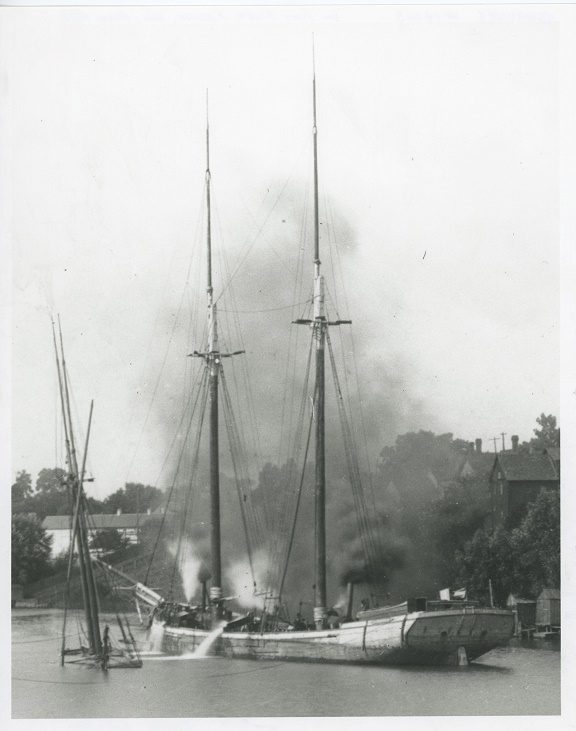
KEWAUNEE, May 1893 in Racine’s Root River being pumped out
The following lengthy article from the Racine Journal of April 26, 1893, tells of the rescue on April 20th of the KEWAUNEE’s crew by using the breeches buoy. The story details how that kind of rescue was no walk in the park.
KEWAUNEE DISASTER
“A short time after this, the schooner KEWAUNEE was sighted and had her signal up for a tug, but by this time the seas were running mountains high and Capt. Knudson of the GILLEN knew that it would be folly to make an attempt to go out and bring her in, on account of the shallow water and so the vessel came to anchor directly east of Hubbard street and north of the harbor piers.
“The vessel was laden with lumber, the anchorage was good and she appeared to ride the seas gracefully. It was hoped that the weather would moderate along toward evening, but it did not. Instead it increased in violence and when night fall came on there was a thirty mile gale blowing from the east and such seas had not been seen at this port for thirty years.
“Captain George Breckenfeld and his gallant crew, of the Racine Life Saving station, were up and on the alert and when the weather was not too thick, kept the KEWAUNEE in sight.
“All through the early part of the night the wind would blow in squalls. But at midnight it was blowing a perfect hurricane and accompanied by rain and it was impossible to see thirty rods distant. At 1 o’clock this morning it cleared up a little and the KEWAUNEE was still at anchor and apparently in no danger. Then it thickened a little and the boat was lost sight of.
“At 2 o’clock Captain Breckenfeld and one member of his crew patrolled the beach as far up as the brick yards, but could not even catch a glimpse of the KEWAUNEE or any other ship that might be out and they returned to the station.
“It was 3 o’clock when the rain let up for a short time and then the lifesaving crew made the discovery that the KEWAUNEE was on the beach, directly east of Hubbard street, and the crew could be seen huddled on the fore part of the ship. With all the haste possible the crew summoned John Geb, who, with his team, hauled the lifesaving apparatus to the shore opposite the stranded boat.
“It was just a quarter of 5 o’clock when the mortar was in position and ready to fire a line to the KEWAUNEE and the crew were not astir and ready to catch it. Boom, sounded the mortar, but the line broke. Then another shot was fired and again the mortar line broke and things began to look discouraging. By this time a large crowd had gathered on the shore and were eager to assist. They had been awakened by the firing of the mortar. A third shot was fired and this time it went true to the mark and struck the vessel across the bows.
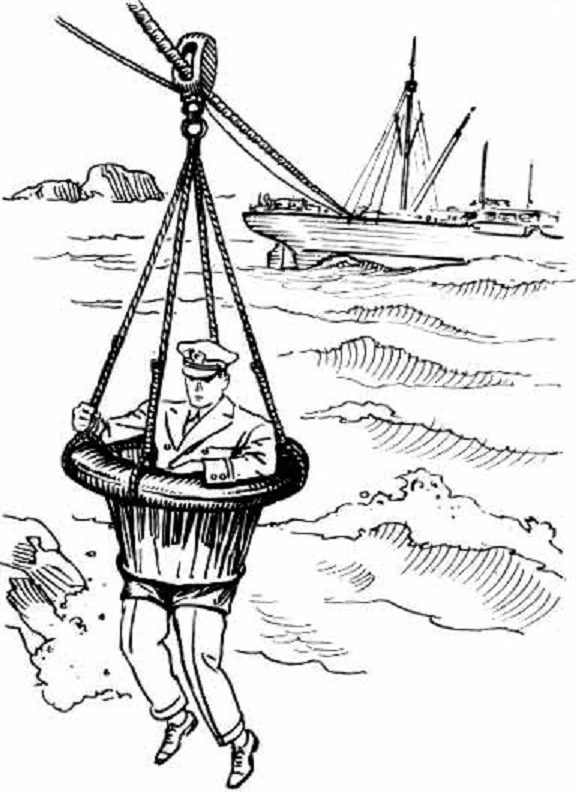
Breeches Buoy in calm seas and working perfectly. Courtesy of Wiktionary.
“In a short space of time the crew had made it fast to the cross trees of the foremast and then willing hands on shore assisted in hauling the large line out. It was made fast to the mast and the breeches buoy was hauled out. But it became twisted and it was with great difficulty that the sailor could manage to get near it.
“The first man to attempt to get in and come ashore was Seaman John Christianson, and he was obliged to climb hand over hand on the main line to get in, but he succeeded and down he shot. Upon nearing the shore, the lurching of the vessel gave slack to the line and the sailor went down into the cold and angry water, but he was hauled to land, much exhausted and was immediately taken in hand and given stimulants and then taken to John Korzelius for food and dry clothing.
“Again the breeches buoy was sent out and this time John Sauerville, the cook, came in and he too was in an exhausted condition, not even having on a suit of oil skins. He too was cared for and sent to the home of Captain Breckenfeld, of the lifesaving crew.
“Peter Greenwald, the second mate, was the next man to get into the breeches and he too was landed safely after getting a ducking, and in fair shape.
“Captain William Steed, was the fourth one to come in and he appeared to be the most unlucky one of all, for just as he reached the breakers he went down and was completely submerged by the chilly waters and lost his hat, but he was landed and could hardly walk on account of his wet clothing. Stimulants were offered the old navigator as he walked up the shore, but he said, “No sir, I have no use for whisky nor any man who uses it.” The captain even refused a dry cap offered him and displayed the pluck of a pure blooded old English seaman. He walked to his home on Lake avenue, disrobed himself, partook of hot coffee and food and was soon in bed and sleeping.
“The fifth man landed was Andrew Amundson, the first mate. Like all the rest he was ducked in the breakers, but after partaking of stimulants he went to work assisting the life savers.
“Chris Neidten, a seaman, came in next and he was lively as a cricket and assisted in the work of landing the others.
“John Jackson, another seaman, came to land next and was in good shape and went to work.
“The eighth and last man to leave the ship was Andrew Olsen, a strong and healthy looking young seaman and he was the freshest of them all. He was a fine looking young man and did not seem to be suffering from the terrible exposure.
“All of the crew left their clothing on the boat and will recover the same when the wind goes down.
“At 12 o’clock the whole crew was able to be about and did not seem to be troubled in the least.
“First mate Andrew Amundson was seen by the Journal reporter and he said that the KEWAUNEE left Manistee, Mich., Tuesday afternoon about 5 o’clock with a cargo of 215,000 feet of mixed lumber, consigned to Kelley, Weeks & Co. They had a fair run across the lake and when off the harbor signaled the tug, but as the GILLEN did not come out, the captain knew that it would be folly to attempt to reach port on account of the terrible condition of the river and the shallow water, and so came to anchor.
“Only the large anchor was cast over as it was thought the boat could easily ride out the storm. Everything went all right until about 1 o’clock this morning, when it was noticed that the vessel was gradually dragging toward the shore. But the anchor caught and no farther fear was apprehended. Ten minutes later, however, the wind commenced to blow a perfect hurricane and the seas piled over the staunch boat from bow to stern and then it was feared they could not weather the storm. At exactly five minutes of 2 o’clock the anchor chain parted, and the boat whirled about like a top and was soon broad side on the beach, bow to the south and stern to the north. The small boat was washed away and the deck load commenced to wash away.
“The crew took to the rigging and clung for over one hour, exposed to the terrible wind, rain and seas, the water going over them every minute. It became so cold that they could stand it no longer and all hands crawled to the forecastle and remained there until the vessel filled with water. Then they came on the fore deck and the live saving crew rescued them and it was a splendid piece of work and Capt. Breckenfeld and his crew are entitled to the highest praise for their hard and successful work. They were assisted by Nels Johnson, the coal and wood merchant, Captain James Easson and others.
“Hundreds of people flocked to the lake shore when it became known that the vessel was ashore and they stood in the driving rain for hours watching the waves carrying away the deck load and a portion of the cabin went. The lumber would no sooner strike the beach than men, women and children would lug it up hill and it was necessary for Kelley, Weeks & Co. to send men over to stop the pirates.
“The KEWAUNEE was built at Port Huron in 1886 and cost about $20,000. But with the depreciation of vessel property her value suffered. Her first owner was Mr. Arnold. For years she was commanded by Captain William Byron and upon his death Captain Steed became captain. She is at present owned by James H. Kelley and his son Frank Kelley and they value her at $5,000. Her rating is B 1. A few years ago she was rebuilt and this spring she was recaulked and received new canvas. There is no insurance on the craft. The 20,000 feet of lumber on board is valued at $3,500 and is not insured. It was shipped by the State Lumber company and did not belong to Kelley, Weeks & Co., until landed on the dock so the loss falls on the State company.
“The boat lays on a sandy bottom and it is believe that she can be rescued when the storm subsides, but she will be badly wrenched and damaged.
ROW ABOUT LUMBER
“When the lumber from the KEWAUNEE was cast up by the waves, some six thousand feet landed on the sand lots of James Cape and much more landed on adjoining property. B. F. Weeks, of the firm of Kelley, Weeks & Co., and some of the yard men went over with teams to recover the lumber, but imagine their surprise when Mr. Cape and his son Albert refused to let them enter the premises and remove the lumber. Mr. Weeks offered them $10, but it was refused and $75 was demanded, which was pronounced outrageous. When Albert Bath attempted to enter the land, Albert Cape threatened to shoot him and Bath says he placed his hand on his hip pocket. James Cape was armed with a scantling and hot words ensued between him and Mr. Weeks, and Mr. Cape told him that all that saved him was his age and it was thought for a time he would strike Mr. Weeks with the weapon.
“A large crowd was present and Mr. Cape and his son were denounced in severe language for their action, especially as the time of a bad ship wreck, but they held to their decision and would not allow any person to remove the lumber.
“This unusual action on the part of Mr. Cape and son was ascertained to be for revenge. It appears that last year Mr. Cape was digging a sewer on Lake avenue. He proposed to dig up Second street and not leave a passage for teams. Messrs. Kelley, Weeks & Co., insisted that a road way should be left. This required tunneling under the road and Mr. Cape said that it cost him $50 extra, and that now he had a chance to get even and that was why he demanded $75 for allowing teams to enter his sand lots. He said openly to Mr. Weeks and Mr. Frank Kelley that it was for nothing else, but revenge. What will be done in the case has not yet been decided, but no doubt the owner of the lumber will arrive from Michigan and bring Mr. Cape to time. “
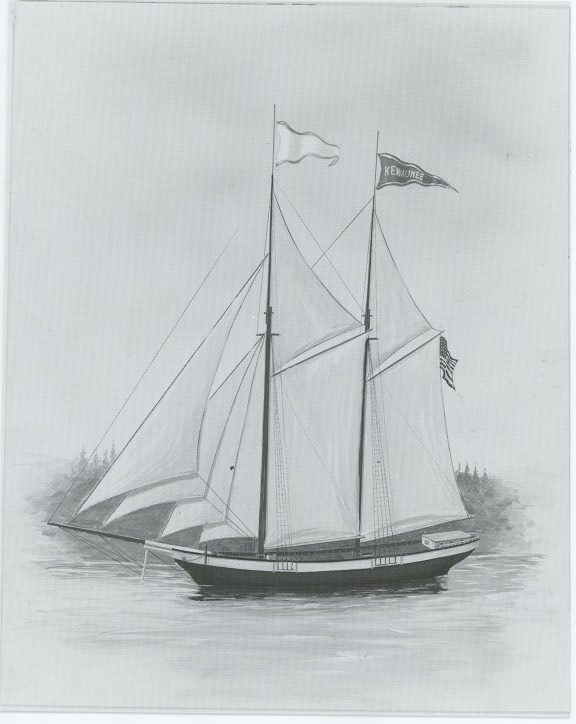
Painting of the KEWAUNEE
The following is a follow up on how the lumber disagreement was settled and appeared in the Racine Journal Times on April 21st.
“The action of James Cape & Son, in refusing to allow Kelley, Weeks & Co., to remove lumber which had floated ashore on their sand lots, has created much talk. It was a question whether the Capes were right or wrong. In the eyes of the law they were right, but did they act wisely in displaying such arbitrary measures in the hour of a bad ship wreck and simply for revenge. They did not want the lumber and only acted as they did for revenge. But things took a different turn last evening. The marine law says that a keeper of a lifesaving station shall take charge of all wreckage and Captain Breckenfeld went over to the beach and took charge of the lumber and today teams entered the sand lots of Mr. Cape and hauled the lumber away, notwithstanding the demands of Mr. Cape. Had Mr. Cape refused to let the lifesaving captain on the land and take possession of the lumber a United States marshal would have been called to take a hand.”
The gale of April 20, 1893, was not the end of her. She sailed on. In April of 1921 she was sold Canadian to Mrs. Mary A. Daryaw of Kingston, Ontario, who promptly renamed her the MARY A. DARYAW. The DARYAW burned on October 15, 1927. About three in the morning at Kingston, fire was discovered in her hold. Kingston firemen were relentless in trying to save her but in the end her sails were gone as well as her cabin and the hold was severely damaged.
Suzette Lopez
Photo Credit: Great Lakes Marine Collection of the Milwaukee Public Library and Wisconsin Marine Historical Society.
