
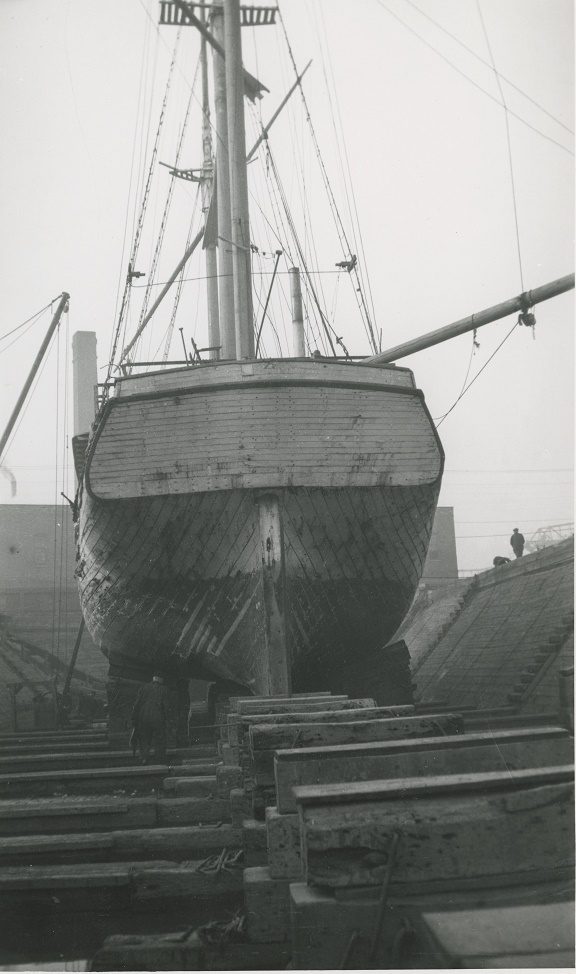
“The owners of the LILY E. abandoned her to the underwriters on Tuesday, May 29th, eight days after the stranding. They had made every possible attempt to rescue her but had not succeeded in changing the position of the wreck in the least. She was stripped, the steam pump removed , and the tug CROWELL returned to Manistee, but Capt. Blackburn still felt confident that the LILY E. could be saved as soon as a southwest sea set in so that the vessel could be worked out of the bed which she had formed in the sand.
“The underwriters met with the Milwaukee Tug Boat Company on Wednesday to formulate a new plan for the release of the LILY E. The plan proposed by the company was to have a diver patch the hull until she could be pumped out with their large centrifugal pump and released.
“The wind swung around to the southwest on Friday, June 1st, and a slight swell set in causing the LILY E. to work in the bed in the sand. Shortly after noon, the tugs WELCOME and J. J. HAGERMAN were ordered to the wreck and a hawser from each tug was made fast to the vessel. About 2 p.m., the tugs began to pull, the HAGERMAN keeping a steady strain while the WELCOME jerked. After an hour of steady work the wreck began to move and continued gradually until about 4 p.m. when she was on an even keel with her stern swung around into the channel. The tugs succeeded in getting the wreck off and into the channel shortly after 7 p.m. The LILY E. was towed into the harbor and ran into shallow water opposite Wolfe & Davidson’s main yard.
“The schooner was placed in drydock on June 3rd where temporary repairs were made, towed to a dock to discharge her hold full of lumber on June 13th and was again docked that evening. The survey of the LILY E. was completed on the next day and she was found to be so badly damaged that it was doubtful whether the underwriters could force the owners to accept her, as the wrecking bill and the cost of the repairs would be large. She required a part new keel forward, several new planks forward and aft, entire recaulking and fastening, a new stern post and rudder, and a new cabin. It had been supposed that her centerboard was badly damaged but the survey showed that only a new head ledge would be required. Her pocket pieces were found to be in good condition but she had been considerably damaged on the port side from working into the sand and several new frames amidships were required.
“The repair of the wreck was pushed and completed in about two weeks but the LILY E. remained at Wolf and Davidson because of a disagreement between M. Engelmann & Co. and the underwriters. The cost of releasing and repairing the wreck was said to exceed $5,000 while the vessel was insured for $7,500. When the owners abandoned her, they claimed that she was a total wreck, but the underwriters refused to accept the abandonment and desired that the owners pay half of the expenses which the latter most decidedly objected to. On July 2, Chris. Hansen, John Mercurt, Leverisa Johnson, John Nichel, Andrew Nelson and Edwin Gandlesen, who fitted out the vessel and were given a certificate of the amount due by the master, libeled the LILY E. for wages aggregating $110 because of the disagreement between the parties involved.
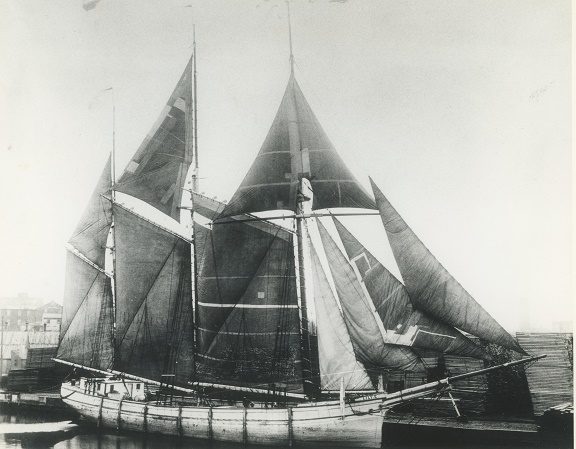
“Capt. James Riordan of Buffalo for the underwriters and one of the owners met on July 5th, but nothing definite was decided. After Mr. Engelmann arrived from Manistee, a satisfactory settlement was agreed upon between the parties, the underwriters accepting abandonment of the vessel and then selling all back to Engelmann & Co. The LILY E. left for Manistee on the evening of July 9th in charge of Capt. Brook, in far better condition than when she went on the beach.
“Although this incident was a major disaster, the worst weather of the year was yet to come with the arrival of the equinoctial gales. From November 11 to 17th, a series of gales resulted in the greatest destruction of property since the “Alpena Gale” of 1880 which damaged the LILY E. in North Bay. The loss of life was not in proportion to the loss of property in other seasons because of the efficacy of the U. S. Life-Saving Service which did not become well established over the lakes until the late 1870’s. A recapitulation of the disasters on November 21 listed 60 vessels lost or damaged and 55 lives lost with several vessels still to be heard from.
“On the morning of November 11, 1883, the LILY E., Capt. Brook, arrived off Manistee from Milwaukee with 2500 bushels of oats shipped by J. A. Bryden & Co. and a crew of eight on board. A strong southwest gale was blowing and a high sea running as she was picked up outside by the tug CAROLINE WILLIAMS of Manistee and towed toward the harbor. At 11:00 a.m. the towline parted and the LILY E. struck the pier and stranded on the beach about one-eighth mile north of the U. S. Life-Saving station. The accident was immediately discovered by the station patrol and the life-saving crew hauled the surfboat to the beach opposite the schooner. In fifteen minutes they were alongside the stricken schooner although their efforts were obstructed by quantities of drift wood. Capt. Brook and his crew with their baggage were taken into the surfboat and safely landed on the beach.
“During the afternoon Mr. Engelmann arrived and requested that Capt. Brook be set on board to supervise the securing of the schooner by running lines to the shore. This service was performed and the keeper also ordered the whip-line attached to the LILY E. so that the breeches buoy could be used in case of need. This was a wise decision because by the time the captain was ready to return to shore he could only be landed by this means as it was impossible for the surfboat to be forced through the flood-wood.
“The station crew was employed from the 11th to the 26th in saving sails, booms, etc. and trying to dredge a channel to enable a steam tug to get to the vessel. At 5 a.m. on the 26th, the LILY E. was hove off the beach into deep water but the sea began to make and rapidly grew so heavy that it was impossible for the tug which was standing by to get to her. It became necessary to scuttle the schooner in order to save her from again stranding, leaving the keeper and five of his crew with no means of escape except in the small yawl which hung from the davits at the schooner’s stern. The sea became so heavy that the yawl was torn from her fastenings and swept ashore placing those on board in a perilous position. The keeper jumped overboard at a favorable moment and succeeded in reaching the shore on some of the flood-wood.
“He hurried to the station with two other members of the crew who had been left ashore in case of their services being needed and obtained a team to rush the beach apparatus to the shore opposite the schooner.
“The first shot from the gun hurled the line between the fore and main topmasts but too high to be reached by the men on board on account of the danger in going aloft while the vessel was pounding so hard. The second shot threw the line between the fore and main masts closer to the deck where it was seized and the apparatus was soon in working order. The crew of nine was safely landed after a thorough wetting in the breeches buoy as it was pulled through the surf.
“Another attempt was made to get the LILY E. afloat on the 27th.” WOULD THIS ATTEMPT BE SUCCESSFUL? Find out in part four.
(Schooner Days in Door County, by Walter & Mary Hirthe, p 71-80)
Suzette Lopez
Photo Credit: Great lakes Marine Collection of the Milwaukee Public Library and Wisconsin Marine Historical Society.
