(Part I of III)
By John Dillon
Having grown up in Milwaukee’s Bay View neighborhood on the corner of S. Shore Drive and Iron Street, playing in what is now Cupertino Park and growing up at the South Shore Yacht Club and then buying the Ren Estes house on the corner of S. Shore Dr. and Estes St. gave me an appreciation for the history of the shore line and how it was developed. I was able to find archived nautical charts of the Milwaukee Harbor which allowed me to zoom in the Bay View shoreline.
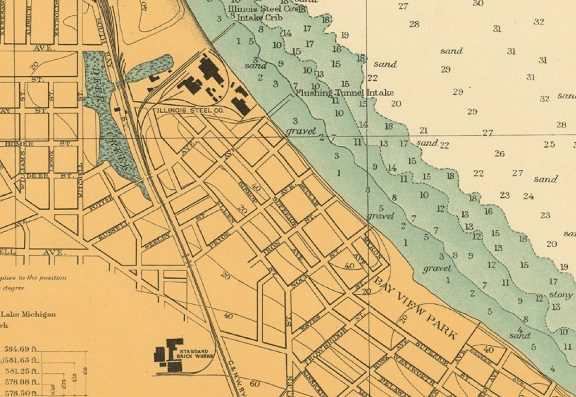
This chart is from 1912, so this is before the first breakwater (which was filled with slag from the steel mill and is now Cupertino Park) was built. The steel mill would still be in business for another 17 years. Elijah Estes had passed away 25 years ago. You’ll also see the Russell Ave. intake, Deer Creek and Bay View Park with no bath houses. The street names and layout are also interesting.
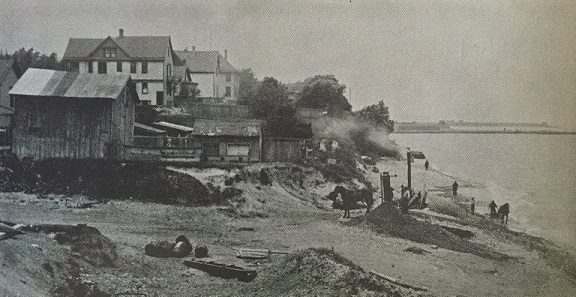
This is a photo that I believe Paul Schmidt originally posted in Vintage Bay View. This is at the end of Iron St. at the water front. This was taken well before the first breakwater was built (which is now Cupertino Park). It faces north from Iron St. and shows a gravel operation. You can see the Russell Ave. Intake in the distance and also the steel mill dock. Erosion of the shore line was a constant problem that needed to be addressed.
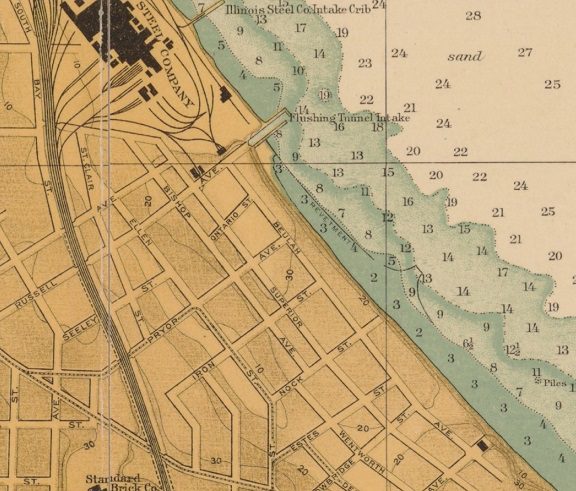
This chart is from 1916 and you can see the first breakwall in place in what is now Cupertino Park. The South Shore Yacht Club was incorporated in 1913, but at this point they were meeting in member’s homes with no permanent clubhouse. You can also see the first bath house is constructed in the lower right hand side of the chart.
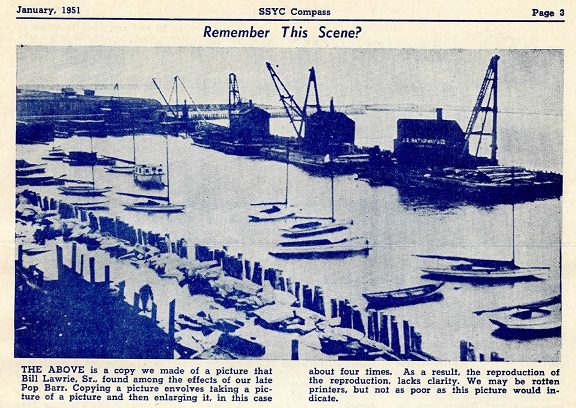
This photo that was in South Shore Yacht Clubs newsletter, shows an old photo of the beginning construction of the first breakwater in Bay View. The initial construction began at the Russel Ave. Intake. Hathaway Construction won the construction bid and began their work, however a large storm swept through causing major damage to their barges and they were unable to complete the work. The Edward Gillen Company (Gillen was a member of South Shore Yacht Club) then took the project over and completed the work.
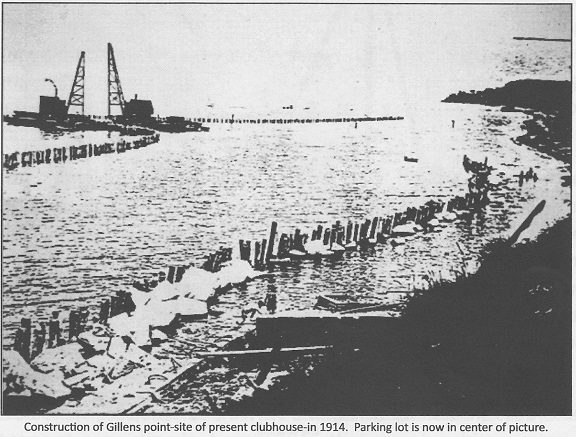
This photo is from 1914 with Gillen working on the breakwater. Gillen’s Point, which it was called, would become the site of the current South Shore YC.
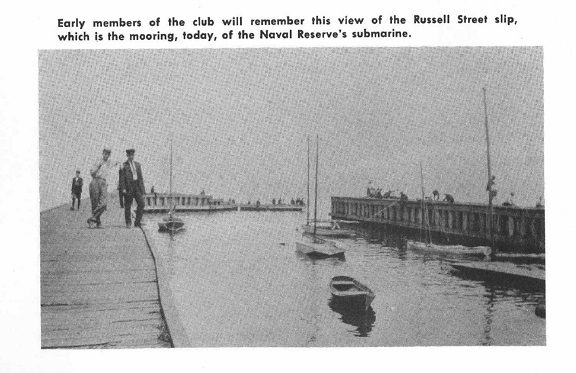
This photo shows the Russell Ave. Intake prior to the construction of the first breakwater. Because there was no breakwater the SSYC members would moor their boats at the intake. There was a small dog leg pier at the end of the intake that offered some protection for the boats moored there.
Photo at top of page
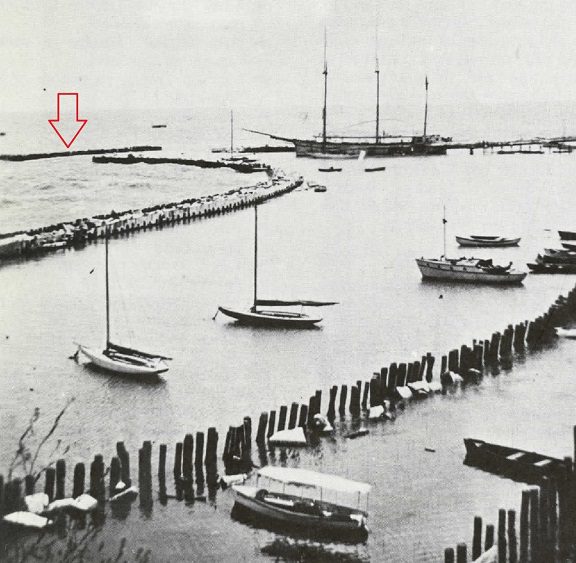
1916 was also the year when the Lily E was opened as the new floating club house located inside Gillen’s Point. The red arrow points to “Aves Feces” Island which provided two gaps in the breakwater that allows boats to pass through.
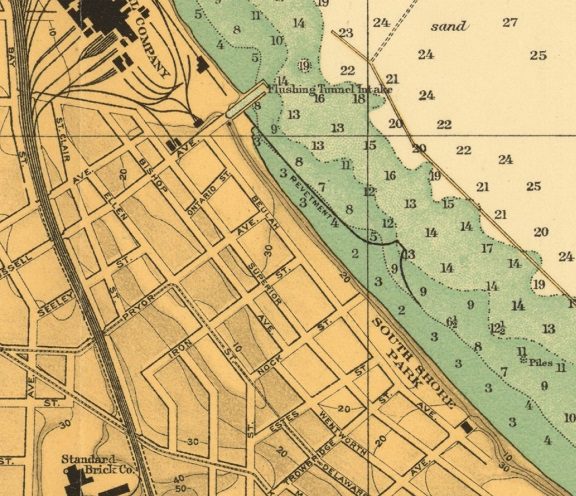
This chart is dated 1924. As you can see, by this time the current breakwater was completed and the Milwaukee Harbor concrete breakwater shown by the dashed line was being planned. The Lily E. fell into disrepair during WWI and then was battered by storms during the fall of 1921 and became an unsalvageable wreck. It was abandoned and burned in place mid-summer 1922. Its remains were left in place which is now the current fence line and parking lot of South Shore Yacht Club.
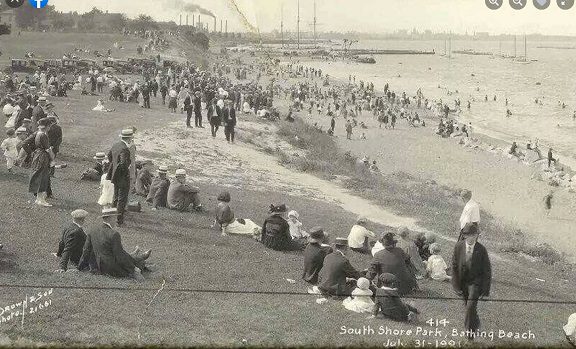
This photo shows South Shore Beach in 1921. You can also see the Lily E. in the background. The following year it would be burned in that location. You can also see a crane along the shoreline which was used to haul and put in the SSYC members boats. It’s apparent the filling in of this area started on the south end where the launching ramps are now located. In the top right portion of the photo you can also see the current breakwater being built. The rolling mill smoke stacks are in the background and it is probably the Elijah Estes house in the far left of the photo. It would also be torn town in the near future. Eight years in the future the steel mill would be shut down.
————-
John Dillon grew up just up the hill from the South Shore Yacht Club (SSYC) on S. Shore Dr. and Iron Street. At the age of 10 he joined the SSYC Junior program, took sailing lessons there and then began competitive sailboat racing which he did for the next 50 years. His interest in sailing and history started with artifacts around the house from the Rosa Belle, his great-grandfather’s schooner that ran lumber and other goods on Lake Michigan. He is now retired and living on the Caribbean Island of Bequia teaching sailing to the local youth on the island.
Photos provided by John Dillon
