
By James Heinz
In a previous article entitled “The Great Lakes Shipwreck Whose Ghosts Haunted Oprah Winfrey”, I told the tale of the EASTLAND, whose capsizing in the Chicago River in 1915 killed over 800 people in the worst disaster in the history of the Great Lakes. At the end I said that the EASTLAND would rise from its watery grave and participate in one of the most bizarre episodes in Great Lakes history.
In 1921 the EASTLAND sank a German U-Boat in Lake Michigan.
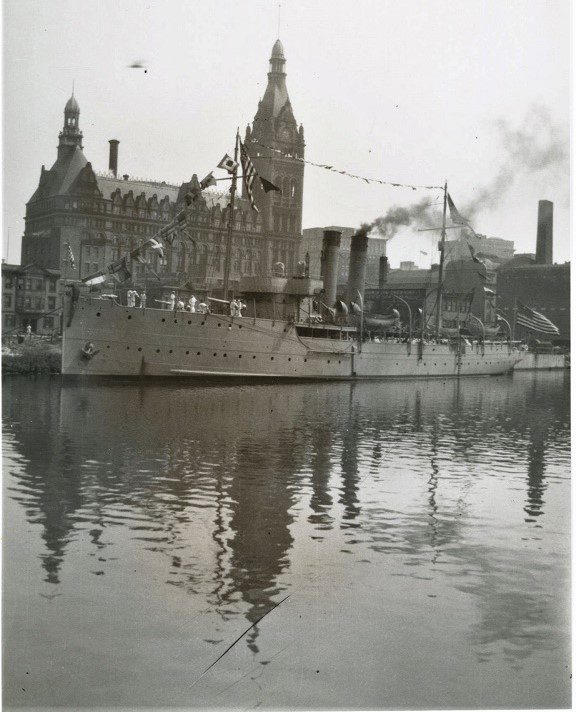
Photo at top of page – the WILMETTE in front of Milwaukee’s City Hall in 1918
Two months after the EASTLAND sank, she was raised and sold to the U.S. Navy. The Navy converted the EASTLAND into the USS WILMETTE IX-29, which was used as a training gunboat for the Great Lakes Naval Training Center in Waukegan, Ill. She was equipped with four 4 inch guns, two 3 inch guns, and two 1 pounder guns and was commissioned in September 1918, two months before the end of the War to End All Wars. The WILMETTE never left the Great Lakes and only saw action against an enemy vessel once in its life, as we shall see.
At the end of World War I, the German fleet surrendered it’s warships to the Allies. The U.S. Navy received six German U-boats. This small flotilla of U-boats was sailed across the Atlantic by American sailors, a task made more difficult because disgruntled German sailors had sabotaged them prior to the turnover.
One of these U-boats was the UC-97. She was an ocean going minelaying submarine commissioned in September 1918 and surrendered in November 1918 without seeing action. She was 185 feet long, 18 feet long, drew 12 feet of water, and displaced 483 tons. She had 2 diesel engines and 2 electric motors that could drive her at 13 mph on the surface and 7.6 mph submerged with a range of 11,340 miles. She was equipped with 6 mine tubes that could lay 14 mines, three torpedo tubes, and a 105 mm or 88 mm deck gun.
She entered the Great Lakes through the St. Lawrence River and spent the summer of 1919 making port calls in the Great Lakes to sell war bonds. By late August her machinery was no longer functioning and she was tied to the shoreline along Chicago’s Grant Park.
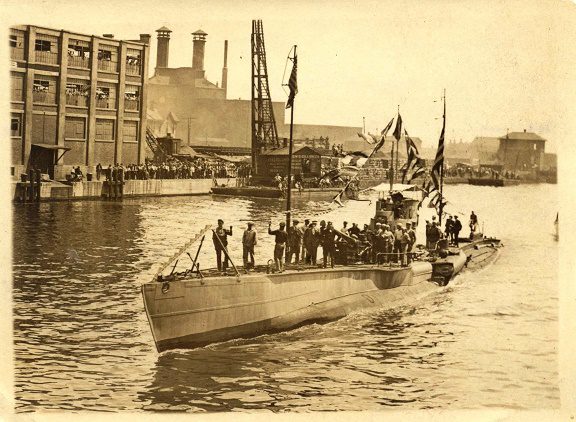
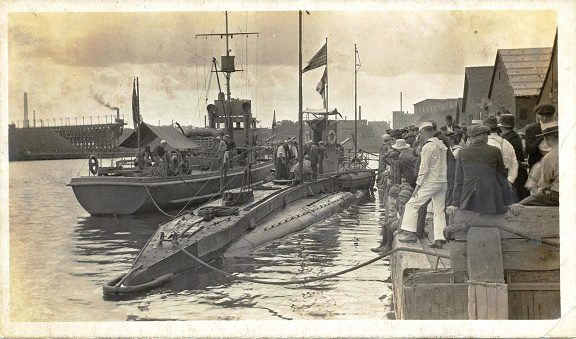
UC 97 in 1919
The treaty ending World War I stipulated that all German warships in Allied hands be disposed of by July 1, 1921. On June 21, 1921, UC-97 was towed 37 miles off Highland Park, Ill., and the WILMETTE sank her with 18 rounds from a 4 inch gun as part of Naval Reserve training.
During World War II, the WILMETTE trained naval personnel assigned as members of the Naval Armed Guard who were assigned to man guns aboard civilian cargo ships, like Milwaukee’s singing mayor Carl Zeidler, who disappeared at sea during World War II https://wmhs.org/on-memorial-day-remember-milwaukees-singing-mayor/
WILMETTE’s moment of glory came in August 1943 when she carried President Franklin Roosevelt, Chief of Staff Admiral D. Leahy, and others on a 10 day fishing trip in Whitefish Bay on Lake Superior. The ship was chosen because she still had comfortable cabins left over from her days as the EASTLAND. FDR liked to relax aboard ships, as I reported in a story about boats built on the Great Lakes that became presidential yachts https://wmhs.org/presidents-royalty-elvis-and-marilyn-monroe/
As for the ghosts of the EASTLAND, famous World War II war correspondent Ernie Pyle served aboard her for three months at the end of World War I. He reported ““It was still in sinking condition, I assure you. It constantly shied to the right, and once in a while felt as though it wanted to lie down in the water.” The ship’s desire to lie down in the water must not have been reassuring to crew members who remembered the previous occasion when the ship did just that. Pyle did not say anything about ghosts.
In 1945 WILMETTE was decommissioned and was scrapped in 1946.
Photo credit: Great Lakes Marine Collection of the Milwaukee Public Library and Wisconsin Marine Historical Society.
——————————–
James Heinz is the Wisconsin Marine Historical Society’s acquisitions director. He became interested in maritime history as a kid watching Jacques Cousteau’s adventures on TV. He was a Great Lakes wreck diver until three episodes of the bends forced him to retire from diving. He was a University of Wisconsin – Milwaukee police officer for thirty years. He regularly flies either a Cessna 152 or 172.
