By James Heinz
The Navy called them Landing Ship, Tank or LST. Their crews said that LST stood for Large Slow Target or Large Stationary Target. One of them is a museum ship in Muskegon, Mich.
Wikipedia tells us: “The design of the Landing Ship, Tank (LST) was born out of a contradictory set of requirements: the vessel needed to be highly seaworthy to cross oceans, yet possess a sufficiently shallow draft to deliver heavy armor and personnel directly onto unimproved beaches. By flooding extensive ballast tanks, the ship could achieve a deep draft for stability during ocean transits; upon approaching a landing site, the water was pumped out, allowing the flat-bottomed hull to ride high in the water and safely run aground.”
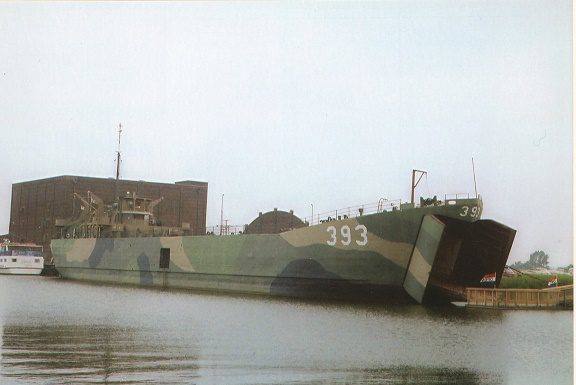
Photo at top of page: LST 393
“The bow had a large door that could open, deploy a ramp, and unload vehicles. The LST had a flat keel that allowed the ship to be beached and stay upright. The twin propellers and rudders were protected from grounding.” The flat keel made for a very difficult ride in rough weather.
When LSTs wanted to get off the beach, they pulled themselves off using a stern winch to pull them towards an anchor they had dropped during the run into the beach.
1,051 LSTs were built. One of them was LST-393. WMHS files show that she was built in 1942 in Newport News, Virginia. She displaces 2,860 tons, is 311.7 feet long, 50 feet wide, and 21.6 feet high. She had two diesel engines that could make 12 knots.
She had a crew of about 9 officers and about 110 crew. She was armed with one 3 inch gun, five 40 mm guns, six 20 mm guns, and 6 machine guns.
In her career, LST 393 sailed 51,817 nautical miles, stopping in 38 different ports, transporting 9,135 soldiers and 3,248 vehicles. She carried 5,374 enemy POWs and 817 U.S. casualties. She participated in the Occupation of Sicily and the Invasion of Italy at Salerno in 1943.
On June 6, 1944, The Longest Day, she landed her cargo of Sherman tanks on Omaha Beach. According to Wikipedia, there she stayed for the next 2 days under enemy fire the whole time due to the failure of Allied planners to fully understand the complex tides and currents of Normandy. LST 393 made 30 round trips to Normandy, as I reported in a previous story: https://wmhs.org/on-this-day-a-ship-built-in-wisconsin-led-the-normandy-invasion/ .
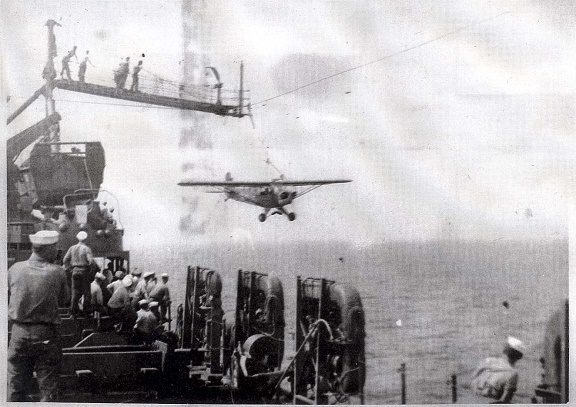
The plane hanging from a crane shows the Brodie landing system courtesy of www.lst393.org
After the European campaign ended, LST 393 was transformed into an aircraft carrier. She was equipped with the Brodie arresting system, which enabled light aircraft to land on her decks.
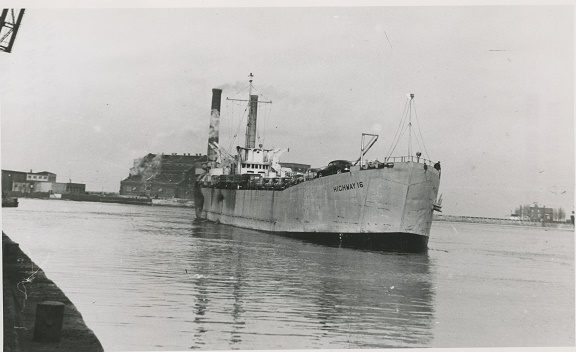
HIGHWAY 16 at Milwaukee, November 27, 1948
In 1948 she was transformed again, this time into a Great Lakes auto carrier. She was sold to the Wisconsin and Michigan Steamship Company, who brought her up the Mississippi River through the Illinois Waterway to Chicago, where her name was changed to HIGHWAY 16. Her bow doors were welded shut and she was modified to carry 195 new cars from Muskegon to Milwaukee, where Highway 16 began.
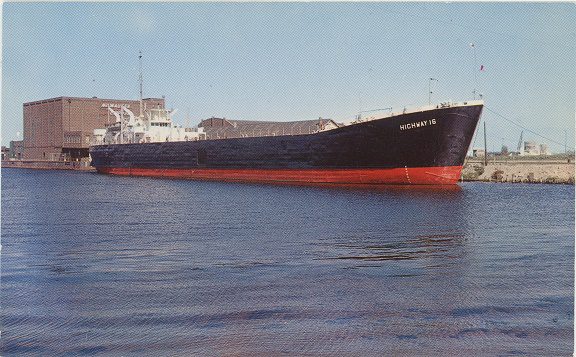
color post card of HIGHWAY 16
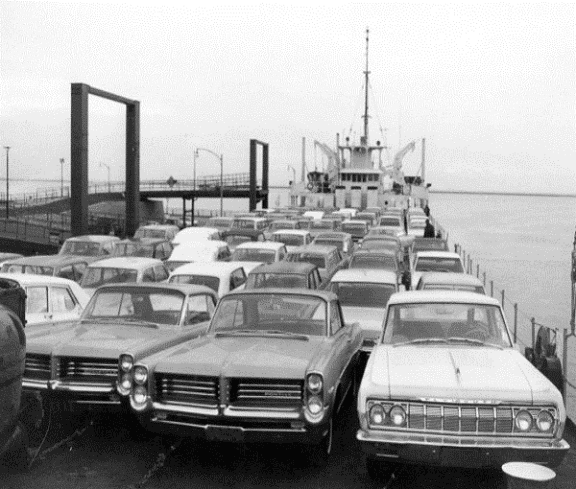
December 1963
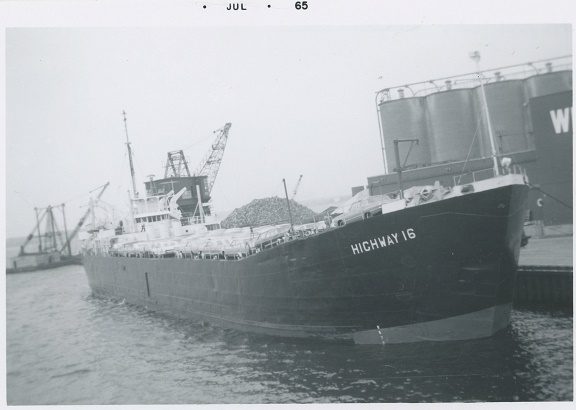
July 1965
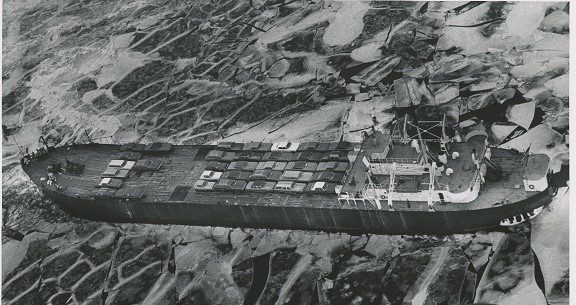
HIGHWAY 16 trapped in ice about 2 miles outside of Muskegon on February 11, 1971
Veteran Great Lakes sailors were skeptical of the experiment. One said that HIGHWAY 16 could not handle the weather of Lake Michigan, which he compared to that of the English Channel. He had apparently forgotten that as LST 393 she had already survived at least 30 round trips across the Channel. He was proven wrong when the experiment lasted until 1975.
After that she was apparently sold to the Sand Products Corp., for whom she worked until 2000, when restoration began. Today she floats in Muskegon Harbor, one of three existing LSTs that participated in D-Day. 26 LSTs were lost to enemy action in World War II and 13 to other causes. You may also read of another D-Day ship on the Great Lakes: https://wmhs.org/a-tugboat-in-kewaunee-harbor-today-participated-in-the-d-day-landings/
On this June 6, remember her and all who sailed in her, as a monument to the Greatest Day of the Greatest Generation.
———————————-
Photo credit: Great Lakes Marine Collection of the Milwaukee Public Library and Wisconsin Marine Historical Society
James Heinz is the Wisconsin Marine Historical Society’s acquisitions director. He became interested in maritime history as a kid watching Jacques Cousteau’s adventures on TV. He was a Great Lakes wreck diver until three episodes of the bends forced him to retire from diving. He was a University of Wisconsin – Milwaukee police officer for thirty years. He regularly flies either a Cessna 152 or 172.
