By James Heinz
On July 21, 1831, the whaleship MENTOR under the command of 31 year old Edward Barnard left New Bedford, Mass., with a crew of 21.
Just before midnight on May 21, 1832, in the middle of a storm, the MENTOR struck a reef at the northern end of the Palau archipelago in Micronesia. Ten men took off in one of the boats and were never seen again. Barnard and the remaining crewmen then abandoned ship in the remaining boat.
Things rapidly got worse.
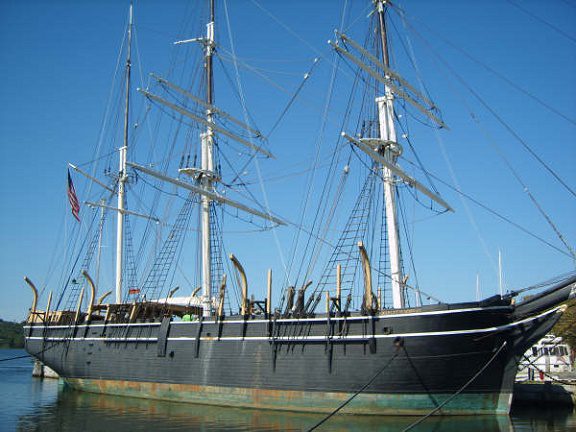
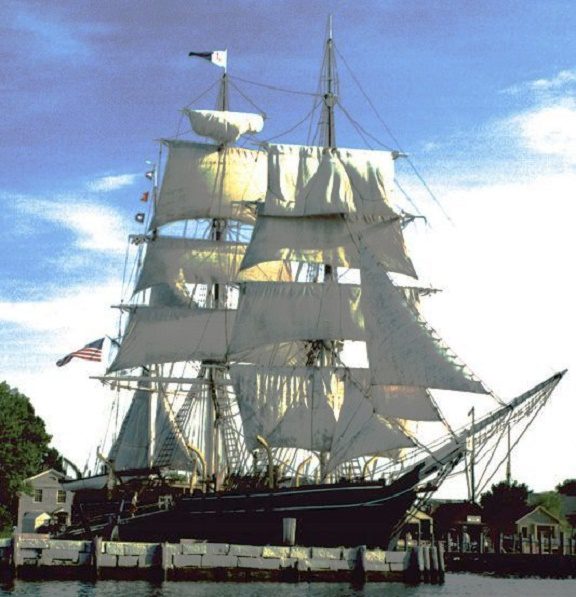
The whale ship CHARLES W. MORGAN, built in 1841, would have been very similar to the MENTOR
Approached by natives who at first seemed friendly but soon tried to hijack them, the MENTOR’s crew was able to escape in their boat to the island of Babeldaob, where they were found by another group of Palauans and taken prisoner. They were treated well, especially after they found a Royal Navy deserter who had been living on the island since 1800 who could translate.
Things rapidly got worse.
The MENTOR’s crew had landed in the middle of an ongoing war between Babeldaob and the neighboring island of Koror. In 1791 two British ships had helped Koror defeat Babeldoab. (Aboard one of the British ships was Amasa Delano, the great grandfather of President Franklin Delano Roosevelt.)
The MENTOR’s crew became pawns in a game of diplomatic tug of-war between Koror and Babeldaob, who both wanted the crew to obtain guns for them. To pacify Mentor’s crew, the Babeldaob leader promised to build a canoe for them so they could leave to get guns for him.
Months passed, and the people of Babeldaob somehow proved to be incompetent at building the same canoes that they built all the time. Eventually a canoe was constructed and the MENTOR crew left in it and their own boat at night to avoid Koror patrols.
Things rapidly got really worse.
After two weeks at sea the crew was incapacitated by exhaustion, hunger, and dehydration. They landed on the island of Tobi out of desperation. Tobi was described by one of the crew as “one of the most horrible and wretched on the face of the globe.”
The crew were stripped and made slaves, working from dawn to dusk at backbreaking labor with little food or water until they looked like walking skeletons. After two months on Tobi Barnard alone was able to escape to a passing Spanish ship, leaving the rest of his crew behind. He returned to New Bedford on August 18, 1833.
Barnard had survived everything the Pacific Ocean could throw at him, including storms, shipwreck, imprisonment, escape, dehydration, exhaustion, slavery, and malnutrition.
He would not survive a Lake Erie seiche.
Wikipedia states: “A seiche (/seɪʃ/ SAYSH) is a standing wave in an enclosed or partially enclosed body of water…Lake Erie is particularly prone to wind-caused seiches because of its shallowness and its elongation on a northeast–southwest axis, which frequently matches the direction of prevailing winds and therefore maximizes the fetch of those winds. These can lead to extreme seiches of up to 5 meters (16 ft) between the ends of the lake. The effect is similar to a storm surge like that caused by hurricanes along ocean coasts.”
On October 18, 1844, a Lake Erie seiche occurred. WMHS files tell us that the seiche was so bad that numerous ships and canal boats were driven ashore or wrecked. One of these was the schooner PENNSYLVANIA.
WMHS files show that she was built in 1836 at Lyme, New York. She displaced 109 tons and was 80 feet long, 20 feet wide, and had a depth of hold of 8 feet. The ship was sailing from Cleveland to Buffalo with a cargo of whiskey and flour.
Barnard had somehow ended up in command of her, possibly because he thought Lake Erie was safer than the open sea. After having survived the perils of the Pacific, how dangerous could a lake with an average depth of 30 feet be?
WMHS files contain reports that state “Schooner PENNSYLVANIA, Barnard, master,… foundered near Point Abino, Ont., vessel, crew and cargo totally lost, 10 lives”.
“1844 Schooner PENNSYLVANIA was wrecked on the north shore of Lake Erie and all lost, 10 lives.”
“Part of a fore-scuttle (hatch) with “Pennsylvania”, in red chalk…as well as a white eagle, supposed to be from the stern of the schooner Pennsylvania, Captain Barnard, have been picked up at this place (Silver Creek NY).”
WMHS files show that the wreck of the PENNSYLVANIA was still observable in 1865.
All of the information about the MENTOR and its crew’s adventures in the Pacific come from the book THE WRECK OF THE MENTOR by Eric Jay Dolin, available from the Milwaukee Public Library.
——————–
Photos courtesy of Wikipedia.
James Heinz is the Wisconsin Marine Historical Society’s acquisitions director. He became interested in maritime history as a kid watching Jacques Cousteau’s adventures on TV. He was a Great Lakes wreck diver until three episodes of the bends forced him to retire from diving. He was a University of Wisconsin – Milwaukee police officer for thirty years. He regularly flies either a Cessna 152 or 172.
