
Many of you have had a Thanksgiving Day experience that has remained fresh in your memory. I am sure that was the case for the 17 crew members of the CHARLES STEWART PARNELL. Not only was the dinner burnt, so was their ship – during dinner!
The CHARLES STEWART PARNELL was built in 1888 at Detroit by the Detroit Dry Dock Co. for M. J. Cummings of Oswego, New York. She was a wooden steamer that measured 256.4 feet in length, 38.5 feet in beam and 19.8 feet in depth and was used for general freight.
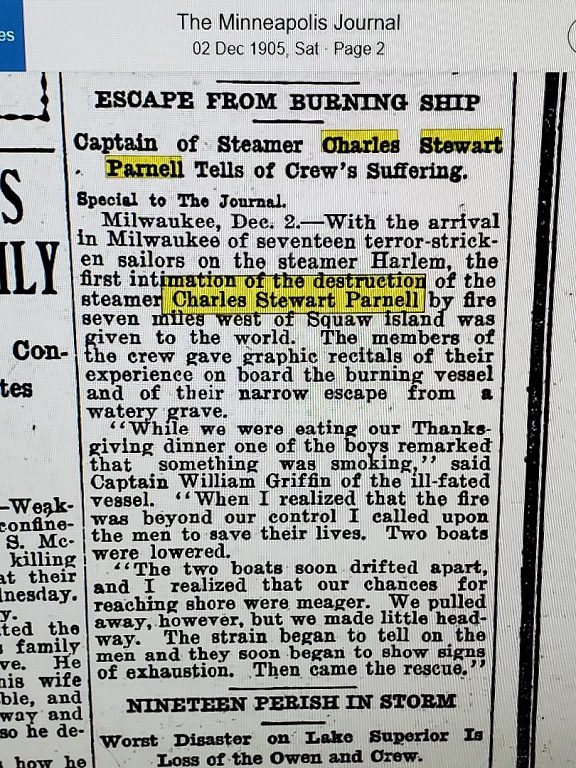
The PARNELL caught fire while the crew was eating Thanksgiving dinner on November 29, 1905, off Squaw Island on Lake Michigan. Luckily no lives were lost. Below is part of a lengthy story printed in the Milwaukee Sentinel on December 2nd describing the exciting events of that day.
PARNELL is Burned
Crew of Steamer Brought Here by the HARLEM
Seventeen Have Narrow Escape
“With the arrival in Milwaukee of seventeen terror stricken sailors on the steamer HARLEM at 2:30 o’clock yesterday afternoon, the first intimation of the total destruction of the steamer CHARLES STEWART PARNELL by fire seven miles west of Squaw island was given to the marine world. The members of the crew gave graphic recitals of their terrible experience on board the burning vessel and of their narrow escape from a watery grave. …
“The men are from Buffalo, Wyandotte, Mich., and Oswego, N. Y. The boat was making the last trip of the season and the members of the crew have all made arrangements for work during the coming winter.
Thanksgiving Dinner Disturbed
“While we were eating our Thanksgiving dinner one of the boys remarked that something was smoking,” said Capt. William Griffin of the ill-fated vessel.
“No attention was paid to the matter until one of the other members of the crew said that something was burning. We then decided to investigate and in a few minutes we discovered to our horror that the boat was on fire. The fire started under the steering gear from some cause which I cannot imagine. All of my men were on deck by this time and we soon had two different lines of hose turned on the flames. The fire started in a peculiar place and it was a hard matter to get at the burning part of the ship. We worked like Trojans for half of an hour and then it was discovered that the coal below was on fire.
“Then I knew that the boat was doomed. I think that spontaneous combustion in the coal cargo was the original cause of the fire. The boat was a wooden one and the flames became fiercer. A strong southwest wind was blowing and this worked to our disadvantage. When I realized that the fire was beyond our control I called upon the men to save their lives. The vessel was then a mass of flames. Two row boats were lowered into the sea and the crew pulled away from the burning mass. The heat was intense.
Tossed About in Small Boats
“After the men were in the rowboats we started pulling for shore,” continued captain. “We were then about six or seven miles from the mainland. A heavy wind was blowing and the waves beat over the small boats. The two boats soon drifted apart and I realized that our chances for reaching the shore were meager. We pulled away, however, but made little headway. The strain began to tell on the men and they soon began to show signs of exhaustion. About 4 o’clock I noticed a steamer coming toward us. It was the HARLEM. The next problem was to get aboard the big boat. To head straight for the steamer was to court death in a collision. The HARLEM then began circling our boat, coming nearer all the time. After considerable maneuvering a line was thrown to us and we were soon safe and sound aboard the big boat.
“It was a terrible experience. The feel that you are alone on a roaring sea with no visible means of assistance is something that I do not care to experience again. About 6 o’clock the PARNELL sank to the bottom of the lake. The burning mass was reflected for miles on the plunging waves and the picture was one I shall never forget.”
His First Shipwreck
“The captain was the picture of dejection when seen yesterday afternoon. The only personal effects which he had saved were the clothes he was wearing. The books and all the belongings of the crew were entirely destroyed. The captain has been sailing on the lakes for the last forty years and this is his first misfortune of any consequence.
“The men were in a particularly happy frame of mind when we sat down at our Thanksgiving dinner,” said the weather beaten captain. “Little did we think that before night we would be battling with the roaring waves below us for our lives.”
“Capt. Hendricks and the men of the HARLEM are as brave a lot of men as you can find plying on the lakes,” he said. “At times they risked their lives to bring us safely on board their vessel.”
“Capt. Griffin’s right thumb was nearly torn off while he was endeavoring to pull the hose through a window. Outside of the injury to the captain the members of the crew escaped with but little injury.
Had Miraculous Escape
“The escape of the crew of the burned steamer PARNELL was nothing short of miraculous,” said Edward Hendricks, on board the steamer HARLEM. “We were just coming out of the North pass near Mackinaw when I notice the fire about twelve miles in the distance. I immediately gave orders to the engineer to put on full steam and we made for the burning vessel. We had a heavy load of 3,500 tons of coal, but we succeeded in making time at the rate of fourteen miles to the hour. I saw the men getting into the rowboats and immediately concluded that in the heavy seas prevailing they were in great danger. About 4 o’clock we came within hailing distance of one of the rowboats. We experienced but little difficulty in getting Capt. Griffin, Mate Rolfson and the other members of the crew in this boat on board. The other boat with the remainder of the crew had drifted some distance away. As we approached them I saw that the men were in an exhausted condition and that great care would have to be taken to prevent a collision with the small boat and save the men from drowning.”
Boat Half Filled With Water
“We circled around the boat and finally one of our men was lowered into the boat with a rope. When he got into the boat the vessel was half full with water. The men of the PARNELL were standing to their knees in water. One by one the rope was tied around the waists of the men and they were pulled aboard. I then decided to make some efforts to save the burning vessel. The bow of the HARLEM was turned toward the PARNELL, but the heat was so intense that when the sides of my boat began to blister I decided to withdraw. You cannot imagine how fast a boat loaded with hard coal will burn. When it began to grow dark the scene of the burning vessel throwing masses of light out over the rolling waves was a sight never to be forgotten. Suddenly the burning boat disappeared. The depth of the water at the point where the vessel went down is about 138 feet.”
“It was the most eventful voyage of my sailing career,” continued Capt. Hendricks. “We were on Lake Huron thirty-four hours and it took nine hours for us to come fifty miles from Sheboygan yesterday. …”
After reading about this crew’s experience, I think we can all be thankful for our day.
Suzette Lopez
