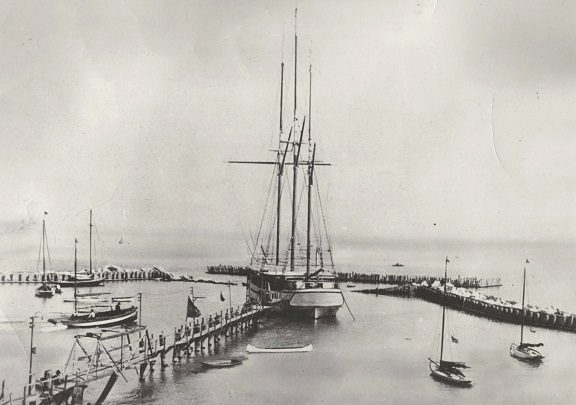
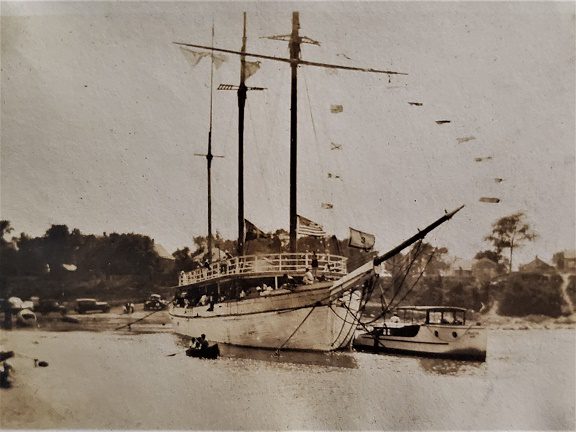
“The conversion of the schooner from lumber to leisure began almost immediately and moved rapidly throughout the fall of 1915 and the spring of 1916. A new floor was placed in the hold, it was wired for electricity, and iron work was erected to support a hurricane deck which would serve as the dance floor on the LILY E. Even the rigging was restored with the replacement of the broken foretopmast and the addition of a raffee yard at the cost not to exceed $5 for the latter. Some of the renovation and repair was accomplished in the dry dock at the south yard of the Milwaukee Dry Dock Co., formerly Wolf and Davidson, located at the foot of Washington Street.
Photo at top of page: Post Card courtesy of Bruce Nason
“Another strong driving force which carried the conversion forward was the establishment of the S. S. Y. C. Auxiliary. At a regular meeting on August 13, 1915, a letter from the wives, mothers, sisters and daughters asked permission to use the name of S. S. Y. C. Auxiliary for their organization. They also asked permission to use the schooner on a certain day each week, and wanted the privilege of selling lunch and refreshments on Labor Day. “A motion was made and seconded that we allow the wives, mothers, sisters and daughters of the members of the South Shore Yacht Club to use the name of South Shore Yacht Club Auxiliary.” Motion carried. They sold lunch and refreshments on holidays and catered the club’s private parties with the proceeds dedicated to the purchase of items for what was affectionately being called the “ship”. Some of their initial donations included skylights, cups, saucers, plates, glasses and table cloths.
South Shore Yacht Club photo courtesy of John Ebersol
“By July 4, 1916, much of the work was completed and the LILY E. was triumphantly taken to the Milwaukee Yacht Club for the holiday celebration. The membership boarded the good “ship” at 8:30 a.m. and had a fine trip across the bay towed by Gillen’s tug. There were flags at every angle and the whole code of flags was strung at the top of the mast. The yacht club was a colorful sight and an ideal subject for another emerging recreation, the moving picture. A movie man, Raymond D. Clifton, was busy all day and all the members of the club took part in the film. The “ship” was also used by a motion picture company of Milwaukee in a number of marine scenes.
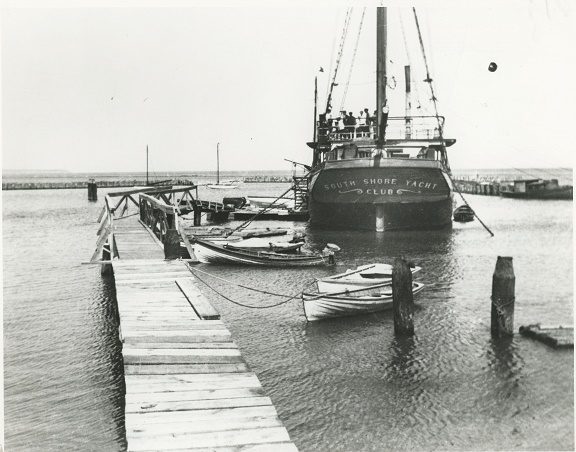
“With the advent of World War I, the resources of the club were depleted by the call of arms and the maintenance necessary to sustain a wooden vessel was deferred. After the war, the club began to plan for a new land based club house and the future of the LILY E. became uncertain. The club considered at least one offer for the “ship” from another yacht club, but she was never sold. At a regular meeting on January 30, 1920, the Commodore told of visiting the Park Board regarding the location of a club house on park property, and the problem of repairing the main deck of the LILY E. was discussed but nothing definite was decided upon.
“In the meantime, the development of the lake front continued as the city had plans to fill in behind the pilings to the north, along the beach, in order to increase the amount of park land on the shore. Mr. Andrew M Heederick spoke on a new club house site at the regular meeting of March 11, 1921, and a motion was made and seconded “that the club go on record to procure the site which is to be filled in due east of the LILY E. for a new club house and the Building Committee was to take up the matter with the Park Board.” Motion carried. In the spring of 1921, the fire insurance on the LILY E. was canceled and by the fall it was a major task just to keep her afloat. At an informal meeting following the regular meeting of September 9th, the group discussed ways and means to keep the “ship” afloat after Shipkeeper H. Diederich had informed the Commodore that the pumps had been working for several hours with no apparent result. But, as in the case of thousands of her predecessors, the nemesis of all Great Lakes vessels, the equinoctial gale was about to deliver the final blow.
“Throughout the fall what seemed to be a never-ending gale battered the LILY E. in her anchorage at south shore. With her seams opened, the “ship” rested on the bottom and worked into the sand as she had done many years before just a short distance to the north. It was obvious to all by the winter of 1921-22 that the LILY E. could no longer serve as a floating yacht club. The membership of South Shore Yacht Club had so many fond memories of the “ship” that they had great difficulty in even thinking about her remains.
“The time for the final disposition of the LILY E. had arrived of necessity. The “ship” was to be consigned to the boneyard; or given over to flames at her moorings; or, as suggested by the harbor commission, relegated to still another role played by many of her contemporaries; i.e., being hauled down the beach and allowed to settle as a breakwater where the currents were rapidly eating away the shore line south of the city limits. The knowledge that the city was going to fill in the Gillen’s point and the cost of releasing the vessel were deciding factors in the decision.
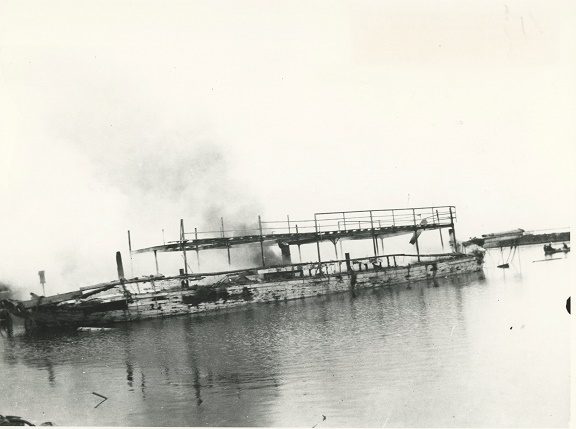
“On a still, cloudy day in midsummer of 1922, there was a Suttee in Milwaukee. A dozen mourners wended their way to where the funeral pyre was to flame, poured on the oil, and then stood still to watch and remember, as the fiery, clutching arms reached up and wrapped their victim in hot embraces. When it was over, there was little left of the LILY E., and as if to make sure that she would not become another “Ghost Ship of the Great Lakes”, she was buried in fill by the city. In 1936, the present S. S. Y. C. was built on the point of land over the former anchorage and in 1976 a gate was built at the bow of the LILY E., ex-LOUISA McDONALD. (Schooner Days in Door County, by Walter & Mary Hirthe, p 71-80)
Suzette Lopez
Photo Credit: Great lakes Marine Collection of the Milwaukee Public Library and Wisconsin Marine Historical Society.
