By James Heinz
In honor of National Historical Marker Day we highlight one of Milwaukee’s markers
As the first European settlers of the Great Lakes region arrived by ship at their new home, at the end of their long voyage, they found that they had a problem:
There was no place to get off the ship.
The early Great Lakes frontier was completely undeveloped, with none of the infrastructure necessary for loading and unloading ships. Using rivers as harbors would seem an obvious solution. And like all obvious solutions, it turned out not to be a solution at all, since many rivers were blocked by sandbars formed when sediment carried by the rivers hit the lakes. Also the river mouths were narrow and too shallow for many ships.
Early European arrivals quite literally jumped over the sides of ships anchored in the Lake and waded ashore to their promised land. Their tools and household supplies were handed over the side of the ship onto strong backs. Many of these new arrivals often fell into potholes in the sandbars while wading ashore. Ships’ small boats were used to carry people and goods over the sandbars, but these boats often capsized in the surf.
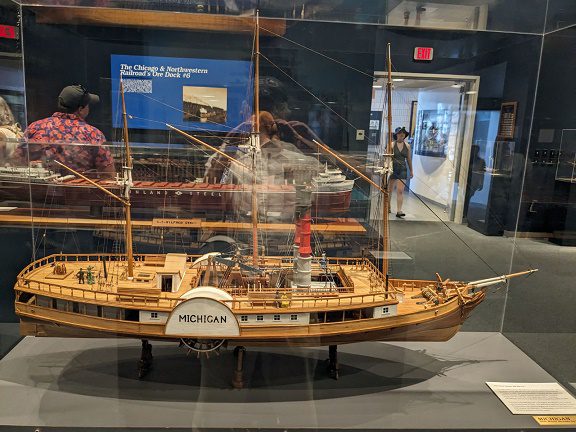
Sidewheeler MICHIGAN on display at the Wisconsin Maritime Museum
Milwaukee founder Solomon Juneau himself found this out when he arrived in Milwaukee in June of 1835 on the sidewheeler MICHIGAN, the first steamer to arrive in Milwaukee. WMHS files report that “The passengers and their trunks filled the boat. As there was a heavy sea on, we were washed back into the lake as often as we could run ashore; but at the third trying, when near the beach, the sailors jumped out and pulled the boat ashore by main strength. It filled with water and so did our trunks. Every one of us was wet to the armpits…”
The Milwaukee River then exited to the Lake where the Coast Guard station is today. The river mouth was too shallow for many ships to enter the lagoon behind Jones Island. Small boats and a small steamboat could come out to ships on the Lake to transfer cargo and people.
This was not efficient, especially when settlers had to ship out their first season’s harvest to Eastern markets. The obvious solution was to build piers out into the Lake so that people and cargo could be unloaded safely and efficiently. And like all obvious solutions, it turned out not be a solution at all, since winter storms destroyed these piers within a few years. But for a while, it was all the settlers had.
The WMHS blog recently ran articles about the remains of these piers that can be seen from the air: https://wmhs.org/the-abandoned-piers-of-lake-michigan-i/ https://wmhs.org/the-abandoned-piers-of-lake-michigan-ii/
Construction of Milwaukee’s first pier into Lake Michigan, known as the North Pier, started in the fall of 1842. Wooden pilings were driven into the Lake bottom 65 feet north of what is now the east end of Clybourn Street. Why was this location chosen? Possibly because Milwaukee’s first brewery had been established on the shore at this location in 1840, ready to provide golden liquid sustenance to thirsty arrivals.
The pier was finished by the summer of 1843. It was 44 feet wide and extended 1,200 feet into the Lake, ensuring 12 feet of draft over the easternmost part of the pier. It had a warehouse and a toll gate at the shore end to ensure that the docking and unloading fees were paid, but that sure beat getting wet up to your armpits.
It remained in operation until 1846, when it was abandoned due to ice and wave damage. Three subsequent piers, all built to the south of North Pier, were in operation from 1844 to 1857. In 1857 the Army Corps of Engineers completed the “straight cut”, which eliminated the need for piers out into the Lake.
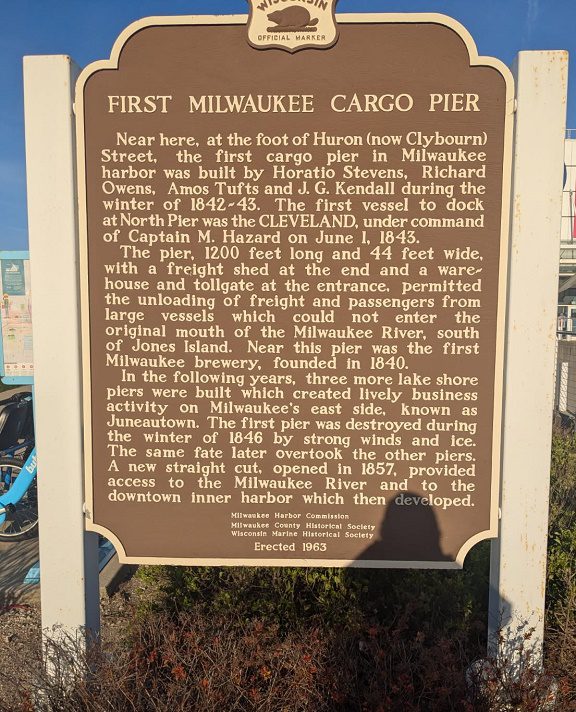
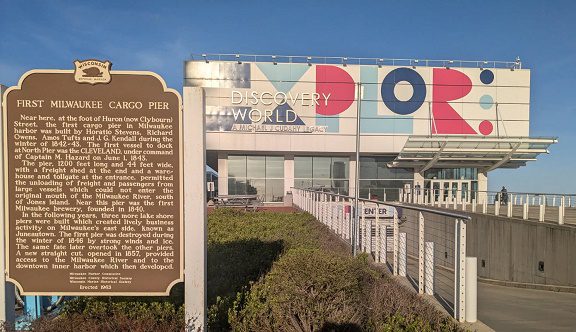
Friday April 24th is National Historic Marker Day, a good time to visit the Wisconsin Historical Society’s historical marker commemorating the North Pier, located in front of Discovery World museum at 500 North Harbor Drive. The marker was established in 1963.
In case you are curious, the first ship to visit was Milwaukee was HMS FELICITY, which arrived at the original river mouth on November 3, 1779, checking to see if the indigenous inhabitants had developed any fancy ideas about independence. https://wmhs.org/the-first-european-ship-that-visited-milwaukee/
——————————–
Photos by James Heinz
James Heinz is the Wisconsin Marine Historical Society’s acquisitions director. He became interested in maritime history as a kid watching Jacques Cousteau’s adventures on TV. He was a Great Lakes wreck diver until three episodes of the bends forced him to retire from diving. He was a University of Wisconsin – Milwaukee police officer for thirty years. He regularly flies either a Cessna 152 or 172.
