
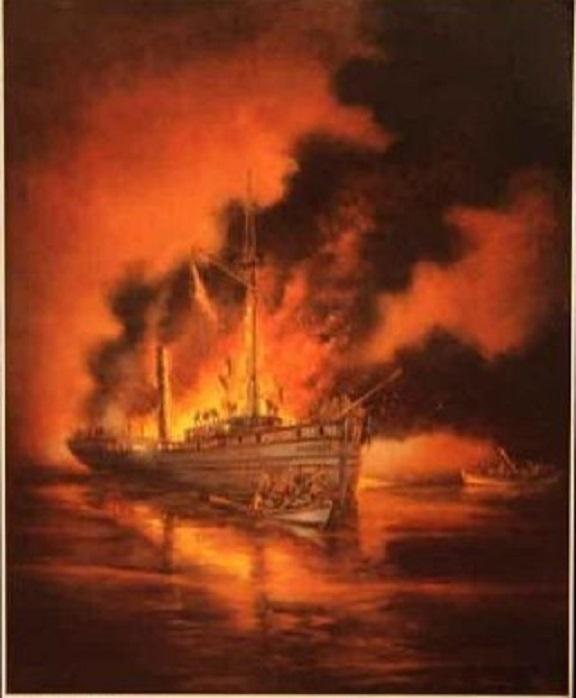
On this day November 21, 1847, tragically a long journey which started in Rotterdam in September ended in one of the most lakes horrible disasters off the coast of Sheboygan. The propeller PHOENIX burned.
Photo at top of page: PHOENIX poster by Wm J Koelpin
There were more than 250 passengers on board and the crew. It is estimated that 200 of the passengers were emigrants, all from Holland, all hoping to start a new life in the new world. Out of nearly 300 souls on board, 43 survived the fire.
The PHOENIX was launched on April 26, 1845, from the shipyard of G. W. Jones in Cleveland. Built for Pease & Allen of Cleveland, she measured roughly 140 feet in length, 22 feet in beam and 10 feet in depth. The following is part of her description from the Cleveland Herald.
“The PHOENIX is a most beautiful vessel, of about 320 tons measurement. She belongs to Messrs. Pease & Allen, E. R. Burkle and her captain Geo. W. Jones. She is 145 ft. long, 23 ft. beam, and 10 ft. hold, including her guards, she is 26 ft. beam, this being the largest size vessel that can pass through the enlarged Welland Canal, for which trade the PHOENIX is designed after the present season.
“In one respect the PHOENIX differs from all the propellers I have ever seen. Her engine is placed “midship,” or nearly so, she having 2 freight holds, one aft and one forward of her machinery. On her main deck she has two cabins, which are also separated by her engine room. The one aft, or gentlemen’s cabin is fitted up with state rooms, and has berths for 30 passengers. The cabin is conveniently, neatly and elegantly furnished and finished. Her forward or steerage cabin is large conveniently arranged expressly for emigrants and that class of passengers, and is not excelled by any steamboat on the lakes. It will, with the standing berths and sacking frames give good accommodation to 200 passengers. Connected with it is a large kitchen, having cooking stove, pumps, &c. Besides these two cabins, she has on her upper or promenade deck, a large saloon, with 8 berths, for cabin passengers; a wash room and a bar; with this she can, in her best cabin, well accommodate 40 passengers. She has one engine; the boiler is 20 ft. long, with 2 furnaces, each 5 by 3 ft.; 24 main flues, 15 ft. long and 9 inches in diameter; with steam chimney and heater, the heater forming a part of the smoke pipe or chimney, and contains 38 one inch copper tubes, 3 ft. long, through which the exhaust steam passes, thence into the chimney. The entire fire surface of the boiler, from keelson up to and through the upper deck, is surrounded by having water back, water bottom, and (by the placing of the heater) a water jacket, through the deck extreme length of smoke pipe, including the steam chimney and heater, 42 ft.: Length above deck 33 ft.; diameter 38 inches. The cylinder is placed vertically; diameter 20 inches; stroke 43 3/8 inches; piston works from below; the main shafts are 48 ft. long, and in two parts connected by a sliding clutch coupling; inner end of the shaft 7 inches diameter; outer end 6 inches diameter; these main shafts are connected by a cross shaft by means of bevel gears, allowing the whole power of the engine to be worked as well upon one propeller alone as upon both, or if necessary, without moving either propeller; the power is applied direct to the main shafts through two connecting rods working at an angle from the cross head.”
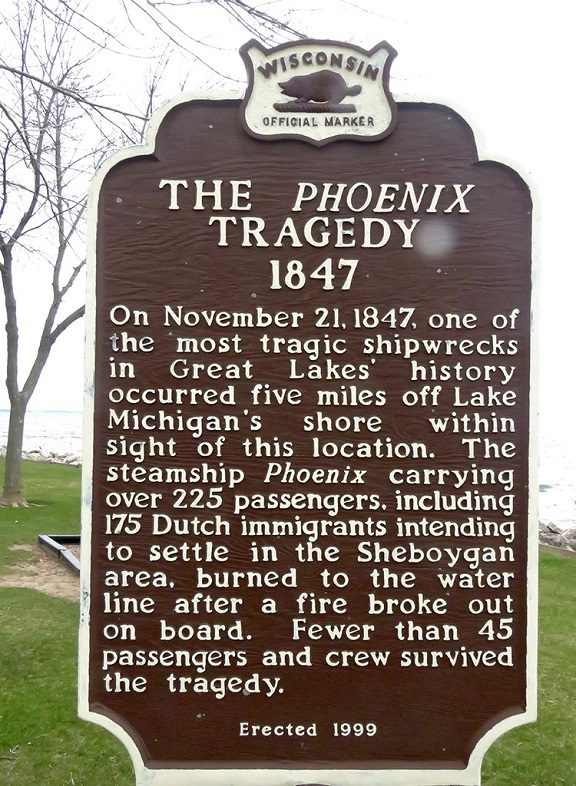
Wisconsin Official Marker, photo by Carl Eisenberg, 2021
She was built to be a beauty. Newspaper accounts vary on how many were on board as well as how far from shore the PHOENIX was when the fire was discovered. This could be in part because it seems there were two fires as noted in the following partial account from the Buffalo Daily Courier of November 30th:
“This unfortunate vessel was, on Sunday, the 21st instant, within about 15 miles of Sheboygan, and about the same from Manitowoc, when it was discovered that she was on fire in her hold. She had been compelled to put to sea, being unable to procure sufficient anchorage in Manitowoc Bay, where she had gone for shelter. This fire was soon extinguished, but this was no sooner done than it broke out in the forward front of the boiler deck, having been communicated from the boilers. The vessel was about 6 miles from the shore. The greatest confusion prevailed after the second discovery of fire, as it then appeared that there was no hope of extinguishing it. A rush was made for the small boat, which would have rendered it entirely useless, but Mr. Davis Blish, of Southport, a gentleman whose name should henceforth be had in perpetual remembrance among those who navigate the lakes, drove the crowd away, and having taken Capt. Sweet, the commander of the propeller, from his berth, where he lay sick, and directing as many to follow as the boat could safely carry, the boat left for the shore, Mr. Blish voluntarily remained behind.
“The propeller DELAWARE hove in sight about the time the small boat left, but was unable to arrive in time to save those on board from destruction. Before the DELAWARE reached the spot, the burning vessel had sunk, and all on board were either burned or drowned, with the exception of two, who were picked up.
“Mr. Blish perished among the rest. It appears probable that 240 lives were lost. One hundred and fifty of the passengers had recently arrived from Holland. This is a greater destruction of life than has ever occurred at any one time upon these lakes.”
The wreck of the PHOENIX is just north of the Sheboygan city boat ramp in about eight feet of water. It is scattered over a large area. The only known piece of wreckage left is her smokestack which Steve Radovan located in 2022 in 130 feet of water.
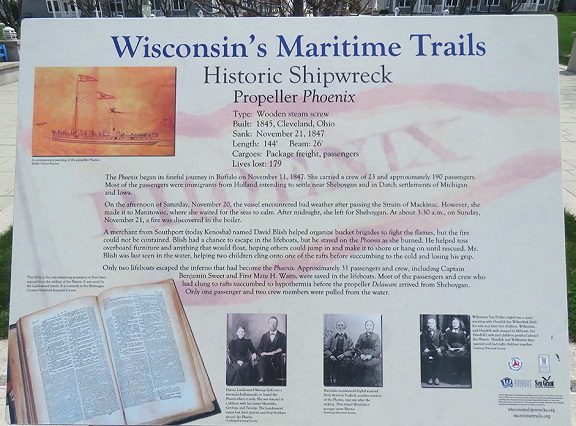
Wisconsin Maritime Trails Marker, photo by Carl Eisenberg, 2021
Many Dutch immigrants have settled in the Sheboygan/Manitowoc area. The PHOENIX disaster will be remembered.
Suzette Lopez
