
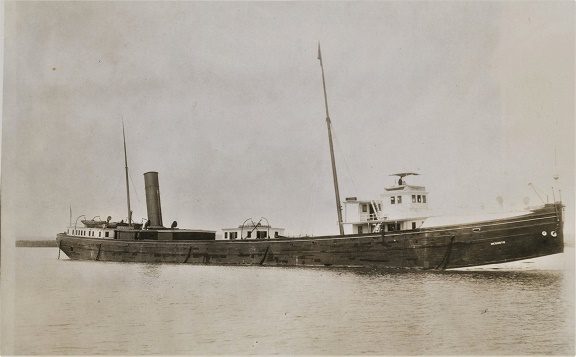
On this day September 28, 1908, the wooden steamer NESHOTO stranded in dense smoke 2 ½ miles off Crisp Point in Lake Superior. Yes, dense smoke due to forest fires in the Upper Peninsula and plains west of Crisp Point and Vermilion. Luckily her crew of 16 were rescued by the life savers from the Crisp Point station who had heard their distress signals and discovered the stranded ship. A northwest gale pounded her to pieces and wreckage was strewn all along the beach. At the time, she was part of the Gilchrist Transportation Company’s fleet, bound down with 2,822 tons of iron ore, not insured and valued between $40,000 and $50,000.
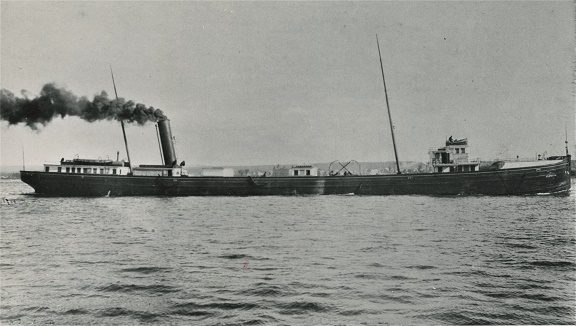
The NESHOTO was built in 1889 at Cleveland by Thomas Quayle and Sons for Robert R. Rhodes of Cleveland. She was one of the best wooden freighters on the lakes measuring 284.2 feet in length and 42.5 feet in beam. She was sold to the Gilchrist fleet in 1901.
Her launch was viewed by about two hundred who braved a thunderstorm and heavy rain. It was written about in glowing terms even though the Cuyahoga River was low which caused a three and a half foot drop for the NESHOTO from the ways to the water. As you will see by the two articles below, there were two different stories of how Captain Humphrey experienced the launch. Perhaps the writers were on opposite sides of the ship.
Marine Record, April 25, 1889, p. 4
“LAUNCH OF THE STEAMER NESHOTO
“On Wednesday at 3 p.m., the fine wooden propeller NESHOTO was launched from Quayle’s Sons shipyard. The time given out for the launch was strictly adhered to, and, in spite of the heavy rain and the thunder storm which was circling around at the time, fully two hundred persons witnessed the launch of one more elegant and well finished mammoth lake carrier. The NESHOTO was built to the order of R. R. Rhodes and others, among whom are the Cleveland shipbuilding company, and Mr. A. E. Manning of this port. Although the river was low, causing a drop of about 3 feet 6 inches from the ways to the surface of the water, no uneasiness whatever was experienced by her builders, and the successful results proved their admirable judgment to have been well founded. Precisely at 3 p.m. the busy hum and hammering subsided, and the word was given to standby, every detail having been previously arranged. The word was given to cut, and the huge vessel, as if obeying a natural impulse, moved steadily toward the element which she is bound to adorn. All eyes were strained to catch sight of this first and only experience which a vessel can have during her career. When reaching the end of the ways she bounded gracefully into the water as though glad to be embraced by the soft cushion afforded by the glorious liquid, instead of the hard, solid, and unyielding wave on which she had been reared. A large number of people were on her decks, including Mr. A. R. Manning and Captain Humphrey, and others who received a considerable shaking up before the splendid vessel could recover her surprise at the novelty of being water bourne. It was not until she had steadied herself, however, that the perfect symmetry of her for, spars and rigging could be properly realized by the onlookers, many of who expressed great pleasure at having the opportunity of witnessing the dedication of the latest addition to the superior tonnage of these inland seas.
“The dimensions of the NESHOTO are 285 feet keel, 300 feet over all, 42 feet beam, and 22 feet depth of hold; her hull is painted black, and the deck fittings are superior to most of the modern steamers. A turtle back forward is painted white with handsome brass finished stanchions and strong wire netting around the forecastle deck, which gives her the appearance of an ocean liner, and the same work, as regards stanchions and netting, is carried from and around the pilot house and texas, across a commodious bridge which leads on to the top gallant forecastle. The several deck houses are finely finished in white oak graining, and the entire appearance of the decks shows the greatest attention to necessary details, a portion of which must be credited to the practical skill of Captain W. H. Humphreys.
“Her entire machinery has been built and fitted by the Cleveland shipbuilding company, and is of superior workmanship and material. The engine is a triple expansion, cylinders 20, 31 and 52 inches, with 40 inch stroke; boilers 11 ½ by 14 feet, and are allowed 150 pounds of steam. She has all of the modern appliances, including steam steering apparatus and a Providence ship windlass, manufactured by the American ship windlass company, Providence, R. I. The three spars are what are known as pole masts, and we believe that rigging was never fitted in a more ship-shape manner, while the rake of the smoke stack corresponds to a nicety with that of her stays and the lead of the fore and aft stays, and the whole appearance of her rig was enhanced by the exhibition of the new bunting.
“Local tradesmen have assisted by their excellent workmanship and pride of trade in finishing the details, Mr. John Thompson deserving credit for the fine, and perfect manner in which he has fitted the net work, pipe fitting, etc., while Van Tassel & Co. have done the plumbing work throughout the ship. Her draft of water forward was 4 feet 6 inches, aft 10 feet 5 inches. Captain w. H. Humphrey will carry her along to fame and fortune; Christ Castle chief engineer; Charles Cook first mate; Frank Newline second mate.
“The NESHOTO has the best wishes of the Marine Record, and all the good we wish her is a long and prosperous career.”
————
Marine Record, April 25, 1889, p. 1
“Captain Humphrey had a narrow escape from being re-christened at the launch of the NESHOTO Wednesday afternoon. He was standing on the starboard side of the top gallant forecastle, holding on to the low rail. When the boat dropped from the ways she lifted him off his feet, and threw him clean and decent over the side. He held on with a vice like grip, however, until assisted onboard. The Captain will probably have the opportunity to pay her back for this smart trick later on; in the meantime he has our sympathy while he is courting the bark to grow on his hands and figure head.”
Suzette Lopez
Photo credit: Great Lakes Marine Collection of the Milwaukee Public Library and Wisconsin Marine Historical Society.
