
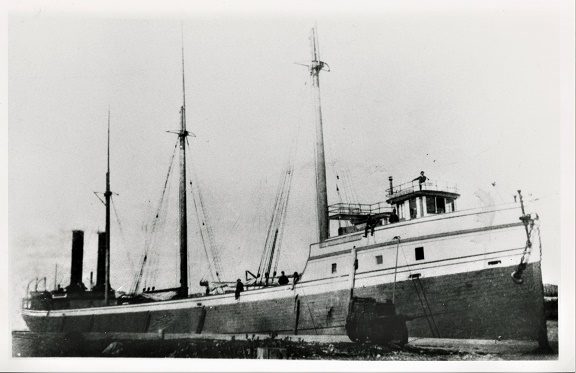
On this day October 17, 1896, the steamer AUSTRALASIA caught fire near Baileys Harbor. The crew tried desperately to contain the fire but ended up scuttling her in 15 feet of water near what is now Whitefish Dunes State Park. Lifesavers from Baileys Harbor reached her soon after she struck bottom, rescued the crew and took them to Sturgeon Bay. All were saved.
She eventually was declared a total loss. Her cargo and machinery were salvaged. Today the wreckage lies 350 yards off the Whitefish Dunes State Park beach in Door County. The following article of October 19th from the Milwaukee Sentinel details the event.
“A VICTIM OF FIRE
“The steamer AUSTRALASIA, owned by James Corrigan of Cleveland, and bound from Cleveland to Milwaukee with a cargo of 2,200 tons of soft coal, was burned to the water’s edge at Whitefish Bay Saturday evening and now lies upon the bottom with her bow resting in ten feet of water. The AUSTRALASIA passed through the Straits of Mackinac early Saturday morning and headed towards the west shore of Lake Michigan.
“About 6 0’clock in the evening, just after land had been sighted off Bailey’s Harbor, fire broke out beneath the boilers and resisted every effort of the crew of extinguishment. The flames speedily licked up the bulkhead separating the freight hold from the engine and boiler compartment and made their way forward beneath the deck. Seeing that his steamer was doomed to destruction the captain headed her for Whitefish Bay. Before abandoning their posts the engineer threw the throttle of the engine wide open, and the fireman filled the furnaces of the two boilers with coal, so as to hold a good head of steam as long as possible. Fortunately the heat of the blaze beneath the boilers did not disable the machinery and it carried the steamer landward until bottom was struck near Whitefish Bay. While the crew of the steamer were fighting the fire the lookout of the Bailey’s Harbor station sighted the flames, and the lifesavers were soon in pursuit of the AUSTRALASIA with their large lifeboat under canvas. They reached her soon after she struck bottom and took off the crew, who were grouped forward. Before abandoning the burning hulk the captain caused holes to be bored through the hull forward to fill the hold with water as speedily as possible and thus save the bulk of the coal cargo.
“This is the purport of one account, at least, it does not tally with another from Sturgeon Bay, from which point the tug JOHN LEATHEM was hurried to the scene on receipt of a telephone warning forwarded from Bailey’s Harbor. The captain of the LEATHEM states that the AUSTRALASIA was four miles off land when he reached her and had been abandoned by the crew, the lifesavers having taken the latter to Jackson Port. The LEATHEM, he says, then got a line on the AUSTRALASIA, intending to take her to the Sturgeon Bay Canal entrance. Finding this impossible, he claims to have towed the steamer ashore and then scuttled her by ramming a hole through her side. While this may possibly have been the case, it is hardly probable, as no one is prepared to believe that a tug could perform such a ramming feat without losing her stem and in fact shattering her entire bow. At any rate the Leathem & Smith Towing & Wrecking company will have a salvage claim to file against the underwriters. …”
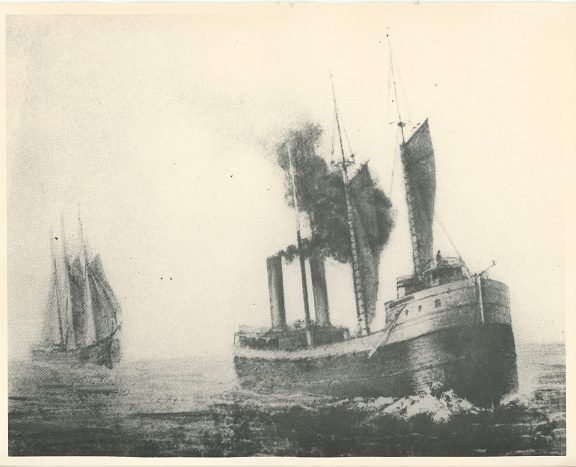
Fr. Dowling’s painting of the AUSTRALASIA towing the NIAGARA
When built in 1884, the AUSTRALASIA was the largest craft on the lakes. Below is a complete description from the British Whig of September 4, 1884.
“AN IMMENSE BOAT
“The largest wooden craft ever built will be launched in Bay City, Mich., in a few days. The name of the monster ship is the Australasia. This craft is being constructed in A. Davidson’s ship yard. She is a double decker and has seven hatchways. When completed her cost will be about $150,000. Her first cargo will be a load of salt to Chicago. No officers have yet been appointed, but it is understood that Capt. Davidson will command her on her first trip. The Bay City Evening Press gives a description of the huge steamship. The following are her dimensions: extreme length, 305 ft.; length of keel, 285 ft.; breadth of beam, 40 ft.; depth of hold 22 ft.; depth of lower hold, 12 ft.; distance between decks, 10 ft. Her keel was laid about November 1, 1883, and since then from 75 to 150 men have been employed upon her. The “skeleton” of the boat, so to speak, is enclosed in a complete network of iron bands, which the planking hides from view. A belt or girt of iron ten inches wide extends from stem to stern on the outside near the top of frames, and on the inside is another band of the same dimensions. To this the outside cord is thoroughly riveted. The latter are riveted straps five inches wide and half an inch thick, which take a diagonal course to the turn of the bilge, where they take hold of the long floor timbers. These diagonal straps commence at every opening of the frame cross twice, and are firmly riveted at each crossing.
“The Australasia has probably the largest engine on the lakes. It is a fore-and-aft compound, the high-pressure cylinder being 30 inch bore and 45 inch stroke, the low-pressure 54 inch bore with the same stroke. The boilers are made of Otis steel. They are two in number, 8 feet shell and 27 feet long. They rest on the lower deck. The shaft is 11 inches in diameter; the wheel 12 1/2 inches (sic) in diameter, with fourteen feet lead. The pilot-house, captain’s and officers’ quarters are forward, the crew’s between decks aft, and the engineers’ and steward’s aft. They are all large and commodious, conveniently arranged and handsomely furnished. The net tonnage is now being figured upon by the Government officer. Her carrying capacity is estimated at 3,000 net tons, 600,000 bushels of corn, or 2,000,000 feet of lumber.”
Suzette Lopez
Photo Credit: Great Lakes Marine Collection of the Milwaukee Public Library and Wisconsin Marine Historical Society.
