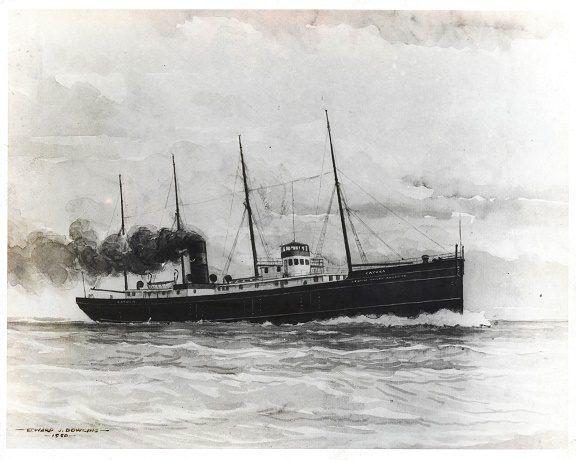
On this day April 2, 1889, the steel steamer CAYUGA was launched at Cleveland by Globe Iron Works for the Lehigh Valley Transportation Co. She measured 290 feet in length and 40.8 feet in beam and was valued at about $260,000. She was one of five of this design built for Lehigh. The E. P. WILBUR, CAYUGA, SENECA, SARANAC and TUSCARORA all carried package freight between Buffalo, Chicago and Milwaukee. They were all very fast, the SARANAC claiming to make 16 ½ miles per hour.
Photo at top of page: Painting of CAYUGA by Fr. Dowling
The next year, almost to the date of her launch, the CAYUGA ended up on Horseshoe Reef. Below is the story as told in the US Life Saving Service Report of 1890. The story shows that if it doesn’t work the first time, try, try again.
“April 9, 10, 1890 – Late in the afternoon of the first of these dates the large steel steamer CAYUGA, of Buffalo, New York, left that harbor for a trip to Chicago, Illinois. She was assisted by a tug as far as the breakwater, then attempted to proceed alone, but the wind, which had been blowing from the southwest and had rapidly grown to a gale, suddenly rendered the craft unmanageable and swept her upon Horseshoe Reef. The water, being banked up by the wind, was fast rising, and was already some five feet above the ordinary mark. This enabled the steamer to pound her way across the reef, and she shortly brought up broadside against the stone embankment that protects the railway as well as the city water-front. The crew numbered twenty-six, all told, but they were not in danger. The disaster, which occurred about a mile and a half north-northwest of the Buffalo Station, (Ninth District,) Lake Erie, was at once noted there, and the life-savers quickly manned the surfboat, and taking a hawser, etc., pulled to the steamer’s assistance. Her great distance from deep water, however, and the fact that there was no line long enough for use, prevented their doing anything at this time, and they soon returned to the station for supper. Half an hour later, a long hawser having been procured, the tugs and the station crew again went out to her. The surfmen ran the line with considerable difficulty, but just as the tugs were about to pull on it one of them fouled and parted it with her propeller wheel. The life-saving crew grappled for the line but failed to find it. They then ran a second line to the tugs, but it was soon adjudged futile to attempt anything further that night and it was decided to postpone operations until daylight. In the morning (10th), the storm having somewhat abated, one of the tugs stopped at the station for the crew and towed them out in their lifeboat to resume the work. Arriving at the place the life-savers ran the hawser, but it was soon parted. They then set about restoring the connection, and after working energetically for some time succeeded in running a sufficient number of hawsers and lines to stand the strain. The tugs, joining their efforts, pulled on the steamer for the next three hours, at the end of which time they floated her. This result was most gratifying, as the belief was fast becoming settled that the craft could be released only after the expenditure of much time and money. Very remarkably, the craft escaped with small injury, and was not even leaking. The propeller broken, the rudder-post bent, and the shoe torn off – these were the principle damages noted at the time, and as the vessel was valued at a quarter of a million dollars they are considered as of trifling importance. The local press in reports of the case alluded in most complimentary terms to the services of the station crew, and the district superintendent shortly afterwards received the following letter from the general agent of the steamboat line:
“Lehigh Valley Transportation Company,
“Buffalo, New York, April 14, 1890.
“Dear Sir: At 4 o’clock in the afternoon of the 9th instant, our steel steamer, CAYUGA, sailed from this port bound for Chicago. She was in light trim, drawing about thirteen feet of water. It was blowing very heavily from the southwest when she left port, and after clearing the breakwater a tremendously heavy gale, averaging some fifty-two miles per hour, began to blow and the ship became unmanageable and was driven onto the rocks by the force of the wind and sea, and for a mile and a quarter pounded over rocks and reefs until she reached the beach near the foot of Carolina street. The sea rolled in very heavily, and it was impossible to get assistance to her of any kind until the life-saving crew, under command of Captain Williams, came out and worked until 12 o’clock at night and succeeded in getting a long line of thirty-six hundred feet of three and one-fourth inch rope on board of the ship. From this a hawser was hauled on board, and during the night and the next day up to 12 o’clock the gale continued to blow and the life-saving crew worked manfully, running lines and hawsers to the ship all the time. The hawsers led to the tugboats, which could not approach the ship because of the rocks and the heavy sea running, and at about noon of the 10th the ship was hauled off and brought into port. I never saw so much bravery and intelligence displayed by men in such a dangerous time as on this occasion, and I take great pleasure in extending my thanks to them, and congratulate you on your good fortune in having so able a crew under your command. I shall report the matter fully to the directors of our company.
“Yours truly, Wm. P. Henry, General Manager. Capt. D. P. Dobbins, Superintendent Ninth Life-Saving District, Buffalo, New York.”
The CAYUGA had a short sailing career – only six years. On May 10, 1895, she was sunk by the str. JOSEPH L. HURD in dense fog about three miles from Skillagalee Lighthouse at 4:30 in the morning. The bow of the HURD was knocked clean off but her cargo of lumber kept her afloat. George Johnson a steward on the HURD was on deck when the collision occurred and was knocked overboard and drowned. The CAYUGA sank in about 25 minutes with no loss of lives. The remaining members of both crews were picked up by the MANOLA.
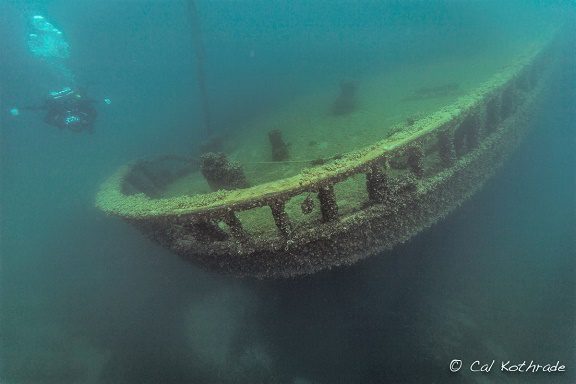
Railing of the CAYUGA courtesy of Cal Kothrade
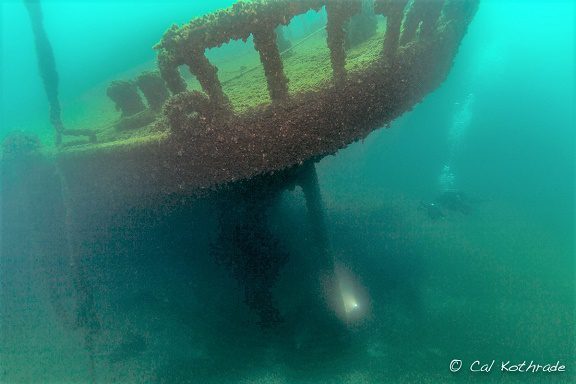
Stern of the CAYUGA courtesy of Cal Kothrade
The CAYUGA at the time was bound from Chicago to Buffalo with 1,500 tons of flour from Milwaukee, valued at $70,000, and 30,000 bushels of oats, valued at $8,500. A large quantity of flour was afloat in the Straits.
The HURD was towed into Harbor Springs by the wrecking tug FAVORITE. She was in sad shape. The underwriters decided to abandon her as repairs would have been very costly. She was bought, repaired, and sailed in the stone trade by Leathem and Smith until 1913 when she burned. She was towed to the end of the Leathem and Smith quarry dock, abandoned and later sank.
The HURD was a wooden steamer built at Detroit in 1869 and measured 171 feet in length and 29.2 feet in beam.
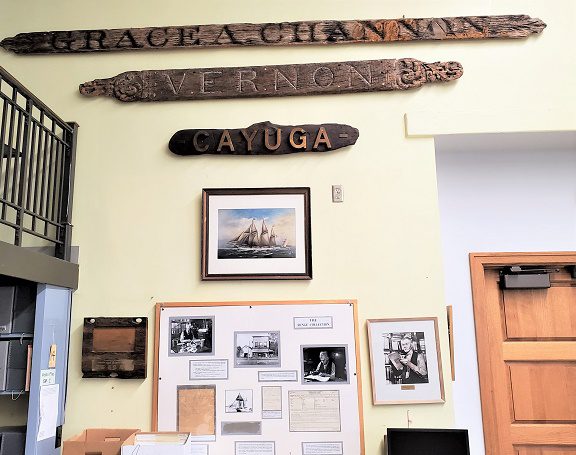
The nameboard from the CAYUGA is proudly displayed on the wall in the Humanities Department of Milwaukee’s Central Library.
Herman Runge notes that the CAYUGA sank in 15 fathoms of water. The wrecker JAMES REID tried to raise her with pontoons and while towing her into shallow water, the chains broke and she sank again. She was never raised.
Suzette Lopez
PHOTO CREDIT: Painting of CAYUGA by Fr. Dowling, Nameboard of the CAYUGA – Great Lakes Marine Collection of the Milwaukee Public Library and Wisconsin Marine Historical Society. Underwater photos are courtesy of Cal Kothrade
