By James Heinz
In a previous story https://wmhs.org/fire-has-claimed-another-great-lakes-freighter/ I told the story of how the 88 year old bulk carrier CUYAHOGA was damaged by fire on March 15, 2024, while in winter layup at Ashtabula, Ohio. This article explains what happened, according to the February 2026 issue of Professional Mariner magazine.
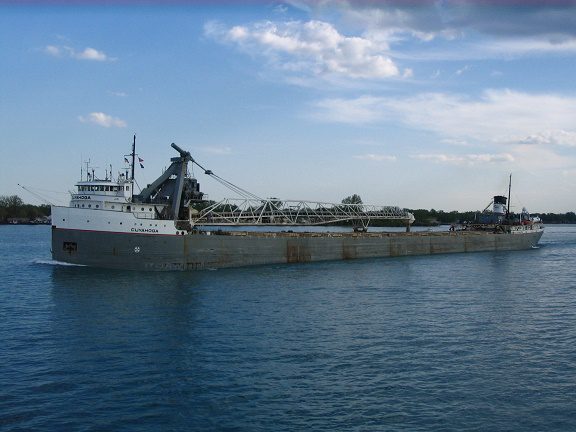
Photo at top of page: CUYAHOGA May 16, 2008 courtesy of Craig Olson
Three workers were involved in installing a replacement ladder on the forward bulkhead of hold #2. This involved grinding epoxy paint off the forward bulkhead to prepare for welding the ladder, and then welding the ladder to the bulkhead using flux core welding.
This activity stopped at 11:30 am. The three men then stood guard for 30 minutes to make sure that they had not started a fire. They then left for lunch and resumed work at 1 pm. At 1:15 pm one of them noticed flames had broken out on the surface of the bulkhead.
No one had told the workers that the epoxy paint used on the bulkhead as far back as 1990 was highly flammable when exposed to high temperatures like a welding torch. In addition, the workers had not been trained in firefighting techniques.
One of the workers had seen the epoxy ignite on previous occasions but had been able to extinguish the previous fires with one water canister extinguisher. Therefore, the three workers then attempted to extinguish this fire with two water extinguishers, but the fire continued to spread and the workers evacuated the hold.
The captain of the ship and other shipyard employees attempted to extinguish the blaze with more water extinguishers. As is so often the case, the fire hoses were under lock and key and nobody had a key.
After emptying 10 extinguishers, the fire had spread to the entire cargo hold and then up to the rubber conveyor belt on the self-unloading boom. At that point the captain ordered everyone to abandon ship. All of this happened in about 15 minutes, which gives an idea of how fast the fire spread.
None of the workers thought to call the fire department but bystanders saw dense black smoke rising from the ship and made the call. The fire department arrived at 1:30 pm with three engines and a ladder truck and began pouring water on the fire.
One problem in ship firefighting is that pouring water into a ship will cause the ship to fill with the same stuff that the hull is trying to keep out of the ship. The firefighters also had to consult with the ship’s crew to make sure that the water did not destabilize the ship and cause it to capsize.
It took until 10 pm or 9 hours for water and foam to extinguish the fire. It had spread to holds #1 and #2, the conveyor belt, and the conveyor belt tunnels. As a result, the CUYAHOGA was declared a total constructive loss of $11 million dollars. The company was fined $164,000 for OSHA violations related to the loss. The National Transportation Safety Board determined that the ladder welding caused a fire that smoldered so slowly that it could not be seen by people looking right at it until it burst into visible flame.
As I predicted in the original article, the CUYAHOGA’s 88 year career was over. In July 2025 she was towed across Lake Erie to Port Colborne, Ontario, for scrapping.
Her fire bears a strong resemblance of the fires that twice damaged the bulk carrier ROGER BLOUGH, the last fire taking her out of service. https://wmhs.org/born-in-fire-died-in-fire-the-great-lakes-freighter-roger-blough/
—————-
James Heinz is the Wisconsin Marine Historical Society’s acquisitions director. He became interested in maritime history as a kid watching Jacques Cousteau’s adventures on TV. He was a Great Lakes wreck diver until three episodes of the bends forced him to retire from diving. He was a University of Wisconsin – Milwaukee police officer for thirty years. He regularly flies either a Cessna 152 or 172.
Photo courtesy of Craig Olson.
