On this day, May 22, 1869, the LOUISA McDONALD was launched at Manitowoc by Jasper Hanson. The two masted schooner was built for Captain A. D. Jones of Manitowoc, later around 1876-77, a third mast would be added. In 1882 she would be renamed the LILY E. which would later become a Milwaukeean as the South Shore Yacht Club.
A great history of her was written by Walter Hirthe in his book Schooner Days in Door County. A book that can be bought through the Wisconsin Marine Historical Society if you want to read more great Door County schooner history.
Hirthe was a great schooner researcher and historian. His story on the LOUISA McDONALD/LILY E. is very interesting one which gives you the feel of being there during schooner days. It also covers much on the sailing days, disasters, rescues and how she became a yacht club. It is lengthy, so is have been broken into five parts. Here is part one.
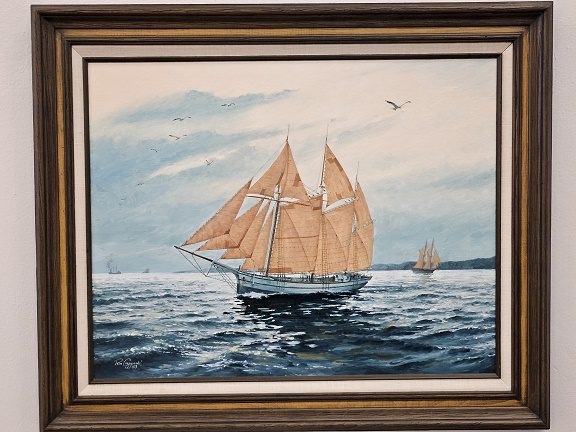
Photo at top of page: The LILY E. a painting by Ron Ceszynski
“Many of the sailing vessels of the Great Lakes fell victim to the ever present perils of wind, waves and ice that had to be faced in performing their services. Those that survived were often relegated to service as river barges, harbor lighters, grain warehouses, etc., or abandoned in backwaters until they too had gone to pieces. There were a few that assumed unusual duties and this is the story of one such schooner which survived 43 years as a commercial vessel before being converted for service of a more genteel nature. However, even in this case the natural elements which exerted their presence with such great fury were to eventually seal her doom.
“Jasper Hanson came to America from Denmark and settled in Manitowoc where he earned his livelihood as a shipbuilder. In the fall of 1868, he completed the beautiful schooner JESSIE PHILLIPS and then commenced work on another of nearly the same size to be ready for the water the next spring. He laid the keel at the end of October in the yard near Jones’ mill where the FLEETWING and the PHILLIPS were built. The new schooner was designed for the lumber or grain trade to have a carrying capacity of 160,000 ft. or 13,000 bushels, and was to be named LOUISA MCDONALD after the daughter of a former resident of Manitowoc.
“It was common practice in the days of sail to “recycle” outfits; i.e., sails, ground tackle, etc., particularly when a vessel was lost since these were the major items that could be salvaged. Such was the case for the MCDONALD because as if by providence, the outfit for the new schooner was delivered by disaster on almost the very day her keel was laid.
“On October 30th, the schooner JAMES NAVAGH of Oswego en route to that port from Milwaukee with 15,045 bushels of wheat struck upon Two Rivers Point. The stern was carried away taking the yawl boat with it and the cabin quickly filled with water. The crew of nine including Capt. John M. Griffin were compelled to crawl out on the bowsprit and jibboom to keep above the water where they remained for about 10 hours before being rescued in two Mackinaw boats manned by residents of Two Rivers. Mrs. Margaret Miles, a widow from Chicago who was the cook, was brought ashore, wrapped in dry clothing, placed in a wagon and driven to Two Rivers as rapidly as possible, but died immediately afterwards.
“The NAVAGH broke in two and went to pieces so that there was no prospect of saving anything beyond the outfit. Messrs. Jones and Hanson purchased the wreck from the insurance company for $1,000 and Capt. James Hughes and his sons recovered both anchors and a large portion of the chains, spars, etc., for use in the new vessel.
”The construction of the fore-and-aft schooner was so far advanced by December that planking had already commenced. The MCDONALD was launched on May 22, 1869, and enrolled at the Port of Milwaukee on June 4th, with the Official No. 15872. Her measurements were 123.6 X 25.6 X 8.0 ft. and 191.59 total tonnage. She cost the owners: Alonzo D. Jones (1/2), Jasper Hanson (1/4), and D. J. Easton (1/4) in the neighborhood of $13,000. On her maiden trip to Chicago under the command of the veteran master, Capt. Joseph Edwards of Manitowoc, she was freighted with 155,000 ft. of lumber, 36,000 lath and 100,000 shingles.
“Capt. Thomas H. Howland acquired a one-eight interest when he replaced Capt. Edwards before the season of ’70 and in his hands the MCDONALD made a good account of herself. She left Manistee at 8 p.m. on August 1, 1870, and arrived in Chicago on the afternoon of the 3rd to deliver 166,000 of joist and scantling; left Chicago on the afternoon of the 4th and arrived at Manistee again at 3 p.m. on the 5th, thus making the quickest round trip of the season in but three and a half days. James Quinn of Chicago became the principal owner of the MCDONALD in the fall of ’70 with Howland remaining as master. A third mast was added to the rig of the schooner before the season of ’77 and her life was uneventful until the great gale of 1880.
“When the storm struck on October 15th, the MCDONALD was in the fleet of nearly 30 vessels that ran for North Bay, a harbor of refuse on the Lake Michigan side of Door County. She was en route from Manistee to Chicago with a cargo of lumber when one of the most memorable storms on the inland seas destroyed or damaged a large number of vessels. Alter the schooner entered North Bay, she collided with the schooner FLORETTA which was already at anchor. The collision sank the FLORETTA and the MCDONALD suffered damage to her rail and stanchions but stayed afloat and managed to reach Manitowoc on the 23rd. She was repaired in the drydock at the shipyard of Hanson and Scove and departed for Chicago arriving there on November 7th. After discharging her cargo of lumber, the MCDONALD turned around for Manistee on the 12th.
“The schooner was involved in a second collision in the waters of Door County but in this incident she experienced the major damage. Shortly after noon on Wednesday, May 10, 1882, the wind in the vicinity of the Sturgeon Bay canal increased in force until a regular gale prevailed in the evening and throughout the night. Among the first craft to suffer damage was the MCDONALD which sought shelter form the storm in the canal. She came inside the harbor piers at the Lake Michigan entrance and let go her anchor because she could not get a tow into the cut. The heavy wind and sea dragged the schooner against the south harbor pier where she pounded heavily. A short time later the schooner HARVEY BISSELL also ran into the canal and let go her anchor. The wind soon drove her against the MCDONALD and both vessels were damaged by the collision. The damage to the BISSELL was light but the MCDONALD had her bulwarks stove in and canvas torn. She was unable to continue on her trip north and had to be taken to Manitowoc for repairs at a cost of about $1,000. The BISSELL also experienced some damage by collision with a second schooner, the JOHN L. GREEN, but they were able to make the necessary repairs in the canal and continue on.
“The LOUISA MCDONALD was sold at the end of the ’82 season to Michael Engelmann of Manistee, a lumberman, who renamed her after his daughter LILY E. The name change became official on June 1, 1883, but first appeared on Enrollment No.153 issued at the Port of Grand Haven on June 23, 1883.
“This change in owner and district brought bad luck to the aging schooner.” FIND OUT IN HOW IN PART TWO.
(Schooner Days in Door County, by Walter & Mary Hirthe, p 71-80)
Suzette Lopez
Photo Credit: Great lakes Marine Collection of the Milwaukee Public Library and Wisconsin Marine Historical Society.
