
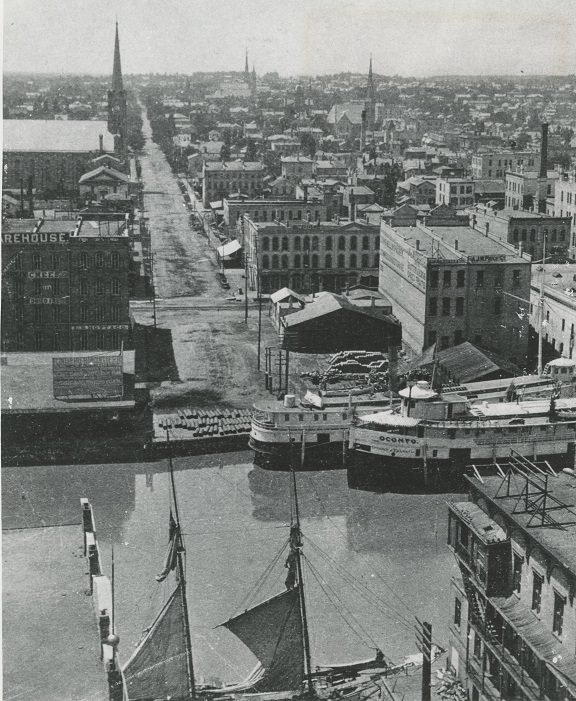
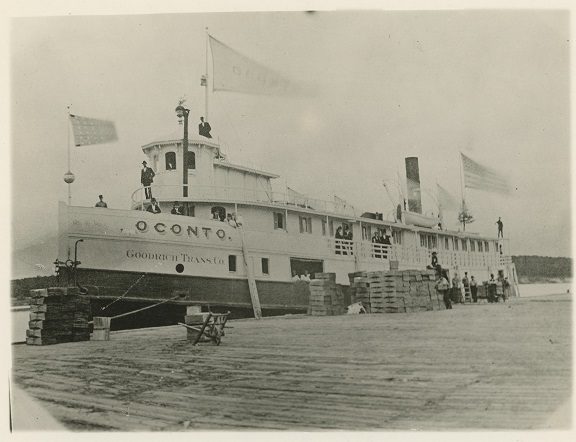
On this day September 20, 1880, the OCONTO was blamed for the burning of 60 dwellings and at least 30 barns in Green Bay, Wisconsin. The wooden steamer OCONTO was built in 1872 at Manitowoc by G. S. Rand for the Goodrich Transit Co. She measured 143 feet in length, 32 feet in beam and 10 feet in depth. She had an eventful career. Some might say she was not lucky but she did manage to have a bit of luck one time, when she wrecked on the Saturday morning her insurance was to expire at noon – so the wreck was covered. The following articles are a few of her mishaps during her career, starting with her burning Green Bay.
“Green Bay was visited by one of the most extensive conflagrations it ever experienced on September 20. There were sixty dwelling destroyed, and at least half that number of barns, to nothing of the damage done to grounds and shrubbery. The fire broke out in the old Astor plaining mill on Washington street, and spread to Adams, thence to Jefferson, and on to Madison. From here it took a jump clear to Cherry street, spread to Pine, from there to Main and to Cedar, on the East river. Outside aid was telegraphed for and fire steamers came from Depere and Oconto, but so terrifically did the wind blow that naught could stay the progress of the flames till they reached the river. The fire is supposed to have had its origin from flying sparks from a steamboat.
“In the present chaotic state of affairs, an estimate of losses is difficult to make intelligibly. It is safe to say it will exceed $125,000, ultimately. It is impossible to ascertain any item of insurance at present. The Presbyterian Church and parsonage, and the high school burned, and the Pine street school was on fire several times, but each time escaped. Among the prominent residences burned were those of J. Bennett, John Last, Dr. Britt, Judge E. P. Most, Postmaster Kimball, Dr. Munroe, E. Houskurm, J. McDonell, D. Williams, Conductor Monohan, J. J. Tracy, J. Shutte and R. Preble. Bad as the fire was, the citizens congratulate themselves that it stopped even where it did.
“The track of the fire was about a mile long, extending from river to river. Of the sixty families burned out and the two or three structures additional to residences, the total loss may be put at $125,000. Insurance $67,000. “ (Wood County Reporter, Thursday, Sep 23, 1880, p. 3)
Photo at top of page: OCONTO at Goodrich dock in Milwaukee River
——-
“Green Bay Globe: It is reported that the insurance companies which lost heavily in the fire of last week are about to bring suit against the Goodrich Transportation Co. for damage. They claim that they have good evidence that the fire originated from a spark from the smoke-stack of the OCONTO, of the Goodrich line, and are confident that they can cover damages. Of course if they secure a judgement, it will open the doors for people who lost by the first without insurance to bring similar action and the prospect is that no small amount of litigation will grow out of the fire.” (Superior Times, Saturday, October 9, 1880, p. 2)
——
“Wisconsin Waifs
“Green Bay Advocate: The Phoenix Insurance Company and the Presbyterian Church of Green Bay and the Phoenix Insurance Company and John Atkinson have commenced suits against the Goodrich Transportation Company, of Chicago, for the losses incurred by them by the great fire here on Sept. 20. It will be remembered that the ground of complaint is the allegation that the fire was set by a spark from one of the Company’s propellers not provided with a spark arrester. “ (Wisconsin State Journal, Monday, November 15, 1880, p. 1)
——
“On Sunday the steamer OCONTO, Capt. G. W. McGregor, was reported lost on Lake Huron with all hands, but word was received on Monday that she had grounded on Saturday morning on Charity Island. All were saved from the wreck. Captain McGregor was part owner of the boat. He at one time sailed the RIVERSIDE. Wm. Brown, the cook on the OCONTO, died from fright during the gale on Friday night. The OCONTO’s insurance expired at noon on Saturday and, as the accident occurred early Saturday morning, she will be covered.“ (Amherstburg Echo, Dec. 11, 1885)
——
“Detroit, Dec. 12, 1885. – The steamer OCONTO left Oconto December 4 at 4 P. M. and soon encountered a terrible gale. When the storm set in it became impossible to see and the lights went out. There were twenty-two passengers and twenty-five members of the crew on board. At 12 o’clock Friday night Charity Island light was sighted. Within fifteen minutes the OCONTO struck bottom at the Southeast point of the Island. The starboard bulwarks were stove in and all the upper railings, two of the life-boats and all the light freight on the hurricane deck were washed away. A blinding snow-storm prevailed at the time. The sea was so heavy that the engines could not keep the boat going. Finally a light was sighted. Everybody took it for the Tawas Light. In fact it was the Charity Island Light. The Captain set the boat around to feel for the entrance, and almost immediately there was a tremendous shock. The propeller had grounded in about six feet of water, but whether on rocks or sand no one could tell. The vessel was about a mile from land. As soon as the boat struck the crew began dealing out life preservers. After all were ready for the ice bath in which nobody could have lived for fifteen minutes it was discovered that there was no leak. When day broke the colors were set at half-mast, and all whistles were blown. About ten o’clock the lighthouse was sighted, and the small metallic life-boat was put over the side, and in it the firemen went ashore, there they found two fish huts. They then took the passengers, Twenty-three in all, ashore. Two ladies and a child were taken direct to the light-keeper’s house and the men began keeping house in the fish huts. Just before the OCONTO struck, Charles Brown, a colored cook, died of fright. The men who reached East Tawas had a terrible experience in the ice and they were completely exhausted. (Buffalo Daily Republic, December 12, 1885)
——
THE “OCONTO ” SINKS.
“The ill-fated steamer OCONTO, after contending with wind, wave and ice for four months and drifting nearly 20 miles from the place she first struck on that stormy night in December last, has gone to the bottom of Saginaw Bay, going down about where she hauled up in the storm of last week near North Island.
“Mr. Merriman, of Port Huron, representing the wrecking company which had contracted with the insurance companies to rescue the steamer, arrived in this city yesterday from Bayport. He states that she lies in 14 feet of water, with the water two feet above the main deck, and that four men succeeded in boarding her on Saturday and report her as in good condition. Later Mr. Merriman endeavored to reach her, but could not on account of the ice. The tug PETER SMITH was to have left Bay City yesterday morning for the OCONTO, but when ready to do so, her commander was informed of her having gone down, and consequently did not leave port. As soon as the ice disappears sufficiently to permit of work being done, a wrecking outfit will be sent from Port Huron and she will be raised.
“If the steamer is raised and is then found to be staunch and seaworthy, it is understood that she will be converted into a steambarge and used for towing purposes.” (Saginaw Courier, April 13, 1886)
——
“The steamer OCONTO, ashore at Charity Island since last fall has been released and arrived here this morning at 7 A. M. She will go into Wolverine Dry Dock for repairs.” (Port Huron Daily Times, Tuesday, May 4, 1886)
——
“The propeller OCONTO, now lying at Port Huron, is being thoroughly overhauled. The damage she sustained by being wrecked at the Charity Islands is not as great as was at first supposed. When the repairs are finished she will run as a passenger and freight boat between Point Edward and Duluth. “ (Saginaw Courier, June 12, 1886)
——-
“The Prop OCONTO Sinks – Yesterday while workmen were unloading the prop. OCONTO, wrecked near Fisher’s Landing, they heard the timbers crack, and she began to sink. All jumped from the boat except Joseph Jellie, of Ogdensburg. He was carried down with her. As soon as he saw she was sinking he grasped the rope which he was fastening to a package and clung to it for his life. Before the boat struck bottom he was clear of her, and when the force of the suction from the sinking boat was spent he was pulled to the surface and carried ashore. Not more than one fourth of the cargo was removed. The boat sank stern foremost, and lies in 140 feet of water at the stern and 70 at the bow. Her topmast sticks above the surface a short distance.” (Kingston’s British Whig, July 13, 1886)
——
“HISTORY OF THE OCONTO – The steamer OCONTO, that struck the rock and went down in the St. Lawrence off Fisher’s Landing, has “a history” at Green Bay, Wis. Some years ago, when belonging to the Goodrich line, she lay at the dock in that city. Sparks from the smokestack fired a building and a large conflagration was the result. Numerous lawsuits for damages were instituted against the vessel owners by residents burned out, and the boat was in danger of libel and seizure. By an application of the company to the United States court the suits were consolidated and transferred to the higher court, with a petition also that the measure of damages allowed be no greater than the value of the Oconto and cargo at the time of the fire. Litigation is still pending. Late last season she was nearly wrecked on Lake Huron, involving repairs and overhauling at an expense of several thousand dollars during the past winter.” (Kingston’s British Whig, July 14, 1886)
———
“The prop. OCONTO, sunk just below the 1000 Island Park dock, has been sold to parties in New York City, and will be raised. (Kingston’s British Whig, July 26, 1886)
——-
“An attempt will be made on Wednesday to raise the steamer OCONTO, sunk near the lighthouse at Fisher’s Landing in 100 feet of water.” (Kingston’s British Whig, October 8, 1888)
——–
The attempt to raise her failed. She slide down the side of the channel and eventually broke in two.
Suzette Lopez
Photo Credit: Great Lakes Marine Collection of the Milwaukee Public Library and Wisconsin Marine Historical Society.
