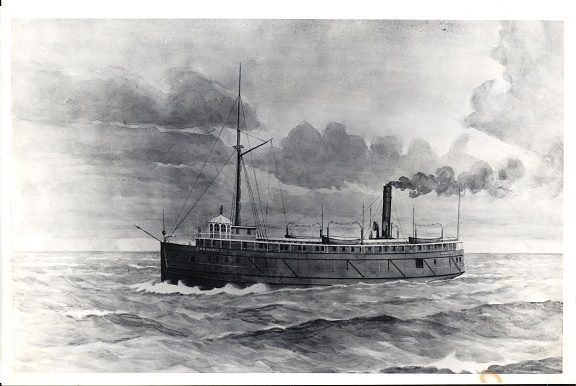
On this day October 5, 1863, the PEWABIC took on her first cargo at Cleveland. She was nearly completed but only able to carry freight. Her owners, Messrs. J. T. Whiting & Co., of Detroit, planned to get in three trips of cargo that fall and then finish her during the winter layup, adding the state rooms and everything designed for the comfort and convenience of passengers. Her officers were: Captain George McKay, Clerk E. F. Prince, First Mate John McKay, Second Mate William Randal, First Engineer R. C. Jackson and Second Engineer Arthur Sawtell.
The PEWABIC was built at Cleveland by Peck & Masters. She was a wooden propeller with one wooden middle arch concealed by cabins. She measured 200 feet in length, 31 feet in beam and 12 feet 6 inches in depth. She ran in the Lake Superior freight and passenger trade from lower lake ports. Pewabic was noted as an Indian word for iron.
On August 9, 1865, the PEWABIC collided with the propeller METEOR off Thunder Bay Light in Lake Huron about 8:30 pm. Both were running at full speed. The PEWABIC was struck on her port bow just aft the pilot house with such force her entire bow was crushed in. She sank in three minutes taking 33 passengers and 7 crew members with her. Many of the passengers had retired to their cabins when the collision occurred. The PEWABIC was heavily loaded with copper at the time, an estimated value of $130,000.
The two should have passed each other with no difficulty. The PEWABIC was on the side towards the shore and the METEOR was the opposite tack. An “unaccountable blunder on the part of someone” was given for the collision in the newspapers. In early September the Board of Inspectors in Detroit placed the blame wholly upon the PEWABIC’s captain George P. McKay and first mate George F. Cleveland. The first mate was arrested and released on bond. Trial took place in Detroit in April of 1866 and the mate was acquitted of the charge of manslaughter and discharged.
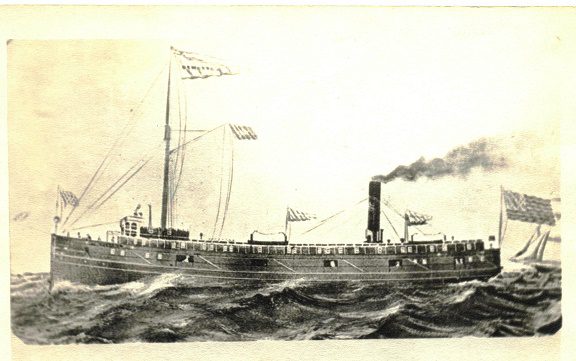
PEWABIC painting
The Marine Review of August 12, 1897, ran a letter from John M. Croneweth, who was the chief engineer of the METEOR at the time, describing the events of that collision. There had been different accounts of the collision in the newspapers and he wanted people to know what had happened from someone who was there. Below is an excerpt of that letter.
“On the night of the collision the METEOR was bound up Lake Huron with a full load of passengers and the PEWABIC was bound down. The weather with us (on the METEOR) had been very fine up to the time of the collision, but officers of the PEWABIC reported that they had for some time been running in mist and rain. It was quite plain to my mind that the main cause of the collision was the deceiving weather, mist, rain and some fog. On both boats the mates were on watch when the collision occurred. The mate of our vessel, the METEOR, said that he saw the white and green lights of the PEWABIC two points off our starboard bow about three minutes before the boats came together, and it was claimed that if the PEWABIC had kept her course the boats would have passed each other in safety; but it was held by this same source of evidence that all at once the PEWABIC shut out his green light and showed his red light. The METEOR’s wheel was put hard aport and one blast of her whistle sounded, but it was too late. A mistake had been made, and in a few seconds the METEOR crashed into the PEWABIC, cutting her about two-thirds in two. It has always been my opinion that the mate of the PEWABIC was deceived by the condition of weather and had misjudged the distance between the two vessels. He thought he had plenty of time to pass to starboard. Many of the passengers who were saved jumped aboard the METEOR while the boats were wedged one into the other. About three minutes after separating, the PEWABIC went down bow first. The pitiful cries of the drowning, struggling for help, are still in my memory, and will remain with me while memory lasts. Both crews did all they could to save life, but it was difficult to find people in the water. On account of the mist and rain the rescuers could be guided only by the cries for help.”
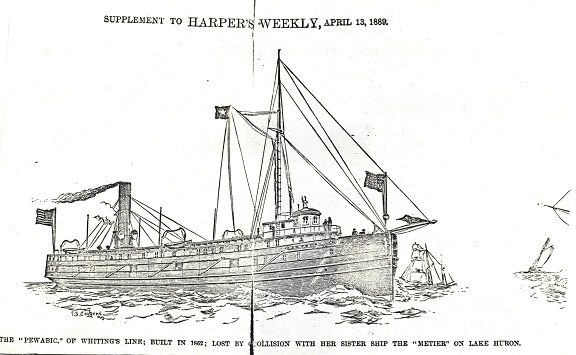
PEWABIC sketch from the Harpers Weekly Supplement of April 13, 1889
Various attempts were made to recover the copper and her safe. Several divers lost their lives during these attempts. In the fall of 1865, Billy Pike drowned. Two or three were drowned during attempts in 1880 and 1884. In 1892, Oliver Pelkey was drowned in a diving suite. In 1897, George M. Campbell and Peter Olsen drowned when the glass of the diving bell broke while they were working on the wreck.
It is said in June 1917, Benjamin Leavitt of Toledo went down 180 feet and brought up a portion of the bulwark, scrollwork and a stuffed American eagle among other items. In September some 70 tons (amount varies in several articles) of copper was recovered along with 10 heavy rolls of leather.
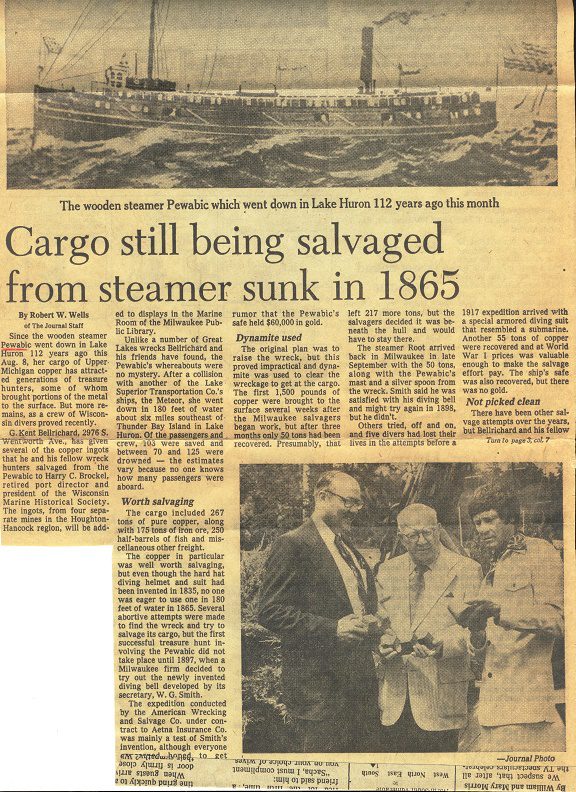
Milwaukee Journal Green Sheet story on the PEWABIC, August 1, 1977.
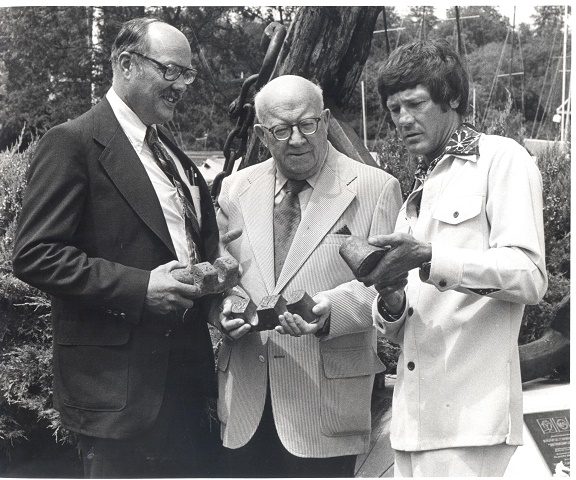
John Steel, Harry Brockel and Kent Bellrichard viewing the PEWABIC copper ingots, August 1977.
In 1977, local wreck hunter Kent Bellrichard presented Wisconsin Marine Historical Society’s President John Steel and retired Port Director Harry Brockel with copper ingots from his dives on the PEWABIC.
Suzette Lopez
Photo credit: Great Lakes Marine Collection of the Milwaukee Public Library and Wisconsin Marine Historical Society.
