By James Heinz
Actually, Thomas Jefferson has already been here and Neil Armstrong has just arrived as I write this. I am not referring to those two famous men. Instead, I am referring to two research vessels operated by the National Oceanic and Atmospheric Administration (NOAA).
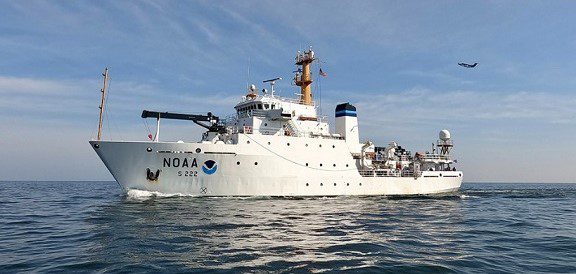
NOAAS (NOAA Ship) THOMAS JEFFERSON was launched in 2014 in Anacortes, Wash.. I already described her sister ship R/V KNORR, which was built by the DeFoe shipyard in Michigan and which found the wreck of RMS TITANIC https://wmhs.org/the-great-lakes-built-ship-that-found-the-titanic/ .
THOMAS JEFFERSON first came to the Great Lakes in 2022, where she surveyed 596 square miles of Lake Erie, rescuing three fishermen in a small boat stuck in a storm as she did so. She then surveyed 363 square miles of Lake Ontario. In the course of these surveys, she discovered 42 shipwrecks, some previously unknown.
THOMAS JEFFERSON off Cleveland in 2022 courtesy of Wikipedia
Despite the density of marine traffic on the Great Lakes, the NOAA website tells us that only 17% of the Great Lakes has been mapped to modern standards, Lake Erie not having been mapped since the 1940s. This mapping is not only necessary for navigation, but also to understand underwater habitats for resource conservation.
NOAA does not map every part of the Great Lakes but only those identified by a hydrographic health model that takes into account “both the likelihood of a risk (e.g., traffic density, known hazards to navigation, reported ship groundings) and the consequence of a risk (proximity to search and rescue stations, proximity to reefs or marine sanctuaries, etc.) “
THOMAS JEFFERSON courtesy of NOAA
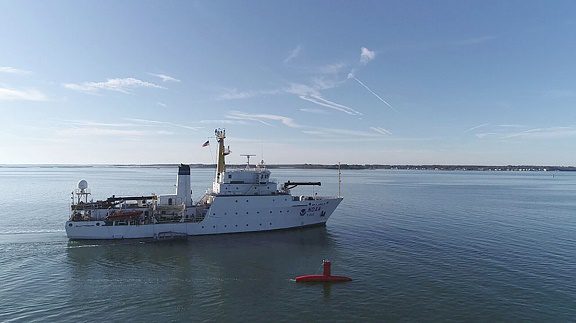
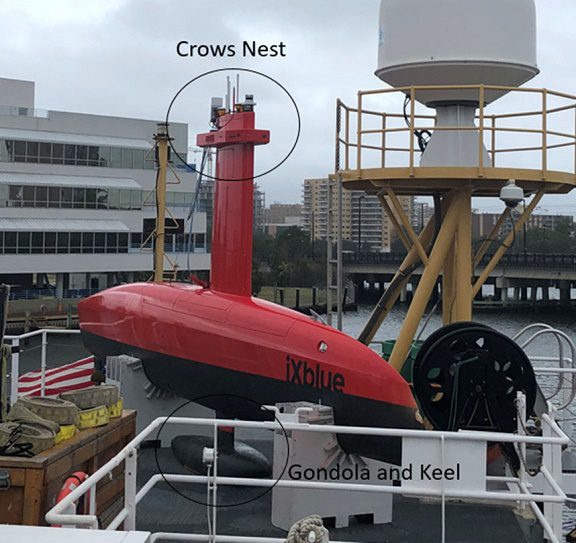
In 2026, the THOMAS JEFFERSON returned and mapped parts of all the Great Lakes except Lake Superior, including the Thunder Bay National Marine Sanctuary, and the area off Milwaukee. She used a DRIX robotic unmanned surface vessel with multibeam sonar to assist her. DRIX looks like a surfaced submarine but does not submerge.
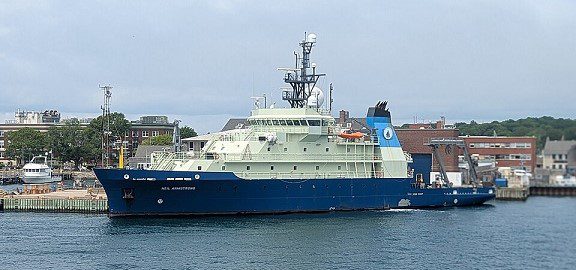
NEIL ARMSTRONG courtesy of Wikipedia
NOAAS NEIL ARMSTRONG was also launched in 2014 at Anacortes, Wash. She is currently operated by the Woods Hole Oceanographic Institute (WHOI). According to the WHOI website, she was expected to arrive in the Great Lakes on November 9 (but was early) to conduct research not into the Great Lakes but into the composition of the universe itself.
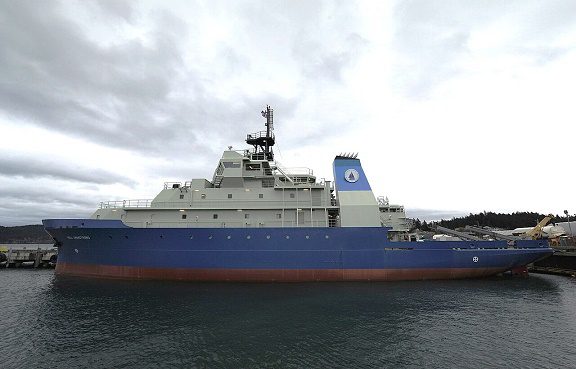
NEIL ARMSTRONG courtesy of Wikipedia
She will proceed to Duluth, Minn., where she will install five frames filled with equipment that will detect sub-atomic particles known as neutrinos as part of the Experimental Neutrino Detector program. Each frame is 30 feet tall and weighs 8,000 pounds. The detectors are large metal drums lined with plastic that light up when hit by subatomic particles. They will be lowered to the lake bed several miles off Two Harbors, Minn., and connected to shore by fiber optic cables.
This is research that R/V NEIL ARMSTRONG’s namesake would be proud of.
——————————–
James Heinz is the Wisconsin Marine Historical Society’s acquisitions director. He became interested in maritime history as a kid watching Jacques Cousteau’s adventures on TV. He was a Great Lakes wreck diver until three episodes of the bends forced him to retire from diving. He was a University of Wisconsin – Milwaukee police officer for thirty years. He regularly flies either a Cessna 152 or 172.
