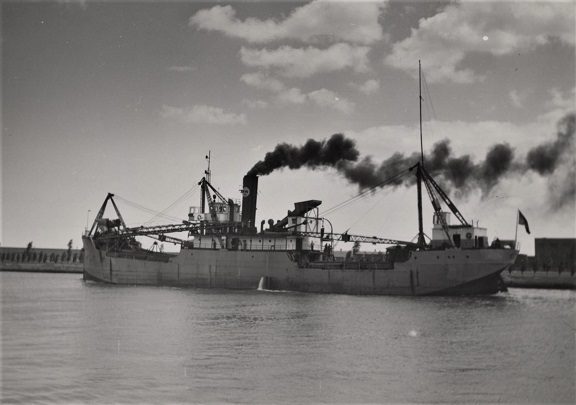
On this day May 30, 1942, the Michigan built FRED W. GREEN was sunk by three German subs in the South Atlantic taking her master and eight other crew members with her.
The GREEN was built in 1918 at Ecorse, Michigan, by the Great Lakes Engineering Works as the CRAYCROFT for the US Shipping Board. The CRAYCROFT was a steel cargo steamer built for World War I service but was launched about six weeks before peace was declared. She measured 253.5 feet in length, 43.8 feet in beam and 20.4 feet in depth. She did work on the Atlantic.
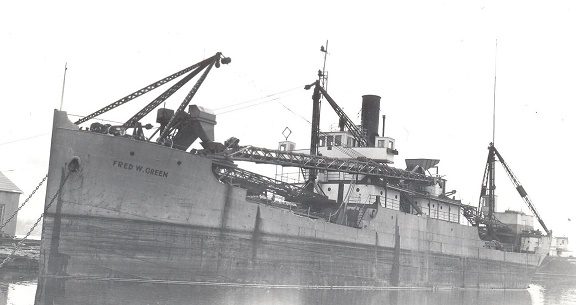
The CRAYCROFT was bought by John T. Roen of Charlevoix (Roen Steamships) in 1927 and rebuilt with a self-unloading conveyor, two 75 foot booms and a 1 ¼ ton clam. On May 22, 1927, the CRAYCROFT arrived in Milwaukee with a cargo of sugar from Philadelphia on her way back to the lakes. She was soon renamed FRED W. GREEN and worked in the sand and gravel trade being home ported in Sturgeon Bay. While still working in 1941, she was sold by the Northwestern Co. owners to the Maritime Commission for over $200,000 and sailed from Sturgeon Bay to New York on November 12, 1941.
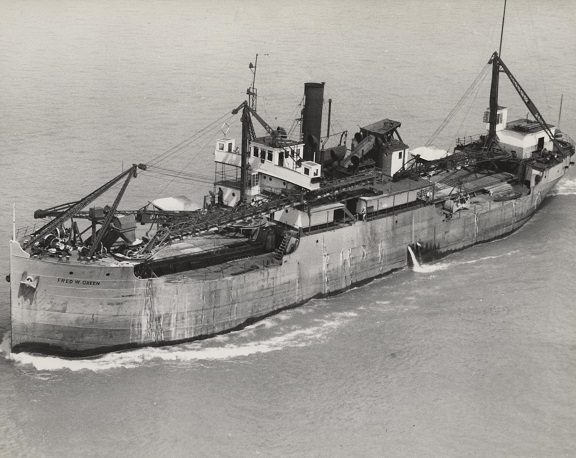
An Oerlikon cannon and two machine guns replaced her deck gear for this service. On May 24, 1942, the GREEN sailed from to New York with army trucks, ammonia and jars of nitric acid for Sierra Leone, West Africa. After passing Bermuda the crew thought they were safe.
A very suspenseful story written by surviving crew member Duncan Anderton appeared in a Scottish paper and was reprinted in John H. Purves’ book The Roen Steamship Company – The Way it Was. He tells his version of what had happened and how a toy compass he bought for hiking in Scotland saved his life.
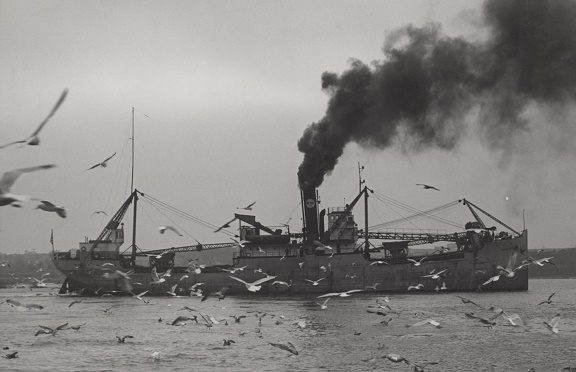
Dated 1941
Anderton claims the longest voyage the GREEN had been on prior to this trip to Africa was 10 hours on a Great Lake. Her top speed was six knots and German U-boats could do twenty knots. The GREEN was so heavy with her cargo and cranes that her deck was always wet as she was only about three feet above the waves and she left a huge trail of black smoke for everyone to see.
Anderton tells of being torpedoed by three U-boats, crawling along the deck while under fire and the ammonia smell choking him. Crew were lowering the lifeboat which was made to carry 27 but in the end had 32 in it. The U-boats stopped shelling once they had abandoned ship. One U-boat rose out of the water and the Captain asked if they could help. Niceties were exchanged and good byes were said.
As the life boat moved on, the U boats closed in and continued torpedoing the GREEN until she sunk. The crew rigged a sail assuming it could take a month to reach land and used his toy compass for direction.
Fortunately, 36 hours later the USS LUDLOW appeared at dawn. Unfortunately the LUDLOW mistook their sail as a U-boat conning tower and started dropping depth charges. This stopped quickly when the LUDLOW got a closer look. The survivors happily climbed the nets onto the destroyer.
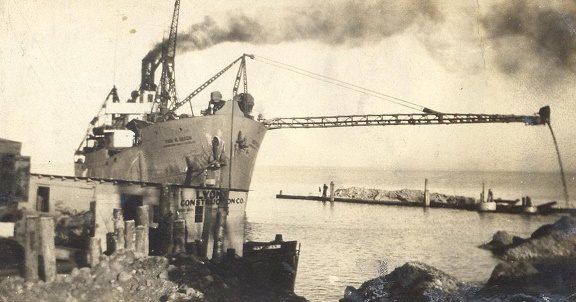
The GREEN’s Great Lakes career was mainly on Lake Michigan. She had worked on filling sand into the space between Milwaukee’s breakwater and the sludge tanks of the new aeration plant addition in July of 1934. She worked on other breakwater jobs but in the end was just hauling gravel, sand, crushed stone and coal. She could not compete with the bigger boats and thus was sold to the Maritime Commission.
Suzette Lopez
Photo Credit: Great Lakes Marine Collection of the Milwaukee Public Library and Wisconsin Marine Historical Society.
