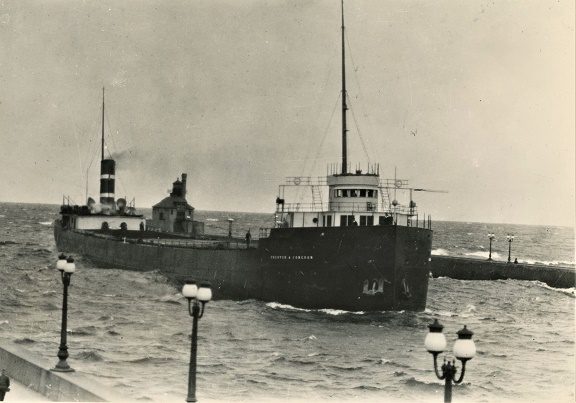
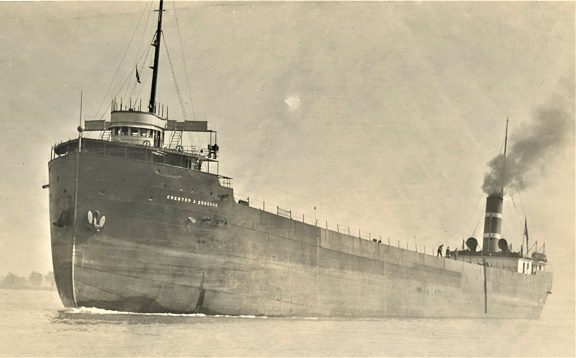
On this day November 8, 1918, the CHESTER A. CONGDON broke in two after going ashore on Canoe Rocks near Passage Island. The CONGDON actually ran ashore on the 6th but the story appeared on page 10 as the front page was full of headlines devoted to the ending of World War I.
Early morning on November 6, around 2 am, the CONGDON left Fort William, Ontario, downbound with around 380,000 bushels of wheat headed to Port McNicoll. The wheat was worth about $2.35 a bushel giving the cargo a value of $890,000.
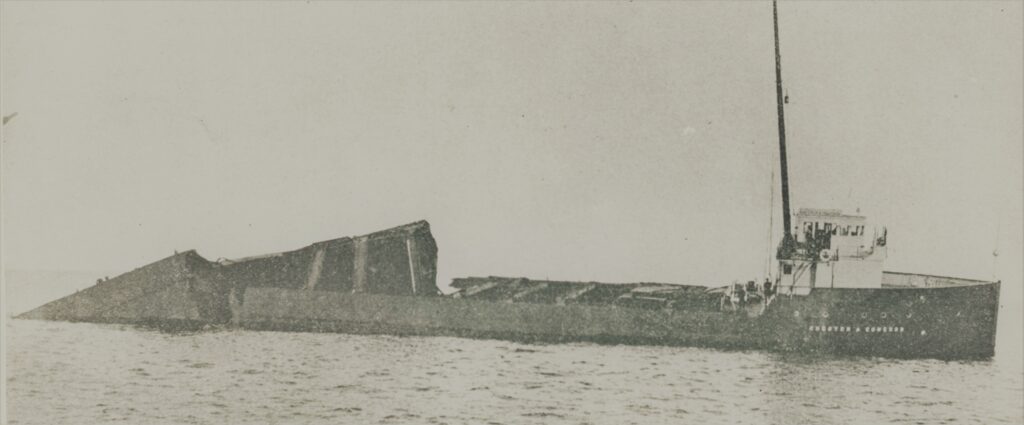
She encountered a southwest gale and a heavy sea, so she retreated to calmer water and anchored for about 6 hours until the wind let up. The CONGDON continued around 10 am. After passing Thunder Cape she came upon a dense fog. The officers did not hear the Passage Island fog signal and ran on the southerly reef of Canoe Rocks. The boats were launched and crew sent different ways to get help. Word reached Fort William and the tug CONMEE and wrecking barge EMPIRE responded. The crew was taken off by the CONMEE and taken to Port Arthur. Only 13,000 bushels of wheat were removed by the EMPIRE. The heavy seas continued and she broke in two, her stern sinking into deep water. Tugs stood by, but it was out of their hands.
The CHESTER A. CONGDON was launched in August of 1907 at Chicago as the SALT LAKE CITY. Built by the Chicago Shipbuilding Company for the Holmes Steamship Co., W. A. Hawgood and A. H. Hawgood, she was christened by Miss Dorothy Holmes the granddaughter of the company’s president. Her captain was James Owen and her chief engineer was John Chapman. She measured 552 feet in length, 56 feet in beam and 26.5 feet in depth. She was renamed in 1912.
The following is some great photography and a diver’s story from our Shipwreck Ambassador Cal Kothrade.
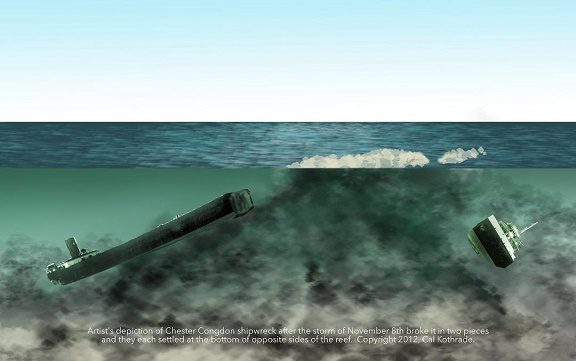
The steel freighter CHESTER A. CONGDON is one of those wreck dives that has a little something for every diver. When the storm of November 8th broke the 532 foot vessel in two pieces after being stranded on the rock reef for two days, the bow slid down one side of the reef, while the rest of the ship slid down the other side.
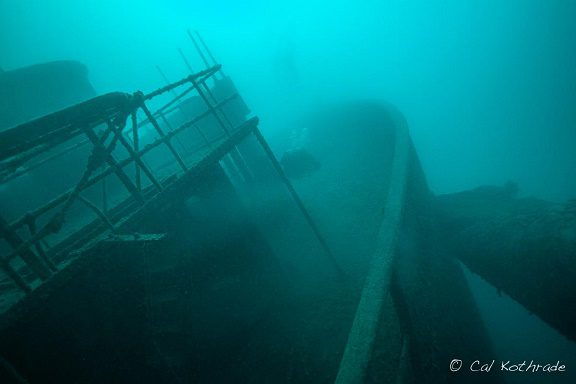
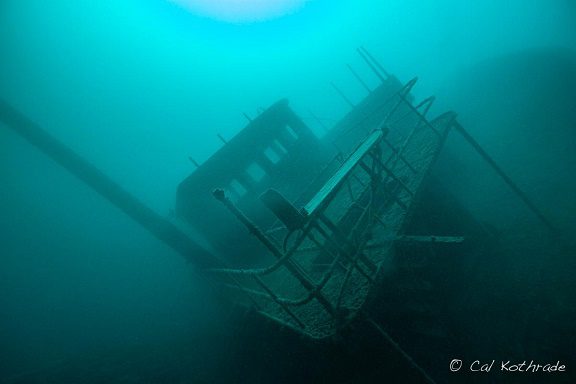
The bow, somehow managed to turn around 180 degrees to finally come to rest on the bottom at a depth of about 80 feet. It now points back up the slope, as if it were a head looking for its own body.
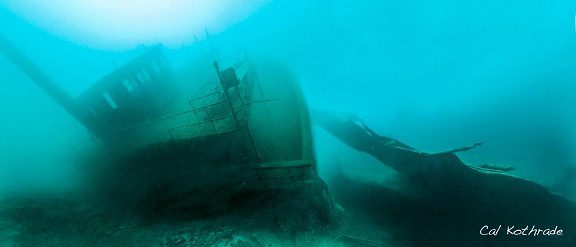
The various rooms and decks are easily penetrated for even recreational divers and she is in great condition. There is other associated steel plating and debris on the bottom along with the bow.
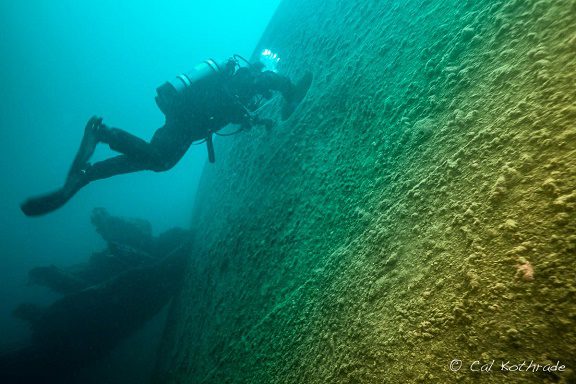
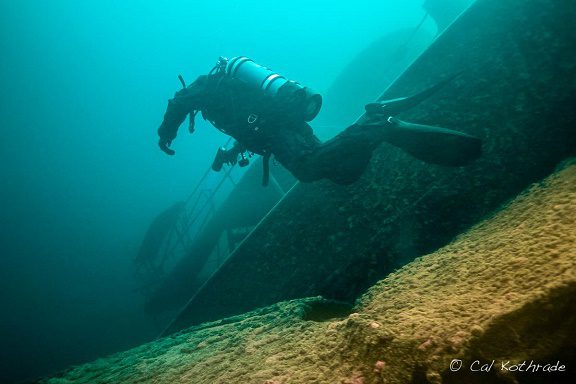
The stern is another dive altogether and I regrettably did not have a chance to dive this section. If one wants to visit the very aft portion of the hull, it will be a technical dive as it reaches depths well beyond 130 feet, and it is of course a very long swim down the length of the hull if you start at the point where the vessel came apart.
Lake Superior is the only Great Lake not yet inundated by the invasive zebra and quagga mussels, so the shipwrecks are amazing. The diver is able to examine how wood ships were assembled, see the rusting steel and rivets, as well as easily recognize small items like hand tools, dishware, etc.
The flip side of that coin is that the water clarity in my opinion is significantly less on average than Lakes Huron, Michigan, and Ontario. The mussels are filter feeders, and over many years, they actually cause the water to become clearer. The other Lakes were once less clear than Superior, with visibility of 5-10 feet being reported as excellent by divers of the time. That time of course being before the mussel invasion in the 80’s. Superior was always more clear due to the colder water, among other factors.
During my week of diving shipwrecks around Isle Royale in 2012, I routinely experienced visibility of 25-50 feet at best. It was also quite cold. We did however manage to shed our drysuits and actually swim in the lake to get clean from time to time. It was August and I would not recommend doing this in the earlier summer months.
I also feel that each Lake has its own color. I know that sounds funny, but on average when you look at the color of the water from both above and below, they all have a slightly different cast. In my opinion, Superior’s is the deepest, darkest blue of them all. I’m sure this helps to make it feel colder than the other Lakes too.
Images were created with a Canon T1-I Rebel DSLR mated to a Canon 10-22mm super-wide rectilinear lens, in an Ikelite housing using natural light and Ikelite DS-161 Movie strobes X2. Post production was performed in Adobe Lightroom. Cal Kothrade.
Suzette Lopez & Cal Kothrade
——————————————————————-
Cal Kothrade is the Shipwreck Ambassador of the Wisconsin Marine Historical Society, a diver, a photographer and an artist. His work can be viewed at www.calsworld.net
PHOTO CREDIT: Above water – Great Lakes Marine Collection of the Milwaukee Public Library and Wisconsin Marine Historical Society. Below water – Cal Kothrade.
