
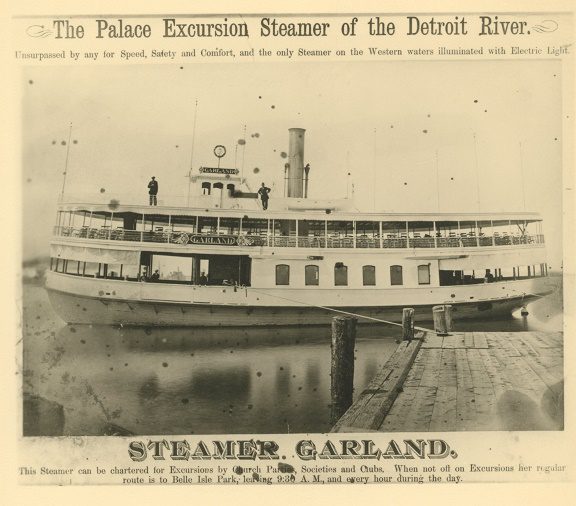
On this day July 22, 1880, the two month old passenger ferry GARLAND was on her way down the Detroit River around 10 in the evening with a party of about 800-1200 (newspaper accounts vary) Detroit Stove Works employees and their friends. When near the Grassy Island Light, she collided with the steam yacht MAMIE carrying amongst the 24 on board the Father and 16 altar boys from the Holy Trinity Catholic Church of Detroit. The MAMIE was cut in two amidships and sank in a few minutes, taking 16 of the 24 with her. The following is the very sad account of what happened.
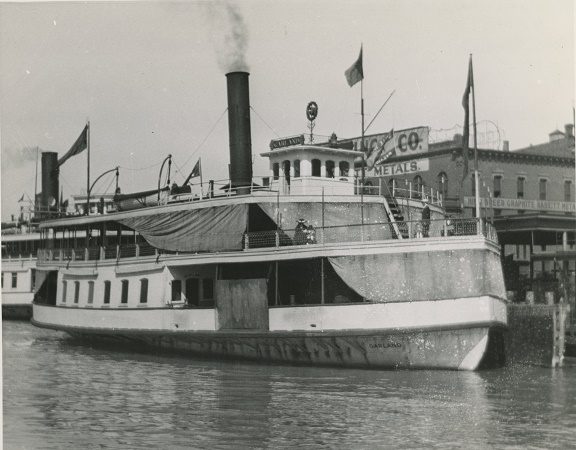
The GARLAND at Detroit in 1938
“The GARLAND, with Capt. George Horn in command and Pilot H. W. Buff at the wheel, steamed directly down the river for Grosse Isle. The scene on the GARLAND was one repeated almost every summer night of the year at the City of the Straits. The bright waters were dancing in the light of the full, round July moon, and on deck where the brilliant electric light shone on hundreds of happy faces, all was mirth and jollity. An hour and a half rolled by and the big steamer glided easily along when a sharp whistle was heard almost directly under the bows of the GARLAND. In less than a minute a crash followed the whistle. Then from mirth and gaiety the scene changed to one of distress and horror. Amid the snapping of crashing timbers, and the groans of the ponderous laboring engines were mingled the despairing cries of drowning boys and women struggling in the water. As soon as the excursionists on the GARLAND comprehended the situation, women shrieked and fainted and all was confusion on deck. But brave, strong men were there and they did all they could to succor and save. The GARLAND’s life-boat was immediately lowered, life-preservers and chairs were thrown into the water and the river was strewn with floating particles, but within three or four minutes the little craft, which but a short time before was plowing the water with its load of young life, had sunk beneath the waves.
“Out of life into eternity! Each fresh disaster seems more awful than the preceding one. The shepherd surrounded with his little flock amidst a merry, joyous scene. But a moment sufficed to change it all. The pastor and seven others were saved, but sixteen went out “on that sea which rolls all around this world.” Three were women and sixteen [thirteen] were boys – youths in their teens, full of the day’s delights, and doubtless even then framing the account which on the morrow they would give their parents of the happy day they spent. No time for prayers – no time to utter the sacred name of mother. Five minutes sufficed for it all, and the moon shone coldly down on the cruel waters that gave back no answering look of pity, rolling on over the silent dead.
“Capt. Horn’s statement. – Capt. George Horn said: “The accident took place just below the Grassy Island light. It is pretty tough, I tell you. We did all we could; lowered the life-boat at once and manned it and threw out the life-preservers. I think the MAMIE must have been trying to cross our bows squarely and that is the reason we struck her amidships. We were going down and she was coming up. I was near the wheel. She showed us nothing but a bright light. She gave one whistle under our bows and we immediately answered it and backed our engine.”
“The pilot’s statement. – H. W. Buff, the man at the wheel, said: “I saw a bright light some time before we got to the MAMIE, a long distance, and I took it to be an anchor light. I had my wheel to leeward and was trying to keep away from it. As we got between the two lights (the Grassy Island and the Mamajuda) I saw the anchor light, as I supposed it, still in our path. There was no red light or green light, which the MAMIE should have carried. About fifty feet from our bow she blew one whistle. I answered it and immediately backed my engine and put my wheel hard a-port. I called Capt. Horn to come and help me at the wheel and he did. We picked up four in our life-boat and Father Bleyenbergh and three others jumped on the GARLAND from the deck of the MAMIE.
“Thomas Eagan and three others of the GARLAND’s crew entered the life-boat and picked up four of the boys. He says the MAMIE sank almost immediately.
“Father Bleyenbergh’s statement. – I left the city Thursday morning on the steam yacht MAMIE to give my altar boys their annual excursion, going to Monroe. We had on board seventeen boys, four ladies, the captain, engineer and myself, twenty-four in all. Arriving at Monroe we passed the day pleasantly and shortly after 5 o’clock in the afternoon started for home. When about halfway between the Grassy Island and Mamajuda lights I saw the steamer GARLAND coming down the river and, following behind, the steamer FORTUNE. At that time the moon was shining brightly and we could see in any direction nearly as far as in daylight. The ladies and myself, the captain and engineer and two or three of the boys were outside of our cabin while the rest of the boys were in the cabin. As the GARLAND neared us I remarked to the ladies: “That boat is coming unpleasantly near to us.” The next instant I saw there was going to be a collision and cried, “She is going to run into us. Come forward quickly!” As I spoke I sprang to the bow of the yacht, followed by Miss Dusseau. I do not believe it was thirty seconds from the time I first spoke to the time I sprang to the bow of the yacht, for the GARLAND was going very rapidly and came upon us like the wind. When I reached the bow of the yacht, Miss Dusseau was at my side and we were just in time to get hold of ropes hanging over the guards of the GARLAND. The next instant I felt a shock, heard a crash. While Miss Dusseau was helped aboard the GARLAND by some man, I climbed up the rope to the deck. Instantly I ran across the deck to the other side of the boat, expecting to see some of my party struggling in the water. When I got there I saw the sinking wreck of the MAMIE just disappearing under the bows of the FORTUNE, while I saw four or five persons struggling in the water. Meanwhile, the GARLAND’s engines had been stopped and there was a terrible scene on board. People not knowing the nature of the calamity were putting on life-preservers, seizing floats and screaming. Ladies were fainting and men were shouting with fear. Soon, however, the real condition of affairs was ascertained, life-preservers were thrown overboard, a life-boat was lowered away and manned, and, in fact, everything possible was done to save any persons who might be found. Only six persons were picked up and it is my opinion that the poor boys died together in the cabin, as the boys saved say that they escaped by crawling through the cabin windows. I do not think the MAMIE was two minutes in sinking out of sight. I do not feel certain to state it, but I know when I first saw the GARLAND and the FORTUNE they were both going very swiftly and I know that when I got aboard the GARLAND and the passengers were screaming and shouting to the FORTUNE to stop, that boat did not slacken her speed but passed on, with her passengers cheering as though in answer to what they supposed was applause from us. Whether the boats were racing I do not know. In answer to the question: “Were there any whistles sounded?” Father Bleyenbergh answered: “Yes, both boats blew their whistles before the collision.” He could not tell, however, which whistle sounded first or how many blasts were given by either whistle. The MAMIE at the time of the collision was going up stream and could not have been making more than six or eight miles an hour. I do not know where the blame belongs, but there was terrible carelessness on the part of someone.” Several times during the interview Father Bleyenbergh, who was very much overcome by his awful experience, was required to assuage the grief of Miss Dusseau, who lost a sister (the wife of the engineer) by the disaster, while all through the house were sobbing servants and assistant priests, going about with tears streaming down their cheeks. Father Bleyenbergh repeatedly asserted that at the time of the collision the moon was shining very brightly and that he and his companions saw the GARLAND, the FORTUNE and other boats many minutes before the fatal meeting.
“Capt. W. Hoffman, in command of the MAMIE, is a native of Detroit, is a very boyish-looking man for his age, 27 years, and in appearance gives no indication of a man accustomed to face difficulties such as a captain of the smallest vessel is liable to encounter. Nevertheless he seems to have had considerable experience, having, he said, had sailing master’s papers for the past three years. In that time he has been master of the GEN. SHERIDAN, running from Sutton’s Bay to Traverse City and Petosky on the Lake Michigan shore; master of the steam yacht LOUISE of Detroit; pilot of the tug BALLENTINE, two years ago; and commander of the MAMIE since last spring. He stated positively that the red and green side lights were burning on the MAMIE, as well as the white light at the masthead. The side lights are not visible from the pilot-house, but about five minutes before the collision he looked out to see that they were all right. The lights are so fastened to the side frames that it is impossible for them to be detached, and when the wreck is raised, he avers, his assertion will be found correct. When he blew one whistle the GARLAND was “a good block away” (this was his way of expressing distance) and the whistle was answered almost immediately. The GARLAND seemed coming down at full speed. She ported and he did the same. The GARLAND then came about, showing both her side lights, and stood right for the MAMIE. He threw his wheel hard a’port and was immediately struck by the GARLAND on the port side, forward of the pilot house, which is about 15 feet from the bow. “When she struck us, said Capt. Hoffman, “She came right upon us, seemed to slide off and struck us again. I then left the pilot house and sprang for the GARLAND’s deck, missed my hold and was dragged aboard by someone. Fred. Martin, the engineer, had jumped on before me.” Capt. Hoffman says that Beardsley, ticket agent of the Garland, told him and Mr. Abar, owner of the yacht NELLIE ABAR, and over fifty other persons on the ferry wharf next morning that the engineer of the GARLAND got no bells at all, but backed off his own accord when the collision took place. Hoffman says the night was clear and bright and that a few minutes before the collision he saw a propeller lying at the dock at Wyandotte.
“The boys ranged from 11 to 16 years of age, and were bright, happy lads chosen for their aptness, grace and manliness to positions of honor in the church of their parents, making the task of notifying the parents of the horrible blow which had befallen them all the more painful for the clergymen. The duty had to be done, however, and was done by priests who came to Father Bleyenbergh’s house from all parts of the city. The scene witnessed by the messengers of the sad news may never be known and cannot possible be realized.” (Amherstburg Echo, July 30, 1880)
—–
“The GARLAND-MAMIE Disaster.- The board of United States steamboat inspectors which conducted the investigation of the GARLAND-MAMIE disaster, has prepared a long report, in which Capt. Geo. D. Horn of the GARLAND and Capt. Wm. Hoffman of the MAMIE are found guilty of neglect and their licenses revoked – Capt. Horn for neglecting to keep a proper lookout and Capt. Hoffman for violating rule three, which declares that when signals of two approaching vessels are misunderstood, both vessels shall slow up, retaining only sufficient speed to give steerage way. It appeared from the evidence that Hoffman did not blow his first signal whistle until the MAMIE had approached within five or six hundred feet of the GARLAND. The other facts established by the investigation are that the GARLAND was in her proper course, that the MAMIE was not in her proper course at the moment of the collision; that the MAMIE’s lights were all burning in their proper places; and that if the GARLAND was overloaded, nothing appeared in the evidence to warrant such a conclusion – the number on board being placed officially at 800. There is a general opinion among vessel men that the decision of the inspectors was just and equable. The Horns are afforded a certain degree of satisfaction because the GARLAND was not censured, so far as her keeping in her proper course and observing the customary rules of navigation were concerned, but simply for not having a lookout at the bow, a regulation not observed by any of the river or ferry steamers. The MAMIE’s owners were much surprised at the decision, and intimated that an appeal would be taken. Buff, Horn’s wheelsman, had no license at the time and was not acting as pilot, but merely as wheelsman under Horn’s orders. A charge of manslaughter, brought by a coroner’s jury, rests against Horn and Buff, and under this the latter cannot escape responsibility.” (Amherstburg Echo, August 20, 1880)
The GARLAND was built in 1880 by the Detroit Dry Dock Co for the Detroit Belle Isle & Windsor Ferry Co. She was 107 feet in length and 29 feet in beam. In 1924, she was sold to the Port Huron and Sarnia Ferry Company of Port Huron to run as a ferry between Port Huron and Sarnia, and renamed CITY OF SARNIA. In 1936-37, this line was bought out by the State of Michigan, who still continued to operate the boats. Herman Runge stated that as of October 1938, the boat would carry pedestrians only after the new high level Blue Water bridge was put into operation. She eventually sank at Port Huron in 1942 and was raised and scrapped in 1947.
The steam yacht MAMIE was reportedly raised and rebuilt.
Suzette Lopez
Photo Credit: Great Lakes Marine Collection of the Milwaukee Public Library and Wisconsin Marine Historical Society.
