By James Heinz
In the 1850s a long-forgotten conflict raged on Lake Michigan, a conflict that would determine the fate of the entire Midwest. I hereby give this forgotten conflict a name:
The Lake Michigan Dredge Wars
In a recent lecture at the Kenosha Civil War Museum and in his book Mastering the Inland Seas, Dr. Theodore Karamanski points out that the key ingredient in the economic development of the Midwest and its vast industrial capacity was the availability of water transportation on the Great Lakes. And until after the Civil War, this priceless advantage could not be fully developed because of one institution:
The United States Congress
Prior to the Civil War Southern congressmen would not vote any appropriations for what they called “internal improvements”, or what we now call Infrastructure, that might disproportionately benefit The North, such as harbor dredging on the Great Lakes.
In those days rivers were used as harbors and their entrances were blocked by sandbars, as I described in a previous article: https://wmhs.org/milwaukees-first-cargo-pier-is-commemorated/
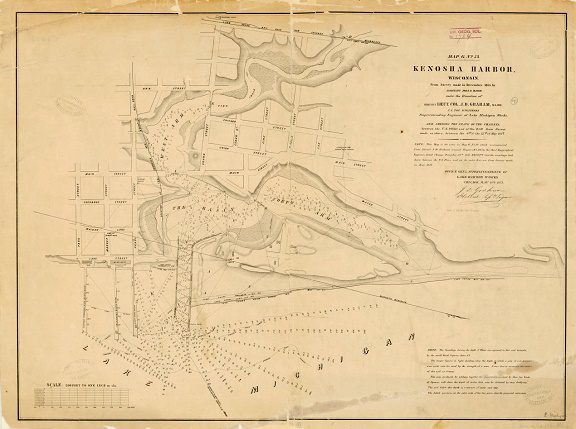
Kenosha Harbor courtesy of UWM American Geographical Society. The harbor survey was by Col. Graham about 1857
Attempts to dredge the sandbars that blocked the entrances to rivers using steam dredges belonging to the U.S. Army Corps of Engineers were blocked by Southern congressional frugality. There was only one dredge assigned to Lake Michigan, which was under the control of the Secretary of War.
The sole dredge promptly became a political football, with every lakeshore community clamoring for it to clear their harbor. Even if the dredge were available, Congressional appropriations to pay for its operation often were not.
According to the book Those Army Engineers: A History of the Chicago District U.S Army Corps of Engineers, in 1854 the Corps’ dredge had cut a channel through the sandbar at the mouth of the Chicago River. The dredge was then transferred to Kenosha and began work there in the spring of 1855.
However, by the summer of 1855 the sandbar at the mouth of the Chicago River simply came back. The Chicago city council voted early and often to demand that the dredge return to Chicago. Kenosha equally repeatedly refused to send it back.
Dredging at Kenosha stopped on September 17, 1855. Only 39 days had been suitable for dredging the Kenosha harbor that entire summer and the job had apparently not been completed.
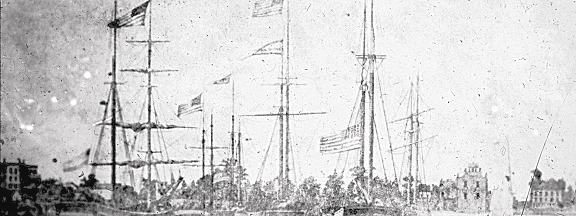
Photo at top of page: Kenosha harbor around 1856 courtesy of the Kenosha History Center
To prevent the dredge from leaving Kenosha, on September 27, 1855, the Kenosha County Sheriff and members of the Kenosha City Council boarded the dredge, and after a scuffle with its caretaker, removed a pile driver hammer, the dredge bucket and other items without which the dredge could not function. The Kenosha sheriff then seized a crane scow and pile driver as well as four other scows, all belonging to the federal government.
A September 28th letter from Colonel James Graham of the Corps demanding the return of the dredge produced a September 29th response from the mayor of Kenosha that the “The property in question has been legally taken and is legally held.”
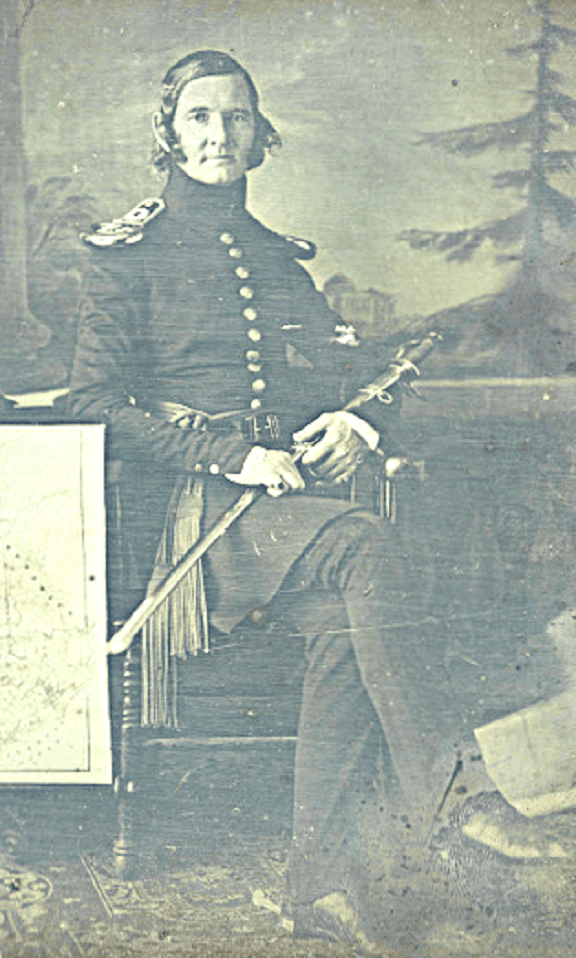
Col. James Duncan Graham courtesy of Wikipedia
Colonel Graham Was Not Amused. The same day he sent another letter to Kenosha alluding to the presence of the warship USS MICHIGAN and its 14 cannons on the Great Lakes and stating “I suppose you are aware that the penalty, in each case of conspiracy by false pretenses against your country may extend to years of imprisonment in addition to heavy pecuniary fine.”
This letter produced a prompt October 1st response from the President of the Kenosha Common Council saying that their militant mayor had suddenly gotten sick and that the Federal property would be returned.
The then Secretary of War Was Also Not Amused. According to Dr. Karamanski, the Secretary declared that Kenosha’s seizing of Federal property amounted to treason against the United States government. Who was this Secretary of War?
Jefferson C. Davis
Yes, that Jefferson Davis, the Jefferson Davis, first and last president of the Confederate States of America, who would commit his own act of treason by seizing Federal property at a place called Fort Sumter six years later.
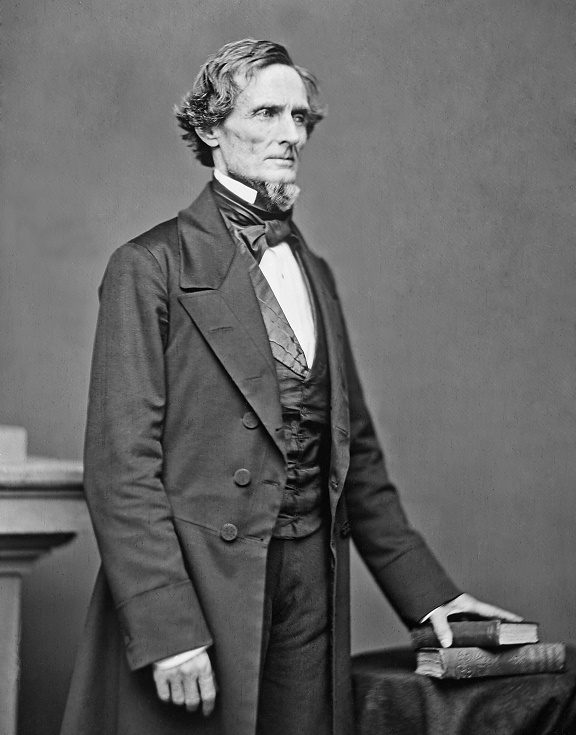
President Jefferson Davis courtesy of Wikipedia
Besides the abolition of slavery and the preservation of the Union, one of the positive effects of the Civil War was that federal funding to improve navigation on the Lakes was no longer restricted and the region was able to develop its full economic potential.
If you ever try to defy the Federal government, remember one thing:
The Feds have the atomic bomb.
Or in this case, the USS MICHIGAN and its 14 guns.
—————-
James Heinz is the Wisconsin Marine Historical Society’s acquisitions director. He became interested in maritime history as a kid watching Jacques Cousteau’s adventures on TV. He was a Great Lakes wreck diver until three episodes of the bends forced him to retire from diving. He was a University of Wisconsin – Milwaukee police officer for thirty years. He regularly flies either a Cessna 152 or 172.
